The End Time Church: From the Cathedrals to the Catacombs
By Dan L. White
Copyright ©2017 by Dan L. White, all rights reserved.
Scripture quotations are from the World English Bible (WEB) which is in the public domain.
Chapter 28
The High Priest’s Sacrifice
When Athaliah tried to kill all the royal descendants of David, she was trying to kill the Messiah, who came from the royal line of David.
When Haman tried to kill all the Jews, he was trying to kill the Messiah, who came from the Jews.
When Herod killed the baby boys around Bethlehem, he was trying to kill the Messiah.
Seems like there’s a conspiracy there, even though Athaliah and Haman may not have known exactly what they were doing, although Herod did.
All those people were acting in their own selfish interests, yet they were also acting in the interest of the most selfish being in the universe. And when that being, Satan the devil, tried to deceive Christ at the great temptation in Matthew 4, he was trying to destroy the Messiah. If Yeshua had accepted Satan’s offer to turn the rock into bread to
how off, or to jump off the temple to show off, or to accept the kingdoms of the world to show off, Satan would have knocked off the Messiah.
The Jewish religious rulers were children of the devil. The Messiah said so. So it was only to be expected that they would do the work of the devil — to kill the Messiah.
On the other hand, the nations of the world, like Rome, had long ago — soon after the Flood — forsaken God. Their works were just as evil as the Jews. Christ repeatedly spoke of his battle against the prince of this world.
John 12
31) Now is the judgment of this world. Now the prince of this world will be cast out.
John 14
30) I will no more speak much with you, for the prince of the world comes, and he has nothing in me.
John 16
11) …the prince of this world has been judged.
Rome and the Gentiles followed the prince of this world. As always, the prince of this world wanted to kill the Messiah, the Savior of the world, and he used Rome, the empire of the world, to do it.
The disciples understood that Yeshua was the Messiah, the promised prophet, the prophesied anointed one.
Matt 16
11) How is it that you don’t perceive that I didn’t speak to you concerning bread? But beware of the yeast of the Pharisees and Sadducees.”
12) Then they understood that he didn’t tell them to beware of the yeast of bread, but of the teaching of the Pharisees and Sadducees.
13) Now when Yeshua came into the parts of Caesarea Philippi, he asked his disciples, saying, “Who do men say that I, the Son of Man, am?”
14) They said, “Some say John the Baptizer, some, Elijah, and others, Jeremiah, or one of the prophets.”
15) He said to them, “But who do you say that I am?”
16) Simon Peter answered, “You are the Christ [Messiah, Anointed One], the Son of the living God.”
17) Yeshua answered him, “Blessed are you, Simon Bar Jonah, for flesh and blood has not revealed this to you, but my Father who is in heaven.
The Jews, supposedly looking for the Messiah, were the ones who actually condemned him to death.
Matt 16
20) Then he commanded the disciples that they should tell no one that he was Yeshua the Christ.
21) From that time, Yeshua began to show his disciples that he must go to Jerusalem and suffer many things from the elders, chief priests, and scribes, and be killed, and the third day be raised up.
Matt 20
17) As Yeshua was going up to Jerusalem, he took the twelve disciples aside, and on the way he said to them,
18) “Behold, we are going up to Jerusalem, and the Son of Man will be delivered to the chief priests and scribes, and they will condemn him to death,
19) and will hand him over to the Gentiles to mock, to scourge, and to crucify; and the third day he will be raised up.”
So the religious leaders of the Jews, the elders, chief priests and scribes, would condemn Christ to death, then the Gentiles would carry that out. All were guilty.
When Christ raised Lazarus from the dead, that naturally attracted a lot of attention.
John 11
41) So they took away the stone from the place where the dead man was lying. Yeshua lifted up his eyes, and said, “Father, I thank you that you listened to me.
42) I know that you always listen to me, but because of the multitude that stands around I said this, that they may believe that you sent me.”
43) When he had said this, he cried with a loud voice, “Lazarus, come out!”
44) He who was dead came out, bound hand and foot with wrappings, and his face was wrapped around with a cloth. Yeshua said to them, “Free him, and let him go.”
45) Therefore many of the Jews, who came to Mary and saw what Yeshua did, believed in him.
Although many of those people who saw that miracle then believed in Yeshua, others reported what he had done to the religious authorities, to check and see if giving a guy his life back was okay with them.
John 11
46) But some of them went away to the Pharisees, and told them the things which Yeshua had done.
Nope. It wasn’t OK with the religious authorities.
John 11
47) The chief priests therefore and the Pharisees gathered a council, and said, “What are we doing? For this man does many signs.
48) If we leave him alone like this, everyone will believe in him, and the Romans will come and take away both our place and our nation.”
Note that the chief priests, who were the Sadducees, and the Pharisees, who were the synagogue rulers, constantly battled with each other over religious supremacy. However, they were willing to ignore their ongoing struggle to join forces when faced with this great problem.
What was the enormous crisis that Israel faced?
Yeshua was healing deformed hands, giving blind people their sight and bringing the dead back to life.
‘Oh, no! Catastrophe and calamity! What are we going to do?’
The chief priests and Pharisees did not deny the miracles. “This man does many signs!” Lazarus was still walking around there somewhere. Hard to deny that! ‘Hey, how you doin’, Laz?’
But just as Pharaoh had done, when the Jews saw those miracles that had to be from God, they hardened their hearts against him. They did not deny the miracles. They just denied the one who was doing the miracles. As Nicodemus had said, “no one can do these signs that you do, unless God is with him,” John 3:2. They were denying God himself.
Once they denied God, then he let this happen.
Rom 1
21) Because, knowing God, they didn’t glorify him as God, neither gave thanks, but became vain in their reasoning, and their senseless heart was darkened.
22) Professing themselves to be wise, they became fools…
They slipped into the darkness of denial, the self deception of those who want to be deceived.
Their human minds reasoned that the miracles would move the multitudes to some kind of disturbance. It was up to the religious rulers — them — to keep the masses under control. That’s what religious rulers like to do — peace, conformity, unity in the body! A disturbance might cause Rome to remove the religious rulers.
So because of the miracles from God done by the Son of God, the rabbis and priests thought they faced a crisis. Rome might even take away their nation!
Wait —
They didn’t have a nation!
Not an independent nation. They were only a smidgen in the great Roman Empire. But they feared that Rome might take away their position and their nation.
It did not occur to them to look to God to save their nation. They had to try to do that themselves. And to save their ‘nation,’ they had to condemn one man to death — that guy who was doing all the miracles.
John 11
49) But a certain one of them, Caiaphas, being high priest that year, said to them, “You know nothing at all,
50) nor do you consider that it is advantageous for us that one man should die for the people, and that the whole nation not perish.”
What they did — the Sadducees and Pharisees, those bitter rivals who joined forces to face this great crisis — What they did they did to save their nation, Adolf Hitler did to save his.
The Jews condemned Yeshua to death to save their nation.
Hitler condemned the Jews to death to save his nation.
In Hitler’s mind, the Holocaust was to save the German nation and culture from the crisis of Jewish domination.
Hitler rallied the Germans by saying he would save the German culture from the Jews, as one historian discussed.
In Mein Kampf Hitler argued that the German (he wrongly described them as the Aryan race) was superior to all others. He went on to say that Aryan superiority was being threatened particularly by the Jewish race who, he argued, were lazy and had contributed little to world civilization. (Hitler ignored the fact that some of his favourite composers and musicians were Jewish). He claimed that the “Jewish youth lies in wait for hours on end satanically glaring at and spying on the unconscious girl whom he plans to seduce, adulterating her blood with the ultimate idea of bastardizing the white race which they hate and thus lowering its cultural and political level so that the Jew might dominate.”
According to Adolf Hitler, Jews were responsible for everything he did not like, including modern art, pornography and prostitution. Hitler also alleged that the Jews had been responsible for losing the First World War. Hitler also claimed that Jews, who were only about 1% of the population, were slowly taking over the country. They were doing this by controlling the largest political party in Germany, the German Social Democrat Party, many of the leading companies and several of the country’s newspapers. The fact that Jews had achieved prominent positions in a democratic society was, according to Hitler, an argument against democracy: “a hundred blockheads do not equal one man in wisdom.”
Hitler believed that the Jews were involved with Communists in a joint conspiracy to take over the world. Like Henry Ford, Hitler claimed that 75% of all Communists were Jews. Hitler argued that the combination of Jews and Marxists had already been successful in Russia and now threatened the rest of Europe.
http://spartacus-educational.com/GERjews.htm
In The Jewish Question speech, delivered before the Reichstag (the German powerless parliament) in Berlin, Germany – January 30, 1939, Hitler spoke of the common enemy.
One thing I should like to say on this day, which may be memorable for others as well as for us Germans: In the course of my life I have very often been a prophet and have usually been ridiculed for it. During the time of my struggle for power, it was in the first instance the Jewish race that only received my prophecies with laughter when I said that I would one day take over the leadership of the State and with it that of the whole nation and that I would then, among many other things, settle the Jewish problem. Their laughter was uproarious, but I think that for some time now they have been laughing on the other side of their face.
Today I will once more be a prophet. [You notice that Hitler was not humble.] If the international Jewish financiers in and outside Europe should succeed in plunging the nations once more into a world war, then the result will not be the bolshevization of the earth, and this the victory of Jewry, but the annihilation of the Jewish race in Europe! For the time when the non-Jewish nations had no propaganda is at an end. National Socialist Germany and fascist Italy have institutions that enable them when necessary to enlighten the world about the nature of a question of which many nations are instinctively conscious, but which they have not yet clearly thought out. At the moment Jews in certain countries may be fomenting hatred under the protection of a press, of the film, of wireless propaganda, of the theater, of literature, etc., all of which they control. […]”
The nations are no longer willing to die on the battlefield that this unstable international race may profiteer from a war or satisfy its Old Testament vengeance. The Jewish watchword, ‘Workers of the world, unite!’ will be conquered by a higher realization, namely, ‘Workers of all classes and of all nations, recognize your common enemy!’ http://www.holocaustresearchproject.org/holoprelude/jewishquestion.html
For Hitler, that common enemy was the Jews.
Again — just as the Jews tried to save their nation by condemning one man to death, so Hitler tried to save his nation by condemning one people to death.
Caiaphas, the high priest, the highest religious position, was the one who came up with the idea to condemn Yeshua to death. Reading John 11 again —
John 11
49) But a certain one of them, Caiaphas, being high priest that year, said to them, “You know nothing at all,
50) nor do you consider that it is advantageous for us that one man should die for the people, and that the whole nation not perish.”
51) Now he didn’t say this of himself, but being high priest that year, he prophesied that Yeshua would die for the nation,
52) and not for the nation only, but that he might also gather together into one the children of God who are scattered abroad.
53) So from that day forward they took counsel that they might put him to death.
54) Yeshua therefore walked no more openly among the Jews, but departed from there into the country near the wilderness, to a city called Ephraim. He stayed there with his disciples.
Caiaphas was speaking, rather arrogantly, not only to those Jewish religious rabbis who denied Yeshua, but also to those Jewish religious rabbis who did believe in Yeshua.
Joh 12
42) Nevertheless even many of the rulers believed in him, but because of the Pharisees they didn’t confess it, so that they wouldn’t be put out of the synagogue,
43) for they loved men’s praise more than God’s praise.
So when Caiaphas made his decree of condemnation, he was talking to Nicodemus and Joseph of Arimathea and others who were trying to straddle the spiritual fence. Some did vote against Yeshua’s death decree but none stood up enough to be thrown out of the synagogue.
The three high priests who served right before Caiaphas had only lasted a year each. By 30 CE, Caiaphas had already been in office for about a dozen years, even longer than Annas had served. So when Caiaphas spoke of not offending Rome, he knew what he was talking about. He was good at that.
The Annas family members were the religious aristocracy in Jerusalem, the family of high priests.
Act 4
1) As they spoke to the people, the priests and the captain of the temple and the Sadducees came to them,
2) being upset because they taught the people and proclaimed in Yeshua the resurrection from the dead.
3) They laid hands on them, and put them in custody until the next day, for it was now evening.
4) But many of those who heard the word believed, and the number of the men came to be about five thousand.
5) In the morning, their rulers, elders, and scribes were gathered together in Jerusalem.
6) Annas the high priest was there, with Caiaphas, John, Alexander, and as many as were relatives of the high priest.
In that passage, although Caiaphas was the official high priest, Annas was called high priest as if he still presided. Since he was the head of the family, he was looked to as the religious head.
The relatives of the high priest included five sons who became high priests themselves. With Annas and son-in-law Caiaphas, that was a total of seven men in that family who served as high priests. Caiaphas served the longest.
Ananus ben Seth (6-15 CE), father of the clan;
Eleazar ben Ananus (16-17), son;
Joseph Caiaphas (18-36), married Annas’ daughter;
Jonathan ben Ananus (36-37), son;
Theophilus ben Ananus (37-41), son;
Matthias ben Ananus (43), son;
Jonathan ben Ananus (44), son who was high priest after Annas died.
http://www.jewishvirtuallibrary.org/high-priests-of-the-second-temple-period
The International Standard Bible Encyclopedia article on ‘Annas’ explains that infamous family.
ISBE, Annas
A high priest of the Jews, the virtual head of the priestly party in Jerusalem in the time of Christ, a man of commanding influence. He was the son of Seth (Josephus: Sethi), and was elevated to the high-priesthood by Quirinius, governor of Syria, 7 ad. At this period the office was filled and vacated at the caprice of the Roman procurators, and Annas was deposed by Valerius Gratus, 15 ad. But though deprived of official status, he continued to wield great power as the dominant member of the hierarchy, using members of his family as his willing instruments. That he was an adroit diplomatist is shown by the fact that five of his sons and his son-in-law Caiaphas held the high-priesthood in almost unbroken succession, though he did not survive to see the office filled by his fifth son Annas or Ananus II, who caused Jas the Lord’s brother to be stoned to death (circa 62 ad). Another mark of his continued influence is, that long after he had lost his office he was still called high priest, and his name appears first wherever the names of the chief members of the sacerdotal faction are given.
Annas’ family members were given their positions by Rome and were subject to being displaced by Rome at any time. But while they were in power, they used it.
He and his family were proverbial for their rapacity and greed. The chief source of their wealth seems to have been the sale of requisites for the temple sacrifices, such as sheep, doves, wine and oil, which they carried on in the four famous booths of the sons of Annas on the Mount of Olives, with a branch within the precincts of the temple itself. During the great feasts, they were able to extort high monopoly prices for theft goods. Hence, our Lord’s strong denunciation of those who made the house of prayer a den of robbers (Mar_11:15-19), and the curse in the Talmud, Woe to the family of Annas! Woe to the serpent-like hisses (Pes 57a).
Proverbial for their rapacity and greed! They had a monopoly on the temple trade. Even the Talmud said, “Woe to the family of Annas!”
Annas had great influence among the Jews because he was high priest emeritus and head of the clan, but Caiaphas was the one who actually held the position of high priest at Christ’s trial. And this was his decree, to save the Jews and himself from Rome: “it is advantageous for us that one man should die for the people, and that the whole nation not perish.”
Acting as high priest, Caiaphas’ words were like a papal bull.
Bullinger’s Companion Bible, John 11:51
The Jews regarded any ex cathedra utterance of the High Priest as inspired.
‘Ex cathedra’ in Latin is ‘from the teacher’s seat,’ and the phrase means “with the full authority of office,” according to Oxford Dictionaries.
When Caiaphas said, ex cathedra, “one man should die for the people, and that the whole nation not perish,” his utterance was inspired —
Much more than he knew.
This Yeshua, who claimed to be a king and who some even thought was the prophesied Messiah, might cause an insurrection against Rome, the rabbis thought. By killing him, a king who could challenge Caesar, the Jewish religious leaders could show their allegiance to Rome and further enhance their own position. For all their study of the scriptures and discussions about the law of God, their religion was really controlled by Rome.
And when Caiaphas made his ex cathedra death decree, acting in the spirit of Satan, he paved the way for salvation for those who overcome the selfish spirit of Satan and of themselves.
Caiaphas thought he was being so clever in saving the Jews’ nation and the rabbis’ position in the Roman Empire. His condemnation did save the nation — the nation of true Israel, all who would be children of God instead of children of the devil.
John 11
51) Now he didn’t say this of himself, but being high priest that year, he prophesied that Yeshua would die for the nation,
52) and not for the nation only, but that he might also gather together into one the children of God who are scattered abroad.
Caiaphas’ decree fit with these prophecies.
Isa 49
5) Now Yahweh says, he who formed me from the womb to be his servant, to bring Jacob again to him, and to gather Israel to him, for I am honorable in Yahweh’s eyes, and my God has become my strength.
6) Indeed, he says, “It is too light a thing that you should be my servant to raise up the tribes of Jacob, and to restore the preserved of Israel? I will also give you as a light to the nations, that you may be my salvation to the end of the earth.”
Rev 5
8) Now when he had taken the book, the four living creatures and the twenty-four elders fell down before the Lamb, each one having a harp, and golden bowls full of incense, which are the prayers of the saints.
9) They sang a new song, saying, “You are worthy to take the book, and to open its seals: for you were killed, and bought us for God with your blood, out of every tribe, language, people, and nation,
Caiaphas decree did save his nation and people from every nation — so that with his death, the Messiah might gather together the children of God. Way to go, Caiaphas!
Moreover, just as Augustus and Herod, kings of this world, paved the way for their ultimate replacement by the King of Kings, so this high priest Caiaphas, by his arrogant, cruel declaration, pointed the way for his ultimate eternal replacement.
Heb 9
1) Now indeed even the first covenant had ordinances of divine service, and an earthly sanctuary.
2) For a tabernacle was prepared. In the first part were the lampstand, the table, and the show bread; which is called the Holy Place.
3) After the second veil was the tabernacle which is called the Holy of Holies,
4) having a golden altar of incense, and the ark of the covenant overlaid on all sides with gold, in which was a golden pot holding the manna, Aaron’s rod that budded, and the tablets of the covenant;
5) and above it cherubim of glory overshadowing the mercy seat, of which things we can’t speak now in detail.
6) Now these things having been thus prepared, the priests go in continually into the first tabernacle, accomplishing the services,
7) but into the second the high priest alone, once in the year, not without blood, which he offers for himself, and for the errors of the people.
8) The Holy Spirit is indicating this, that the way into the Holy Place wasn’t yet revealed while the first tabernacle was still standing;
9) which is a symbol of the present age, where gifts and sacrifices are offered that are incapable, concerning the conscience, of making the worshipper perfect;
10) being only (with meats and drinks and various washings) fleshly ordinances, imposed until a time of reformation.
24) For Christ hasn’t entered into holy places made with hands, which are representations of the true, but into heaven itself, now to appear in the presence of God for us;
25) nor yet that he should offer himself often, as the high priest enters into the holy place year by year with blood not his own,
26) or else he must have suffered often since the foundation of the world. But now once at the end of the ages, he has been revealed to put away sin by the sacrifice of himself.
27) Inasmuch as it is appointed for men to die once, and after this, judgment,
28) so Christ also, having been offered once to bear the sins of many, will appear a second time, without sin, to those who are eagerly waiting for him for salvation.
Augustus had issued an enrollment decree to get money for his empire, and in so doing caused Yeshua to be born in Bethlehem instead of Nazareth.
Herod had improved the temple to win approval from the Jews and in so doing beautified it for the coming of the Messiah.
Caiaphas was the high priest who went into the Holy of Holies on Atonement to offer a sacrifice before the mercy seat throne of Yahweh, and he, as high priest, was the one who actually condemned the Lamb of God to be sacrificed. That Lamb then became an eternal high priest, and He went into the Holy of Holies before the mercy seat throne of the Father for us.
Isn’t it clever how God works these things out?
Psa 2
(1) Why do the nations rage, and the peoples plot a vain thing?
(2) The kings of the earth take a stand, and the rulers take counsel together, against Yahweh, and against his Anointed, saying,
(3) “Let’s break their bonds apart, and cast their cords from us.”
(4) He who sits in the heavens will laugh. The Lord will have them in derision.
(5) Then he will speak to them in his anger, and terrify them in his wrath:
(6) “Yet I have set my King on my holy hill of Zion.”
(7) I will tell of the decree. Yahweh said to me, “You are my son. Today I have become your father.
(8) Ask of me, and I will give the nations for your inheritance, the uttermost parts of the earth for your possession.
(9) You shall break them with a rod of iron. You shall dash them in pieces like a potter’s vessel.”
(10) Now therefore be wise, you kings. Be instructed, you judges of the earth.
(11) Serve Yahweh with fear, and rejoice with trembling.
(12) Give sincere homage to the Son, lest he be angry, and you perish on the way, for his wrath will soon be kindled. Blessed are all those who take refuge in him.
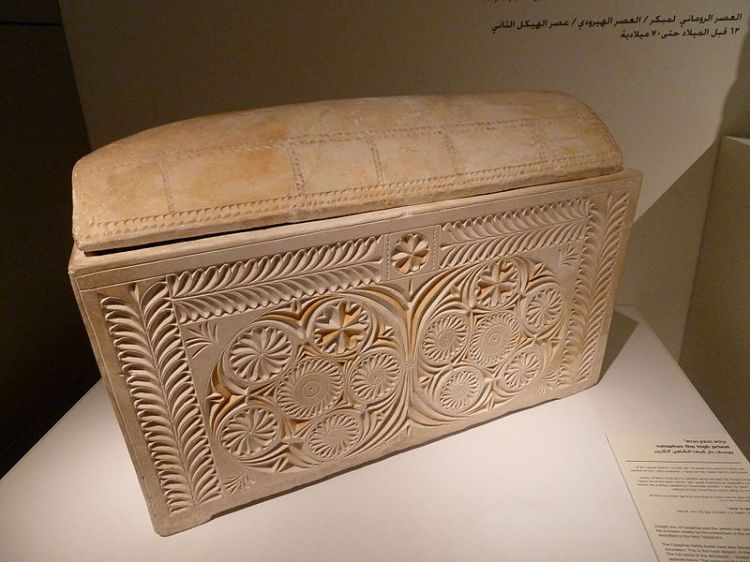
An ossuary, found in Jerusalem, containing the bones of a man named Caiaphas.
By deror_avi – Own work, CC BY-SA 3.0
An ossuary, found in Jerusalem, containing the bones of a man named Caiaphas.
By deror_avi – Own work, CC BY-SA 3.0,
 Dan L. White Homeschool Helpers