Chapter 60 – The Religion of Rome

The End Time Church: From the Cathedrals to the Catacombs

By Dan L. White

Copyright ©2019 by Dan L. White, all rights reserved.

Scripture quotations are from the World English Bible (WEB) which is in the public domain.

Chapter 60

The Religion of Rome

Marcus, the 16th bishop of Jerusalem, and the early Gentile Christians began to copy the government of Rome, with one-man rule. Adopting the government of Rome set the stage for adopting the religion of Rome.

What is the religion of Rome?

Egypt and Pharaoh had ten tests, ten plagues that gave them ten chances to repent. They failed those tests, never really repented and Pharaoh and his army wound up flailing in the sea after the water walls fell in.

After they left Egypt, Israel also had ten tests.

First they faced Pharaoh at the sea, then walked through the sea on dry land. Three days later, the only water they had was the bitter water of Marah, which was healed. Soon after that Israel ran out of food and God gave them manna.

In those tests, Israel never believed that Yahweh would save them. He always did.

And so on until the tenth test, when Israel refused to go into the Promised Land.

After seeing all the plagues on Egypt, after seeing Pharaoh’s army swallowed up by the sea, and after following the cloud for a year through the wilderness – Israel wanted to go back to Egypt.

Num 14
1) All the congregation lifted up their voice, and cried; and the people wept that night.
2) All the children of Israel murmured against Moses and against Aaron: and the whole congregation said to them, “Would that we had died in the land of Egypt! or would that we had died in this wilderness!
3) Why does Yahweh bring us to this land, to fall by the sword? Our wives and our little ones will be a prey: wouldn’t it be better for us to return to Egypt?”
4) They said one to another, “Let us make a captain, and let us return to Egypt.”

After failing the tenth test, and the other nine, Israel wandered in the wilderness for another 39 years, before a new generation finally went into the Promised Land.

The early Christians also had ten tests. In Revelation 2 and 3 are 7 letters to 7 churches of Asia and the letter to Smyrna may refer to these ten tests.

Rev 2
8) “To the angel of the assembly in Smyrna write: “The first and the last, who was dead, and has come to life says these things:
9) “I know your works, oppression, and your poverty (but you are rich), and the blasphemy of those who say they are Jews, and they are not, but are a synagogue of Satan.
10) Don’t be afraid of the things which you are about to suffer. Behold, the devil is about to throw some of you into prison, that you may be tested; and you will have oppression for ten days. Be faithful to death, and I will give you the crown of life.
11) He who has an ear, let him hear what the Spirit says to the assemblies. He who overcomes won’t be harmed by the second death.

“You will have oppression for ten days. Be faithful unto death…” Other translations besides World English Bible say affliction, tribulation, and suffering.

Sobering words. Who said that?

Verse 8 that we just read says “He who was dead and has come to life says these things.”

And He, Yeshua the Messiah, warned of ten days of oppression, affliction, tribulation, suffering — ten days.

Apparently, like Egypt and Israel, the early Christians had 10 tests, going from Roman emperors Nero in 64 CE to Diocletian/Galerius up to 311 CE. These tests were 10 periods of intense persecution, as distinguished from ordinary everyday persecution. The exact time periods may be somewhat arbitrary according to the analysis, but indisputably there were periods of intense persecution of Christians, lasting two and a half centuries, about as long as the US has been a republic.

That’s a long time.

Foxe’s Book of Martyrs categorized the Roman persecutions under these emperors.

Nero, 67 [64]
Nero even refined upon cruelty, and contrived all manner of punishments for the Christians that the most infernal imagination could design. In particular, he had some sewed up in skins of wild beasts, and then worried by dogs until they expired; and others dressed in shirts made stiff with wax, fixed to axletrees, and set on fire in his gardens, in order to illuminate them. This persecution was general throughout the whole Roman Empire; but it rather increased than diminished the spirit of Christianity. In the course of it, St. Paul and St. Peter were martyred.

Domitian, 81
…a law was made, “That no Christian, once brought before the tribunal, should be exempted from punishment without renouncing his religion.”

Trajan and Adrian, 108-138

Marcus Aurelius Antoninus, A.D. 162
Polycarp, the venerable bishop of Smyrna, hearing that persons were seeking for him, escaped, but was discovered by a child. After feasting the guards who apprehended him, he desired an hour in prayer, which being allowed, he prayed with such fervency, that his guards repented that they had been instrumental in taking him.

He was, however, carried before the proconsul, condemned, and burnt in the market place.The proconsul then urged him, saying, “Swear, and I will release thee;–reproach Christ.”

Polycarp answered, “Eighty and six years have I served him, and he never once wronged me; how then shall I blaspheme my King, Who hath saved me?”

Severus, A.D. 192-232

Maximus, A.D. 235
“numberless Christians were slain without trial, and buried indiscriminately in heaps, sometimes fifty or sixty being cast into a pit together;”

Decius, A.D. 249
A young Christian man was “stretched upon a wheel, by which all his bones were broken, and then he was sent to be beheaded,” others were “put to the rack;”

Valerian, A.D. 257
Began under Valerian, in the month of April, 257, and continued for three years and six months. The martyrs that fell in this persecution were innumerable, and their tortures and deaths as various and painful.

Aurelian, A.D. 274
[A Christian man] “was stretched with pullies until his joints were dislocated; his body was then torn with wire scourges, and boiling oil and pitch poured on his naked flesh; lighted torches were applied to his sides and armpits;

Diocletian, A.D. 303
Racks, scourges, swords, daggers, crosses, poison, and famine, were made use of in various parts to dispatch the Christians.”

The persecution by Rome was ended by the Edict of Toleration in 311, and the Edict of Milan in 313 made Christianity an accepted religion in the Roman Empire.

Why did the Romans persecute the Christians for two-and-a-half centuries?

Because of the Roman religion.

What is the Roman religion?

From the book A Pinch of Incense:
The Empire from the start had proclaimed itself tolerant of all authorized religions, and it had certainly authorized some strange ones. But these religions must be considered by the Romans subject as “a personal thing.” The only common “public” religion must be the state paganism of the Empire — often embodied, by law, in the person of the emperor. To reject this, to refuse to enshrine the Imperial ideal as uppermost in the very soul of the subject, was viewed therefore as a blatant defiance, tantamount to rebellion. And it was precisely this commitment that the Christians refused to make.

Nero had shrewdly discerned in the Christian mind this implicit insurrectionism, and on this ground had pronounced Christianity illegal. In Roman law, this was unprecedented. You could be prosecuted for doing something but not for believing something. Thereafter, by proving a person Christian, the state could establish him as a criminal. But how could it prove a person Christian?

An ingenious formula was devised. The suspected Christian need merely be asked to take a pinch of incense and ceremonially burn it to the “genius” of Caesar, [genius, general divine nature that is present in every individual person, place, or thing, Lewis and Short, A Latin Dictionary.] Surely a modest demand. But, astonishingly, Christians refused to do it. Their God, they said, was not Caesar. The sentence could then be passed immediately: seizure of property, imprisonment, often death — by the sword, by fire, by the cross, by being fed to starving animals in the arena as a public spectacle, whatever local sentiment called for.
A Pinch of Incense : A.D. 70 to 250, from the Fall of Jerusalem to the Decian Persecution, by Charlotte Allen, Christian History Project.
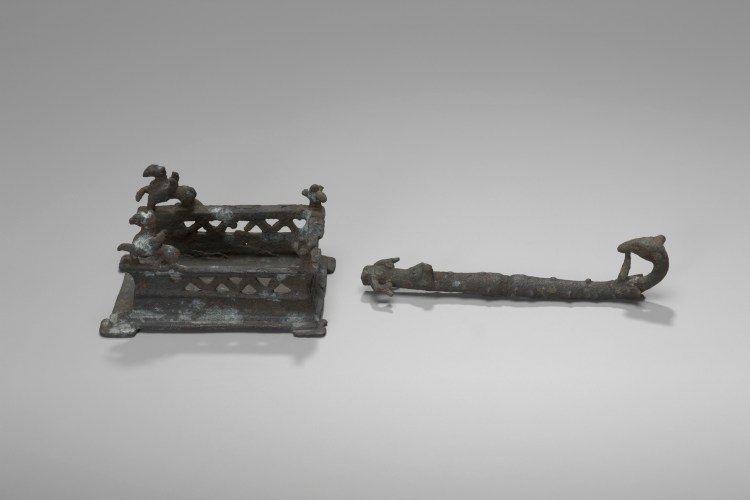
034620, 1933.634a, 1933.634b

Bronze Incense shovel

  1. A.D. 200–256

Photo credit: Yale University Art Gallery

Roman religion is all in, none out, and everyone must accept all other religious beliefs. All were accepted, none were excepted. Everyone was allowed in. No one was allowed out. Each person had to approve what every other person did.

That is the polar opposite of freedom of religion. That is required religion, for unity in the church, which was the Roman Empire. This unity was enforced by centralized one man rule.

This Roman religion reappears in history under different guises, with a church, with governments that don’t even call it religion, and with those who call it “freedom from religion.” The crux of this religion is that no one is allowed to disagree.

As we just read, under Rome, by proving a person Christian, the state could establish him as a criminal. In other words, to be a Christian was a hate crime, a crime for what a person believed and thought.

Christians were not persecuted so much for worshiping Christ as for not worshiping the emperor and the other Roman gods. Some Christians did gain their physical lives and sold their souls for that pinch of incense. In doing so, they then received a certificate from Rome saying they had sacrificed to the emperor god and were allowed to live.
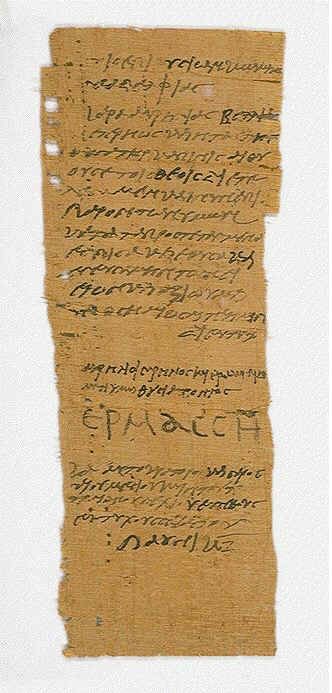
fe661f864342001f2dfd38177b0f9f64

By Unknown – Egyptian papyrus from 250 AD – www.forumancientcoins.com

A libellus (Roman sacrifice certificate) from the Decian persecution 250 AD. Possibly found at Fayoum, Egypt in 1893. Text reads: To those in charge of the sacrifices of the village Theadelphia, from Aurelia Bellias, daughter of Peteres, and her daughter, Kapinis. We have always been constant in sacrificing to the gods, and now too, in your presence, in accordance with the regulations, I have poured libations and sacrificed and tasted the offerings, and I ask you to certify this for us below. May you continue to prosper. Under the above text, written by another hand: We, Aurelius Serenus and Aurelius Hermas, saw you sacrificing. A third hand: I, Hermas, certify. First hand: The 1st year of the Emperor Caesar Gaius Messius Quintus Traianus Decius Pius Felix Augustus. (Based on description at http://www.cachecoins.org/decius.htm)

But those who truly worshiped Christ the King would not mix His worship with any hint of idolatry. They didn’t need a certificate. They had a Saviour.

Remember when the Jews said, “We have no king but Caesar?” The early Christians, by their lives and actions, declared that they had no King but the King of Kings. Caesar wasn’t even on the ballot.

By standing fast, they lost their physical lives but preserved their eternal lives, as the Master had said.

Matt 16
24) Then Yeshua said to his disciples, “If anyone desires to come after me, let him deny himself, and take up his cross, and follow me.
25) For whoever desires to save his life will lose it, and whoever will lose his life for my sake will find it.
26) For what will it profit a man, if he gains the whole world, and forfeits his life? Or what will a man give in exchange for his life?
27) For the Son of Man will come in the glory of his Father with his angels, and then he will render to everyone according to his deeds.

John 12
24) Most certainly I tell you, unless a grain of wheat falls into the earth and dies, it remains by itself alone. But if it dies, it bears much fruit.
25) He who loves his life will lose it. He who hates his life in this world will keep it to eternal life.
26) If anyone serves me, let him follow me. Where I am, there will my servant also be. If anyone serves me, the Father will honor him.

To follow the Messiah’s example of being killed by the Romans was an honor, a spiritual privilege, the last step in this life toward eternal life in the future.

As He said to Smyrna, “Be faithful to death, and I will give you the crown of life.”

So the Romans persecuted the Christians in the most horrific manner. The great Roman Empire was the most cruel government in human history to that time. All because of the Roman religion, which was —

Everybody in, nobody out, and all had to approve all others.

You can easily see that the Roman religion is the religion of Satan. Satan was disapproved, condemned, and cast out of heaven. He wants to be included and approved, regardless of what he does.

You can also easily see that the Messiah’s religion is the opposite of that. The ‘no pinch of incense Christians’ accepted no idolatry whatsoever, they would not approve the sins of those around them, and they gave up their lives rather than give in to the world. Just as Yeshua Himself had done.

Today the Roman persecution of Christians is being denied. Today even the existence of Christ is denied, so it is logical that anti-Christ people will also deny that Christians were persecuted. This is just a Socialist rewriting of history, as the German National Socialists did under Hitler. All of this denial is just an extension of the Roman religion, pushing toward forcing all in with acceptance of all beliefs. And as the Romans did, today people are being punished not for what they do but for what they believe.

Ironically, the Christians began to accept the government style of Rome at the same time that Rome persecuted the Christians for not accepting the religion of Rome. When the Christians accepted Roman style government, though, that set the stage for accepting the religion of Rome.

Should Christians have offered a pinch of incense to the emperor?

What was the big deal?

After all, the idols that pagans worshiped weren’t real and everyone really knew that the emperor wasn’t really a god. What was the actual harm in the merely symbolic ritual of offering incense? Wouldn’t Christ understand that the Christian was only doing it to preserve his life? Wasn’t saving a human life more important than avoiding a silly pagan rite? What about all the friends and family — friends and family! — that would be crushed at the death of a loved one? Offering the incense would just be a way of protecting them. Aren’t all religions basically the same, anyway, people just trying to do good?

Many Christians, though, refused to follow that reasoning. They would not offer the pinch of incense. That’s why the Romans were so furious at them — they just would not listen to reason!

Human reason.

The Roman Empire persecution officially ended in 313, but the Roman religion stayed around. What is the Roman religion? All in, none out, no choice.


Chapter 59 – Kings, Bishops and Popes

The End Time Church: From the Cathedrals to the Catacombs

By Dan L. White

Copyright ©2019 by Dan L. White, all rights reserved.

Scripture quotations are from the World English Bible (WEB) which is in the public domain.

Chapter 59

Kings, Bishops and Popes

At about the same time that the Jews were setting up Bar Kokhba as a Romish ruler, what were the Christians doing?

Well…

The two spiritual leaders of the world are Yeshua the Son of God and Satan, the Father of sin. Satan is the god of this world and Yeshua calls his people out of this world.

These two leaders have opposite spirits.

Christ obeys the Ten Commandments. That’s why He was accepted as the blood sacrifice for all who break the Ten Commandments.

Satan disobeys the Ten Commandments. Eve and Adam and all their descendants who, like Satan, have broken the Ten Commandments must have the blood sacrifice of Christ. As with Eve and Adam, the devil made us do it.

Satan tries to get people to follow his example instead of Christ’s example. Satan tries to get people to break God’s Law.

He does this by seduction, making sin appear attractive.

He does this by coercion, using force to harm and kill those who do try to obey God’s Commandments.

He does this by deception, to get people to think they are obeying God by breaking His commandments.

Needless to say, Satan is a dangerous adversary for us.

Job 1
6) Now it happened on the day when God’s sons came to present themselves before Yahweh, that Satan also came among them.
7) Yahweh said to Satan, “Where have you come from?” Then Satan answered Yahweh, and said, “From going back and forth in the earth, and from walking up and down in it.”

And what was Satan doing when he was going back and forth on the earth?

1Pet 5
8) Be sober and self-controlled. Be watchful. Your adversary, the devil, walks around like a roaring lion, seeking whom he may devour.

Seduction, coercion, deception – anything to get you to break God’s Ten Commandments. That’s Satan’s desire.

Sin by seduction is easy to understand. Eve saw the forbidden fruit and it looked good. Fornication and adultery seem enticing. The pride of life and lust for the world are natural for human nature.

Sin by coercion is easy to understand. The early Christians had to sacrifice to the Roman emperor or face death. One pinch of incense would appease Caesar and Satan. Many Christians chose that one pinch path, willing to trade their souls for their lives. Many did not and their dying prayers were incense to God.

But the third way that Satan gets people to follow him is harder to perceive.

Satan gets people to think they’re following God by following a ruler between them and Christ. This may be a political king or a religious ruler. This ruler may say that he himself is following Christ. In fact, the ruler may be largely obedient.

However, in an attempt to achieve human unity and physically control the carnal human spirit, the obedient ruler urges people to follow him personally. Since people can see and hear that ruler, it’s much easier to follow him than it is to follow an invisible God. So they follow God by following a man of God.

They think.

With that government in place, at some point that ruler, or more likely a successor of that ruler, stops obeying God’s Commandments. He then orders his followers to follow him in breaking God’s Commandments. Most of those followers do that, because they’re following the religious ruler, who they think to be righteous because he’s the religious ruler. The people then break God’s Commandments while they think they’re obeying God. Thus Satan gets people to follow him, while they think they’re following Christ.

It didn’t take long for that to happen with the Christians.

John was the last writer of the New Testament. In his three short letters, even though he was probably the only original apostle left, John did not make himself out to be a pope. He never wrote about everyone needing to be loyal to him personally. He hardly mentions himself at all.

He was the opposite of Barack Obama.

In his little letters, John talks about not sinning, about false brethren who had gone out, about having love for one another – but he never sets himself up as a powerful pope or rabbi.

He never says, “If you don’t follow me, you’re not following God!”

He never says, “You can be saved only if you’re in my group!”

On the other hand, apparently Diotrephes did.

3John 1
8) We therefore ought to receive such, that we may be fellow workers for the truth.
9) I wrote to the assembly, but Diotrephes, who loves to be first among them, doesn’t accept what we say.
10) Therefore, if I come, I will call attention to his deeds which he does, unjustly accusing us with wicked words. Not content with this, neither does he himself receive the brothers, and those who would, he forbids and throws out of the assembly.

Diotrephes accused John — Yeshua’s bosom buddy! — with “wicked words” – or in the Good News Bible:“the terrible things he says about us and the lies he tells!” And those who believed like John and not like Diotrephes, Diotrephes kicked out of the flock. He deflocked them.

Notice that it was Diotrephes alone who kicked people out of the assembly. It wasn’t the assembly who put people out. It wasn’t a small group of elders or shepherds who put people out. The kicker-outer was solely –

Diotrephes.

How could Diotrephes do that?

Because he loved to be first among them. He was the religious ruler, the rabbi, the archbishop, the popino – the one man in charge whom everybody had to agree with.

Diotrephes had set up the government of Rome in the flock of Yeshua.

Some people call this one man rule the government of God. Actually it’s the government of Satan. One man ruled in the government of Babylon and Persia and Greece and Rome, the four powerful historical governments of the world –

Satan’s world.

And at some point, gradually or suddenly, that government of Rome, the government of Diotrephes, the government of one man rule, –

Became the government of the Christians.

Obviously, by the time John wrote his letters – when he had to tell them what sin was and that they shouldn’t sin! — the Christian assemblies were having great spiritual problems. And if Diotrephes was trying to set himself up as a popino, it’s doubtful that he was the only one.

With human nature erupting in the Christian assemblies – chaos, confusion, and carnality – it’s not surprising that Christians would resort to the same human government as Israel long before them.

Give us a king to lead us!” 1 Samuel 8:6, New English Translation.

Eusebius, Christian historian of the fourth century, was a Constantine crony. Since Eusebius supported the Roman emperor, he obviously supported Romish government. Eusebius listed what he said were the first 15 bishops of Jerusalem, as if they were sole religious rulers of the area.

Then along came bishop number 16….

  1. The chronology of the bishops of Jerusalem I have nowhere found preserved in writing; for tradition says that they were all short lived.
  2. But I have learned this much from writings, that until the siege of the Jews, which took place under Adrian [Hadrian], there were fifteen bishops in succession there, all of whom are said to have been of Hebrew descent, and to have received the knowledge of Christ in purity, so that they were approved by those who were able to judge of such matters, and were deemed worthy of the episcopate. For their whole church consisted then of believing Hebrews who continued from the days of the apostles until the siege which took place at this time; in which siege the Jews, having again rebelled against the Romans, were conquered after severe battles.
  3. But since the bishops of the circumcision ceased at this time, it is proper to give here a list of their names from the beginning. The first, then, was James, the so-called brother of the Lord; the second, Symeon; the third, Justus; the fourth, Zacchæus; the fifth, Tobias; the sixth, Benjamin; the seventh, John; the eighth, Matthias; the ninth, Philip; the tenth, Seneca; the eleventh, Justus; the twelfth, Levi; the thirteenth, Ephres; the fourteenth, Joseph; and finally, the fifteenth, Judas.
  4. These are the bishops of Jerusalem that lived between the age of the apostles and the time referred to, all of them belonging to the circumcision. (Eusebius. The History of the Church, Book IV, Chapter V. Translated by Arthur Cushman McGiffert. Digireads, 2005, p. 71).
    Translated by Arthur Cushman McGiffert. From Nicene and Post-Nicene Fathers, Second Series, Vol. 1. Edited by Philip Schaff and Henry Wace. (Buffalo, NY: Christian Literature Publishing Co., 1890.) Revised and edited for New Advent by Kevin Knight. http://www.newadvent.org/fathers/2501.htm 5/25/19.

We have already discussed how James was not the head of the flock. Jerusalem was the birth place and focal point of the early assembly, and if James had been a local pope in Jerusalem, then he would have been pope over the whole worldwide flock. But Paul said that James, Peter and John seemed to be pillars. He did not say that James seemed to be pope. The decision on circumcision in Acts 15 was sent out not by James, but by all the apostles, elders and the whole assembly at Jerusalem.

James was not a pope, a monarchic mega-ruler, either over the whole world or over just Jerusalem. He was a respected apostle who wrote one letter in the New Testament.

So Eusebius’ assumption that the earliest flock had the same type of government as Constantine’s Rome, with James being the sole head of the assembly in Jerusalem, was wrong. In the same way, succeeding Jewish or Hebrew bishops also may not have been popinos. They may have followed the example of the first assembly, unity by spirit and not by compulsion.

Ultimately, though, the worldly approach to government prevailed among those who were not to be of this world.

For example, during the reign of Hadrian, who put down the Bar Kokhba rebellion, Eusebius lists these bishopricks among the Gentile Christians.

In the third year of the same reign, Alexander, bishop of Rome, died after holding office ten years. His successor was Xystus. About the same time Primus, bishop of Alexandria, died in the twelfth year of his episcopate, and was succeeded by Justus. Eusebius Church History, Book IV, chapter 4.

So the practice of one man ruling over an area took root very early in Christian history.

The principle of bishoprics or pastorates is similar to the principle of denominations. Christ forbids denominations because they pit Christians against one another. The ultimate purpose of denominations is boasting, as Paul brought out in the first five chapters of 1 Corinthians. Paulites were better than Peterinos who were better than Apollonesians. To whatever degree, then, Baptists think they’re better than Methodists, who consider themselves better than Episcopalians, who look down on Baptists. That’s why people are in their particular denominations, because they think theirs is better than the others.

Similarly, setting up bishoprics or dioceses or pastorates is defining a territory where one man rules; and when any other Christian comes into that territory, he’s not an equal brother but a subject of that bishop.

Physical requirements like sacrifices, circumcision, garment fringes and blue threads, were given to Israel to remind them to be obedient. They did not work. Often those with the showiest physical signs were the most disobedient in spirit. The New Covenant is based not on physical reminders of sin and obedience, but on a change of heart. If the heart is changed from disobedient to obedient, then the physical signs, which didn’t work anyway, are not needed.

Human government faces the same quandary. Dictatorial type governments are set up to control the people under them. Conflicts and chaos, from uncontrolled human nature, lead people to turn to this type of government. However, if the hearts of those people are changed and their human nature is overcome, then those all-controlling governments, which cannot change human nature and don’t work long term, are not needed.

People who rule themselves do not need a dictator.

So the first fifteen bishops of Jerusalem, according to Eusebius, were of the circumcision, meaning they were Hebrews.

What about number sixteen?

Eusebius goes on:
The war raged most fiercely in the eighteenth year of Adrian, at the city of Bithara, which was a very secure fortress, situated not far from Jerusalem. When the siege had lasted a long time, and the rebels had been driven to the last extremity by hunger and thirst, and the instigator of the rebellion had suffered his just punishment, the whole nation was prohibited from this time on by a decree, and by the commands of Adrian, from ever going up to the country about Jerusalem. For the emperor gave orders that they should not even see from a distance the land of their fathers. Such is the account of Aristo of Pella.

And thus, when the city had been emptied of the Jewish nation and had suffered the total destruction of its ancient inhabitants, it was colonized by a different race, and the Roman city which subsequently arose changed its name and was called Ælia, in honor of the emperor Ælius Adrian. And as the church there was now composed of Gentiles, the first one to assume the government of it after the bishops of the circumcision was Marcus. Eusebius Church History, book IV, chapter 6.

So after the Bar Kokhba revolt, Hadrian ordered Jews not to even come near Jerusalem.

How did that affect the Christians there?

Gibbons’ Decline and Fall of the Roman Empire gave his version of the change in the Jerusalem assembly, and how it became a church.

The emperor founded, under the name of Alia Capitolina, a new city on Mount Sion, to which he gave the privileges of a colony; and denouncing the severest penalties against any of the Jewish people who should dare to approach its precincts, he fixed a vigilant garrison of a Roman cohort to enforce the execution of his orders. The Nazarenes had only one way left to escape the common proscription, and the force of truth was on this occasion assisted by the influence of temporal advantages.

They elected Marcus for their bishop, a prelate of the race of the Gentiles, and most probably a native either of Italy or of some of the Latin provinces. At his persuasion the most considerable part of the congregation renounced the Mosaic law, in the practice of which they had persevered above a century. By this sacrifice of their habits and prejudices they purchased a free admission into the colony of Hadrian…
Gibbon E. Decline and Fall of the Roman Empire, Volume I, Chapter XV, Section I. ca. 1776-1788.

Marcus left his mark on the Jerusalem church. They “renounced the Mosaic law,” and changed the “practice of which they had persevered above a century.” Those who did not follow Marcus were called Nazarenes. The Jerusalem assembly was split between commandment keepers and commandment breakers.

The Mosaic Law means different things to different people.

Sacrifices were a central part of the law of Moses, yet obviously the Jerusalem Christians did not offer sacrifices, even when the Temple stood.

Circumcision was included in the law of Moses, and some Jewish Christians wanted to maintain that practice. However, Paul was adamant that circumcision of the heart was required of all Christians, circumcision of the flesh was required of none. Peter was wrong when he refused to eat with uncircumcised Christians because there was no spiritual difference between Jews and Gentiles. Therefore circumcision has no spiritual effect and is useless for any Christian, including Jews.

The Ten Commandments were included in the law of Moses, but they preceded and succeeded that. The Ten Commandments, first written on tablets of stone with the finger of Yahweh, are now written in the hearts of believers with the same finger. The Ten Commandments are in the Ark of the Covenant at the very throne of God in heaven, right under the Mercy Seat. Breaking the Ten Commandments is the whole problem with humanity. Breaking the Ten Commandments is the religion of Satan. Breaking the Ten Commandments is what Christ never did. Those Commandments include the Sabbath, the sign of the Creator.

The Law of Moses also included the Feasts, which told of Christ’s first coming and still tell of His second coming. Yeshua was born at a festival time, He died at a festival time, and He began His flock began on a festival. That flock, Jews and Gentiles, observed those holy Feasts.

It’s widely believed that the Law of Moses includes all of the above, not only sacrifices and circumcision but also Ten Commandments and Feasts. So when Marcus led the Christians away from the “law of Moses,” he led them away from obeying the Ten Commandments and Feasts.

A more modern historian says:
According to rabbinic sources, he [Hadrian] prohibited public gatherings for instruction in Jewish law, forbade the proper observance of the Sabbath and holidays and outlawed many important rituals. (Barron SW.  Social and Religious History of the Jews, Volume 2: Christian Era: the First Five Centuries.  Columbia University Press, 1952, p. 107).

Johann Lorenz Mosheim, a German Lutheran historian in the first half of the 1700’s, discussed why the Christians in Jerusalem changed so radically under Hadrian’s rule.

Feeling it was the first importance to their well-being, to procure for themselves the liberty of removing their effects into the city of Ælia, [Hadrian’s new Jerusalem] and to be admitted in the rights of citizenship there, a considerable number of the Christians came to the resolution of formally renouncing all obedience to the law of Moses. The immediate author of this measure was, in all likelihood, that very Marcus whom they appointed as their bishop: a man whose name evidently speaks him to have been a Roman, and who doubtless was not unknown in his nation that had been the chief command in Palestine and might possibly have been related to some officer of eminence there. Perceiving, therefore, one of their own nation placed at the head of Christendom, the Roman prefects dismissed at once all apprehension of their exciting disturbance in the newly-established colony, and from this time ceased to regard them as Jews….

Nothing, in fact, can be better attested than that there existed in Palestine two Christian churches, by the one of which an observance of the Mosaic law was retained, and by the other disregarded. This division amongst the Christians of Jewish origin, did not take place before the time of Hadrian, for it can be ascertained, that previously to his reign the Christians of Palestine were unanimous in an adherence to the ceremonious observances of their forefathers. There can be no doubt, therefore, but that this separation originated in the major part of them having been prevailed on by Marcus to renounce the Mosaic ritual, by way of getting rid of the numerous inconveniences to which they were exposed, and procuring for themselves a reception, as citizens, into the newly-founded colony of Ælia Capitolina.
(Mosheim JL. Commentaries on the affairs of the Christians before the time of Constantine the Great: or, An enlarged view of the ecclesiastical history of the first three centuries, Volume 2. Translated by Robert Studley Vidal.)

So Marcus left his mark.

Before him, all the Christians in Jerusalem had believed like the first Christians on Pentecost. They believed like James, the brother of Yeshua, who was used by God to write a New Testament book. They were all Feast observers, knowing their flock had begun on a festival. They were all Sabbath keepers, who tried to obey the Ten Commandments. When James said, “For Moses from generations of old has in every city those who preach him, being read in the synagogues every Sabbath,” he was talking about Jewish and Gentile Christians being in synagogues every Sabbath. The first Gentile Christian Cornelius was “a devout man, and one who feared God with all his house.”  That means that Cornelius and his whole household observed Feasts and Sabbaths. And all those first fifteen bishops and those Jerusalem Christians had believed like that for over a hundred years.

Then along came Marcus.

No Jews or Christians who observed God’s holy Feasts and Sabbaths were allowed in Hadrian’s new Jerusalem, Aelia Capitolina. The Aelia was from Hadrian’s family name — he humbly named the new city after himself! — and the Capitolina was named after Jupiter. [Jerusalem] “was made a Roman colony, inhabited wholly by foreigners, the Jews being forbidden to approach it on pain of death: a temple to Jupiter Capitolinus was erected on Mount Moriah, and the old name of Jerusalem was sought to be supplanted by that of Elia Capitolina, conferred upon it in honor of the emperor AElius Hadrianus and Jupiter Capitolinus,” Cyclopedia of Biblical, Theological and Ecclesiastical Literature, article Jerusalem.

Why on earth would any Christian want to be in such a city? Who wanted to be in Aelia Capitolina, Hadrian’s New Jerusalem, with the temple of Jupiter on the Temple Mount? Who wanted to see a statue of Hadrian and his horsey where the Holy of Holies had been?

Who?

Only those Christians who wanted to fit in with Rome.

Marcus led those Romish Christians in their new beliefs that Rome accepted. And those Christians also accepted the Roman kind of government – one man rule. And that one man rule – Marcus – led those Christians into anomia – lawbreaking.

Having just one man as the spiritual leader of a group lifts up that one man. He gets to thinking more of himself than he should. The people also think more of him than they should. It’s bad for him; it’s bad for them. And at some point, such a government always leads to apostacy and anomia, as with Marcus.

What’s more, if you accept the government of Rome – one man rule – on a local basis, then it’s logical to accept it on a worldwide basis. If it’s good to have a local bishop or priest or pastor, then by the same reasoning, it must be good to have a worldwide bishop or priest or pastor. You logically progress from a local bishop to the pontifex maximus, the “greatest priest” –

The Pope in Rome.