The End Time Church: From the Cathedrals to the Catacombs
By Dan L. White
Copyright ©2019 by Dan L. White, all rights reserved.
Scripture quotations are from the World English Bible (WEB) which is in the public domain.
Chapter 66
Constantine’s Various Visions
Were Constantine’s visions prophecies, or just propaganda?
Constantine claimed he was told in a dream to fight his battles under a Christian symbol.
Or — he saw a vision telling him to fight with the words “in this sign conquer.”
Or — he was told to fight because he had seen a vision of the sun god Apollo.
Encyclopedia Britannica, article Constantine I —
He fought the Battle of the Milvian Bridge in the name of the Christian God, having received instructions in a dream to paint the Christian monogram (Chi-Rho, known as the sacred monogram, is formed by the conjunction of the first two Greek letters of the word Christ.) on his troops’ shields. This is the account given by the Christian apologist Lactantius. A somewhat different version, offered by Eusebius, tells of a vision seen by Constantine during the campaign against Maxentius, in which the Christian sign appeared in the sky with the legend “In this sign, conquer.” Despite the emperor’s own authority for the account, given late in life to Eusebius, it is in general more problematic than the other, but a religious experience on the march from Gaul is suggested also by a pagan orator, who in a speech of 310 referred to a vision of Apollo received by Constantine at a shrine in Gaul.
Three heavenly visions, all different, from 2 different divinities. Were Constantine’s visions real prophecies or really just propaganda?
Galerius, a junior emperor, persuaded emperor Diocletian to persecute the Christians. When Diocletian abdicated his position in 305, Galerius became emperor. Then he got to do his own persecuting.
However, that tenth persecution no more ended the Christian wave than the first nine did. After a few years as persecutor maximus, Galerius came down with his final illness. He then called off his persecution with the Edict of Toleration in 311.
Gibbons’ The History of the Decline and Fall of the Roman Empire Vol. II says,
The experience of six years of persecution, and the salutary reflection which a lingering and painful distemper suggested to the mind of Galerius, at length convinced him that the most violent efforts of despotism are insufficient to extirpate a whole people or to subdue their religious prejudices.
On his deathbed, Galerius requested the Christians to pray to their God for the emperor. They probably did, but he died anyway and he did not get baptized as a Christian.
By 313, only two emperors of the Tetrarchy were left, Constantine in the west and Licinius in the east. Together they issued the Edict of Milan, which accepted the Christian religion as it did all others. This approach of pluralism, accepting all gods or religions, seems good to human reason. The big flaw in that thinking, however, is that the Christian God is real; all others are just human fairy tales.
“Galerius [in his Edict of Toleration] thus recognized the divine authority of the Christian God and the pagan deities, but maintained them as separate concepts. Later Licinius and Constantine [in their Edict of Milan] carried the development a step farther by combining them, and by showing devotion … to an unnamed and impersonal deity, — variously called summus deus, summa divinitas, mens divina, — who was not the exclusive property of the Christians or any sect, but might be common to all religious faiths, although differing in aspect and emanation to each and every faith.”
The Edict of Galerius (311 A. D.) re-considered [article], J. R. Knipfing, Revue belge de Philologie et d’Histoire Année 1922, https://www.persee.fr/doc/rbph_0035-0818_1922_num_1_4_6200, 9/11/19
Notice the concept there. God is in all religions, but with a different appearance in each. So in the Edict of Milan, Constantine did not name any one specific god, like Apollo or Mithra or Yahweh. Since they are all aspects of a common religion, he only used terms that were acceptable to all religions. No Christ or Jesus in there.
In 321, Constantine issued his famous Sunday decree, “On the venerable Day of the Sun let the magistrates and people residing in cities rest, and let all workshops be closed.” As with his titles for God in the Edict of Milan, the Sunday decree was acceptable to both Romish Christians and sun worshipers.
Constantine chose Sunday to be the day for Christian worship as it already enjoyed special status in the Roman week. Named after the Pagan Sun God Invictus, Sunday had become the day when wages were traditionally paid to workers, leading it to be seen as a day of celebration and thanks. In corresponding the Christian Sabbath with an already established day of rest, Constantine ensured that his decree would be accepted swiftly and harmoniously.
Constantine Decrees “Sun-Day” as Day of Rest, 7 March 321, History Channel, This Day in History.
Sun worship has had many forms and names. One was Mithra.
Sunday, the day of the Sun, was especially sacred, as was the 25th of December, the birthday of the god Mithras. This day was celebrated by sacred festivals.
Religions of the Hellenistic-Roman Age, By Antonia Tripolitis, 2002, Wm. B. Eerdmans Publishing Co., Grand Rapids, MI
Another form of sun worship was Sol Invictus, Unconquered Sun. Emperors, including Constantine, often issued coins imprinted with their own likeness and Sol Invictus, to show that the sun god was with the emperor. On his coinage, Constantine frequently used the phrase SOLI INVICTO COMITI, or “companion to the emperor.”

Coin of Emperor Constantine I depicting Solis Invictus with the legend SOLIS INVICTO COMITI, c. 315, by Classical Numismatic Group, Inc.
http://www.cngcoins.com, used by permission.
The Arch of Constantine stands to this day next to the Colosseum in Rome. It was built to glorify Constantine for his victory over a fellow co-emperor, and included a scene of “sacrificial ceremonies in honour of Hercules, Apollo, Diana and Silvanus.” It also has “river gods above the two smaller arches,” and “a single round sculpture depicting the Sun (east side) and Moon (west side), both riding chariots.” https://www.ancient.eu/article/497/the-arch-of-constantine-rome
In fact, the Arch was specifically built to align with the huge statue of Sol. Someone approaching the Arch of Constantine would see big Sol right behind the emperor.
E. Marlowe, “Framing the sun. The Arch of Constantine and the Roman cityscape”, Art Bulletin 88 (2006) 223–242.
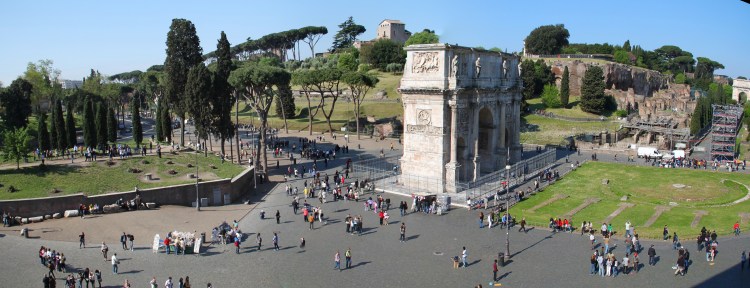
The Arch of Constantine, with this inscription
To the Emperor Caesar Flavius Constantinus, the greatest, pious, and blessed Augustus: because he, inspired by the divine, and by the greatness of his mind, has delivered the state from the tyrant and all of his followers at the same time, with his army and just force of arms, the Senate and People of Rome have dedicated this arch, decorated with triumphs.
By RClay – Own work, CC BY-SA 3.0,
https://commons.wikimedia.org/w/index.php?curid=25978188
Since Constantine still allowed and participated in paganism —
Did he really see Christian symbols in a dream, or did he just see the writing on the wall?
What writing?
Roman emperors had long used religion to help unify the Empire. That’s why they made emperors gods.
Vespasian, “In his last illness he said, “Vae, puto deus fio.”
Translated, the dying Vespasian said, “Oh dear, I think I’m becoming a god.”
Sure enough, “after his death he was immediately accorded deification,” Encyclopedia Britannica, “Vespasian”.
Would he have preferred being a live human or a dead god? It does make you wonder.
All the emperors who persecuted Christians were simply trying to use religion, including emperor worship, to unify the Empire. The Christians wouldn’t offer sacrifice to the emperors, so the emperors sacrificed the Christians.
Over the centuries, emperor worship declined in emphasis but emperors still wanted religious unity. Aurelian, who reigned a few decades before Constantine, tried to create religious unity in the Empire under one form of sun worship. That was a logical choice, since sun worship was already the most common religion in the Empire.
He sought to subordinate the divergent religions of the empire to the cult of the Unconquered Sun (Sol Invictus) and so create the kind of religious unity that came only later with Constantine, Encyclopedia Britannica, Aurelian.
Aurelian strengthened the position of the Sun god Sol Invictus as the main divinity of the Roman pantheon. His intention was to give to all the peoples of the Empire, civilian or soldiers, easterners or westerners, a single god they could believe in without betraying their own gods…During his short rule, Aurelian seemed to follow the principle of “one faith, one empire”, which would not be made official until the Edict of Thessalonica. Wikipedia, Aurelian, 9/16/19.
Notice the crucial points there:
1. a single god they could believe in without betraying their own gods;
2. the principle of one faith, one empire.
Rome had tried to unify the Empire religiously by eliminating Christianity. After about 250 years, from Nero to Galerius, any fool — or emperor — could see that didn’t work. When centuries of trying to unite Rome without Christianity failed, did Constantine see the writing on the wall and then shrewdly decide to unite Rome —
Under Christianity and sun worship?
Did he simply carry on Aurelian’s principle of one faith, one empire —
And then combine ever popular sun worship with Romish Christianity to make a faith that sun worshipers and Christians would accept?
Remember that from the time of Hadrian there were 2 Christian groups, those who were like the original flock and those who were like Rome. The original flock kept the Bible days, as did the Jews and only looked to Christ to govern them. The Romish Christians adopted Roman days — which were the same days that pagans kept. And their government was Rome.
The Encyclopedia Britannica explains how Constantine seized power, to move from the Tetrarchy to the Con-archy.
In 305 Constantine assisted his father, the newly appointed Western emperor, with a campaign in Britain. Their army proclaimed Constantine emperor after his father’s death the next year. A multisided civil war ensued between Constantine and the several other factions vying for the throne. Constantine defeated his main rival for the Western emperorship in 312 and defeated the Eastern emperor in 324 after years of strained relations, thus making Constantine sole ruler of the Roman Empire.
Notice the dates of his accessions. In 312, Constantine became emperor of the west. In 313, he and Licinius issued the Edict of Milan. Then in 314, the very next year, Constantine summoned the western Christian bishops to the Council of Arles.
Encyclopedia Britannica
Council of Arles, (AD 314), the first representative meeting of Christian bishops in the Western Roman Empire. It was convened at Arles in southern Gaul in August 314 by Emperor Constantine I, primarily to deal with the problem of the Donatists, a schismatic Christian group in North Africa.
Who called this council? The Christians as a whole, or the elders, or the big bishop of Rome, later called the pope? Did any of those call that council?
No.
Constantine called this council —
To eliminate schisms among Christians.
No other emperors had fretted about differences among Christians. So what did he care if there were differences among the Christians?
Like all other emperors before him, Constantine wanted to achieve unity in religion in his empire.
Encyclopedia Britannica
At Arles the Donatists were again condemned, but they rejected the decisions reached by the council and again appealed to Constantine to review their case.
Donatists refused to accept ruling bishops who had caved in to Rome during the recent persecution, a fairly conservative group. Yet to whom did the Donatist Christians appeal to settle this Christian dispute?
They appealed to Constantine.
Constantine wasn’t even a Christian!
He deliberately refused to be baptized, until he was on his deathbed. Obviously, he did not think he needed the Redeemer until he was ready to die. The King of the Roman Empire did not bow to the King of heaven until he was about to be dethroned into the dust of the earth.
In refusing to be baptized, Constantine did not think that he individually needed the spirit of Christ to overcome himself. Somehow he — the emperor! — was above that personal need. Apparently, Constantine just wasn’t that carnal, OK?
By contrast, this woman had a great personal need.
Luke 7
36) One of the Pharisees invited him to eat with him. He entered into the Pharisee’s house, and sat at the table.
37) Behold, a woman in the city who was a sinner, when she knew that he was reclining in the Pharisee’s house, she brought an alabaster jar of
intment.
38) Standing behind at his feet weeping, she began to wet his feet with her tears, and she wiped them with the hair of her head, kissed his feet, and anointed them with the ointment.
39) Now when the Pharisee who had invited him saw it, he said to himself, “This man, if he were a prophet, would have perceived who and what kind of woman this is who touches him, that she is a sinner.”
40) Yeshua answered him, “Simon, I have something to tell you.” He said, “Teacher, say on.”
41) “A certain lender had two debtors. The one owed five hundred denarii, and the other fifty.
42) When they couldn’t pay, he forgave them both. Which of them therefore will love him most?”
43) Simon answered, “He, I suppose, to whom he forgave the most.” He said to him, “You have judged correctly.”
44) Turning to the woman, he said to Simon, “Do you see this woman? I entered into your house, and you gave me no water for my feet, but she has wet my feet with her tears, and wiped them with the hair of her head.
45) You gave me no kiss, but she, since the time I came in, has not ceased to kiss my feet.
46) You didn’t anoint my head with oil, but she has anointed my feet with ointment.
47) Therefore I tell you, her sins, which are many, are forgiven, for she loved much. But to whom little is forgiven, the same loves little.”
48) He said to her, “Your sins are forgiven.”
Now who was Emperor Constantine like, the repentant woman or the proud Pharisee?
Baptism is to be washed clean of your sins, if you have any.
Acts 3:19
19) “Repent therefore, and turn again, that your sins may be blotted out, so that there may come times of refreshing from the presence of the Lord,
Acts 2
36) “Let all the house of Israel therefore know certainly that God has made him both Lord and Christ, this Yeshua whom you crucified.”
37) Now when they heard this, they were cut to the heart, and said to Peter and the rest of the apostles, “Brothers, what shall we do?”
38) Peter said to them, “Repent, and be baptized, every one of you, in the name of Yeshua Christ for the forgiveness of sins, and you will receive the gift of the Holy Spirit.
Constantine was not cut to the heart.
He did not see the need to be washed clean of his sins, he refused to repent and humbly seek baptism to cover his sins with the blood of the Savior, and he saw no need for the Holy Spirit in his life. He was Constantine the Great.
In short, Constantine, the great Christian emperor — DENIED CHRIST!
More than his contradictory visions, more than his sun god support, and more than his participation in pagan rites, Constantine’s refusal to seek baptism shows his real view of Christianity. It was not a faith to change a person’s life, to change his life, but just a tool to help unify the Empire — his empire. One faith, one Empire, combining old sun worship with Roman Christianity.
So this is the guy that the Donatist Christians wanted to settle their Christian dispute. But Constantine the non-Christian had called the Christian council to seek unity and when the Donatists did not go along — surprise, surprise! — he refused their appeal.
When centuries of trying to unite Rome without Christianity failed, did Constantine shrewdly decide to unite Rome —
Under Christianity and sun worship?
Absolutely. We know he decided to do that because that’s what he did.
Constantine did follow through with Aurelian’s principles of Empire religion.
- a single god they could believe in without betraying their own gods;
That means a religion that is above all other religions, but accepts practices from those other religions.
- the principle of one faith, one empire.
Such an empire means that humans have achieved unity without the Holy Spirit of God.
Constantine and the Christian Roman Empire that followed him did mesh much of Roman paganism right into Roman Christianity. Pagan peoples had little difficulty accepting a Christian religion that included their doctrines and days. All they had to do was change a few names and then keep on truckin’.
Constantine and his Christian successors did not fully succeed in one faith in their Empire. There was always a remnant of those who did not give in to Hadrian, who would not offer the emperor a pinch of incense, and who would not — even at cost of their own lives — accept Rome’s pagan-Christian combo religion, when Rome again persecuted them. This scattered flock was not under the government of Rome, even Christian Rome, but only under the government of Christ the King.
Those principles of Rome, a single god, accepting but above all other gods, and one faith, one empire —
A religion over all religions, that everyone must be in, but that accepts all other religions, except for those hardheaded, intolerant, judgmental Christians —
That Rome will be seen again as Satan ends his rule.
 Dan L. White Homeschool Helpers