Chapter 74 – The Pharisees, Moses’ Seat and the Hot Seat

The End Time Church: From the Cathedrals to the Catacombs

By Dan L. White

Copyright 2020 by Dan L. White, all rights reserved.

Scripture quotations are from the World English Bible (WEB) which is in the public domain.

Chapter 74

The Pharisees, Moses’ Seat and the Hot Seat

What does it mean to sit on Moses’ seat?

Matt 23 World English Bible
1) Then Yeshua spoke to the multitudes and to his disciples,
2) saying, “The scribes and the Pharisees sat on Moses’ seat.

Young’s Literal Translation and the Literal Translation of the Holy Bible also say “sat;” King James says “sit in Moses seat.”

Most Christian/Messianic Feast keepers believe that God gave the Pharisees authority to change the Feasts.

They believe that God approves the Pharisees replacing what He said in the Bible with what they said out of the Bible. And this is one of the linchpins of their logic —

The Pharisees sit on Moses’ seat!

Just as the Pharisees hold that the Talmud and Mishnah are divinely inspired, these Christians say that the Pharisee calendar is divinely inspired. You can’t question the Pharisee calendar because God inspired it through those guys.

After all, they sit on Moses’ seat!

To sit on Moses’ seat does sound impressive. But if that statement gives the Pharisees authority to change God’s laws, then why did Yeshua go on to say this?

Matt 23
3) All things therefore whatever they tell you to observe, observe and do, but don’t do their works; for they say, and don’t do.

So when the Pharisees sat on Moses’ seat, they said something, but did not do what they said.

What is it that the Pharisees don’t do?

John 7
19) Didn’t Moses give you the law, and yet none of you keeps the law? Why do you seek to kill me?”

The Pharisees don’t keep the law. The law was what they said but did not do.

Stephen affirmed that.

Acts 7
51) “You stiff-necked and uncircumcised in heart and ears, you always resist the Holy Spirit! As your fathers did, so you do.
52) Which of the prophets didn’t your fathers persecute? They killed those who foretold the coming of the Righteous One, of whom you have now become betrayers and murderers.
53) You received the law as it was ordained by angels, and didn’t keep it!”

The Pharisees and the Jews received the law but did not keep it. They said it but did not do it.

What they did do was to kill Yeshua and Stephen. Which brings up a critical question.

Why would God use people to set His Feasts who killed His prophets, killed His Christians, and killed His only begotten Son? The Pharisees and Jews delivered Yeshua to Rome to be executed. Both Jews and Gentiles are guilty of the greatest crime in the history of the world — committed at a Feast time.

Does it seem sensible that God the Father would use people who helped kill His only begotten Son — at a Feast time! — to set His Feasts? Does that seem sensible?

No. It doesn’t seem plausible that God would use Rome as headquarters for His people, and it does not seem sensible that God would use the Pharisees, of all people, to set His holy days.

But what about Moses’ seat?

After Yeshua said that the Pharisees sat on Moses’ seat, then He put them on the hot seat.

Matt 23
4) For they bind heavy burdens that are grievous to be borne, and lay them on men’s shoulders; but they themselves will not lift a finger to help them.
5) But all their works they do to be seen by men. They make their phylacteries broad, enlarge the fringes of their garments,
6) and love the place of honor at feasts, the best seats in the synagogues,
7) the salutations in the marketplaces, and to be called ‘Rabbi, Rabbi’ by men.
8) But don’t you be called ‘Rabbi,’ for one is your teacher, the Christ, and all of you are brothers.

Christ said not to call anyone rabbi. But the Pharisees are thought to have God’s authority only because they are rabbis.

Bit of a conflict there?

If God does not recognize the Pharisees as rabbis, then does He recognize what they do as rabbis?

Ironically, the passage that is most often used to say the Pharisees have divine authority is the New Testament passage that most condemns the Pharisees.

Matt 23 (cont.)
13) “Woe to you, scribes and Pharisees, hypocrites! For you devour widows’ houses, and as a pretense you make long prayers. Therefore you will receive greater condemnation.
14) “But woe to you, scribes and Pharisees, hypocrites! Because you shut up the Kingdom of Heaven against men; for you don’t enter in yourselves, neither do you allow those who are entering in to enter.
15) Woe to you, scribes and Pharisees, hypocrites! For you travel around by sea and land to make one proselyte; and when he becomes one, you make him twice as much of a son of Gehenna as yourselves.

Exactly what did Yeshua say there?

He said that the Pharisees are Gehenna guys.

Would God use guys who are going to Gehenna — the lake of fire reserved for the wicked — to set His holy days? Should those who are most wicked set the most holy?

Matt 23 (cont.)
16) “Woe to you, you blind guides, who say, ‘Whoever swears by the temple, it is nothing; but whoever swears by the gold of the temple, he is obligated.’
17) You blind fools! For which is greater, the gold, or the temple that sanctifies the gold?
18) ‘Whoever swears by the altar, it is nothing; but whoever swears by the gift that is on it, he is obligated?’
19) You blind fools! For which is greater, the gift, or the altar that sanctifies the gift?
20) He therefore who swears by the altar, swears by it, and by everything on it.
21) He who swears by the temple, swears by it, and by him who was living in it.
22) He who swears by heaven, swears by the throne of God, and by him who sits on it.
23) “Woe to you, scribes and Pharisees, hypocrites! For you tithe mint, dill, and cumin, and have left undone the weightier matters of the law: justice, mercy, and faith. But you ought to have done these, and not to have left the other undone.
24) You blind guides, who strain out a gnat, and swallow a camel!

It’s ironic that many Messianics look at Jewish rabbis as having great wisdom, the wisdom of “sages.” Did they not read Christ’s words? “You blind fools! You blind fools! You blind guides!”

Taking Christ at His word — that the Pharisees are blind — should those who are spiritually blind be given the authority to set the most spiritual times? Wouldn’t they also be spiritually blind in how they set their Feasts?

Matt 23 (cont.)
25) “Woe to you, scribes and Pharisees, hypocrites! For you clean the outside of the cup and of the platter, but within they are full of extortion and unrighteousness.
26) You blind Pharisee, first clean the inside of the cup and of the platter, that its outside may become clean also.
27) “Woe to you, scribes and Pharisees, hypocrites! For you are like whitened tombs, which outwardly appear beautiful, but inwardly are full of dead men’s bones, and of all uncleanness.
28) Even so you also outwardly appear righteous to men, but inwardly you are full of hypocrisy and iniquity.

The Pharisees appeared righteous. That is, people thought the Pharisee rabbis were inspired by God, just as people think their calendar is inspired by God. The Pharisees appear righteous.

Matt 23 (cont.)
29) “Woe to you, scribes and Pharisees, hypocrites! For you build the tombs of the prophets, and decorate the tombs of the righteous,
30) and say, ‘If we had lived in the days of our fathers, we wouldn’t have been partakers with them in the blood of the prophets.’
31) Therefore you testify to yourselves that you are children of those who killed the prophets.
32) Fill up, then, the measure of your fathers.
33) You serpents, you offspring of vipers, how will you escape the judgment of Gehenna?

Christ, the judge of all mankind, restates the judgment of the Pharisees — Gehenna. Their religion is the antithesis of what God wants.

Matt 23 (cont.)
34) Therefore, behold, I send to you prophets, wise men, and scribes. Some of them you will kill and crucify; and some of them you will scourge in your synagogues, and persecute from city to city;
35) that on you may come all the righteous blood shed on the earth, from the blood of righteous Abel to the blood of Zachariah son of Barachiah, whom you killed between the sanctuary and the altar.
36) Most certainly I tell you, all these things will come upon this generation.

There are 8 “woes” in Yeshua’s diatribe against the Pharisees/Judaism.

If we say, “Woe is me,” what does that mean?

It means I’m in big trouble.

The Greek word “ouai” that is translated as “woe” means about the same as the English word. It means somebody’s in big trouble.

Chorazin and Bethsaida were in big trouble.

Matt 11
20) Then he began to denounce the cities in which most of his mighty works had been done, because they didn’t repent.
21) “Woe to you, Chorazin! Woe to you, Bethsaida! For if the mighty works had been done in Tyre and Sidon which were done in you, they would have repented long ago in sackcloth and ashes.
22) But I tell you, it will be more tolerable for Tyre and Sidon on the day of judgment than for you.

Judas was also in big trouble.

Mark 14
21) For the Son of Man goes, even as it is written about him, but woe to that man by whom the Son of Man is betrayed! It would be better for that man if he had not been born.”

When Christ pronounced a woe on somebody, like Chorazin, Bethsaida or Judas, they were in big trouble.

And when Christ pronounced a woe eight times on the Pharisees/Judaism, do you know what that means?

They were in big, big, big, big, big, big, big, big trouble!

Now does that sound like God was going to use those people — 300 years later — to change His Feast days?

Probably not.

Okay, so what did Yeshua mean when He said that the Pharisees sat on Moses’ seat?

What was Moses’ seat?

We just read about the woe on Chorazin, and Chorazin had Moses’ seat.

Or one of them, anyway.

Chorazin refers to a town not far from the Sea of Galilee, and the ruins of a third or fourth century synagogue are still there. Moses’ seat was found in that old synagogue.

The Jerusalem Post, November 26, 2012.

“The archaeologist’s spade at Chorazin has unearthed numerous houses near the synagogue and a ritual bath adjoining a sizable oval cistern. In the 1920s, excavators found a decorated stone seat, referred to as, “the Seat of Moses,” which served as the place where an authoritative teacher would sit in the synagogue to read the Torah. The Israel Museum in Jerusalem houses the original seat today, but a replica sits beside the synagogue’s doorway in Chorazin.”
https://www.jpost.com/Travel/Around-Israel/Sites-and-Insights-Capernaum-with-a-view
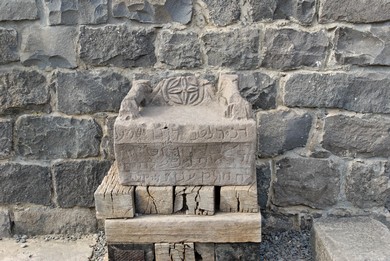
Moses' Seat

A replica of Moses’ seat, where Moses’ law was read, in the synagogue ruins at Chorazin.

The original is in the Israel Museum in Jerusalem.
Image from https://www.seetheholyland.net

Other ruins of ancient synagogues also have Moses’ seat. That’s the way it was done. The rabbi who read the law of Moses sat in Moses’ seat.

So what did Yeshua mean when He said, “The scribes and the Pharisees sat on Moses’ seat?”

In the synagogues, which the Pharisees ran, when they read the law of Moses, they sat on Moses’ seat, the place where the law was read.

Matt 23
3) All things therefore whatever they tell you to observe, observe and do, but don’t do their works; for they say, and don’t do.

When the Pharisees sat on Moses’ seat, they said something, but did not do what they said — “they say, and don’t do.” That is, they read the law, but did not keep the law. They read the law, and Christ said to observe and do that. But their works, don’t do.

Their rules about the Sabbath, don’t do.

Their rules about handwashing and washing of pots, don’t do.

And the Feast days that they set, which are different than the days that God sets, which came centuries after the Son of God walked the earth — their feast days are their works, too. “Don’t do their works.”

Mark 7
7) But in vain do they worship me, teaching as doctrines the commandments of men.’
8) “For you set aside the commandment of God, and hold tightly to the tradition of men—the washing of pitchers and cups, and you do many other such things.”
9) He said to them, “Full well do you reject the commandment of God, that you may keep your tradition.

13) …making void the word of God by your tradition, which you have handed down. You do many things like this.”

That’s exactly what the Pharisees did with the Feast days.

Calculating the Feast days, instead of going by God’s signs that He set in the heavens from Genesis, is only part of the many such things that the Pharisees/Judaism do. In changing the Feast days, they set aside the commandment of God from creation and substituted the traditions created by the rabbis.

Excuse me — I’m not supposed to call them rabbis.

Christ said that the Pharisees sat on Moses’ seat. They read the law from the law reading bench in the front of the synagogues, which was called Moses’ seat, where the law of Moses was read.

Christ also said that the Pharisees are on the hot seat — going to Gehenna. The Feasts will be observed in the Kingdom of God. The Pharisees will not be in the Kingdom of God. Who then, will set God’s Feasts in God’s Kingdom, if the Gehenna guys won’t be there?

Yahweh God Almighty.

Just as He sets them today.

Matthew 23 does not say that God gave authority to the Pharisees to change His Feasts. It does say that the Pharisees are sons of Gehenna. Sons of Gehenna are not given authority from God. They do not set God’s Feasts.

Chapter 73 – Fencing in the Feasts

The End Time Church: From the Cathedrals to the Catacombs

By Dan L. White

Copyright 2020 by Dan L. White, all rights reserved.

Scripture quotations are from the World English Bible (WEB) which is in the public domain.

Chapter 73

Fencing in the Feasts

In 1944, the number one song in America was “Don’t Fence Me In.”

Everyone remembers that big hit, right? Before the Beatles and “Hard Days Night” and before Elvis and “Blue Suede Shoes,” there was Gene Autry and “Don’t Fence Me In.”

That western song had these lyrics.

Oh give me land, lots of land, under starry skies above
Don’t fence me in
Let me ride through the wide open country that I love
Don’t fence me in

By contrast, the Pharisees could have had a song like this.

We’ll Fence It In
Oh give me foods, lots of foods, to set our kosher rules,
We’ll fence
them in.
Give me clothes, hems and fringes, arms and meninges,
We’ll fence them in.
Give me Sabbath, a rest day for spiritual blessing,
We’ll add so many rules that we make it a cursing,
And if there’s anything else
, then we’re still working,
We’ll fence it in.

That Pharisee song was never number one, but has had much more influence than the Gene Autry song.

1906 Jewish Encyclopedia, “Pharisees”
The Pharisees “added new restrictions to the Biblical law in order to keep the people at a safe distance from forbidden ground; as they termed it, “they made a fence around the Law,”

The Pharisees were socialist/communist types. They did not rely on spiritual control but on government control, and they thought they were the religious government. So the Pharisees fenced everything. Sabbaths, foods, clothing – they set rules for everything.

Wikipedia, “Pharisees,” 12/28/19
Jewish law prohibits Jews from carrying objects from a private domain (“reshut ha-yachid”) to a public domain (“reshut ha-rabim”) on Sabbath. This law could have prevented Jews from carrying cooked dishes to the homes of friends for Sabbath meals. The Pharisees ruled that adjacent houses connected by lintels or fences could become connected by a legal procedure creating a partnership among homeowners; thereby, clarifying the status of those common areas as a private domain relative to the members of the partnership. In that manner people could carry objects from building to building.

How about that? The Pharisees made rules, then they made rules to get around their rules.

Whose rules?

Their rules.

Now here is a critical question.

If the Pharisees set rules for Sabbaths, foods, clothing, washing hands and platters, etc., etc., etc. –

Wouldn’t they also set rules for the Feasts?

Can a fish swim? Is the pope a Catholic? Yes! They were absolutely going to set rules for the Feasts, as they did for everything else. That’s what they do. They fence you in.

First of all, most of their Sabbath rules also apply to their Feast high days. So accepting their high days logically means accepting their Sabbath fences for their high days.

But what are the Pharisee Feast days?

The Pharisee Feast days are the days set by the Pharisees in their calendar. Again, when the Temple fell, the Pharisees with their synagogues became Judaism. So the “Jewish calendar” is the Pharisee calendar.

How did the Pharisee calendar come about?

1906 Jewish Encyclopedia, “Pharisees”
The history of the Jewish calendar may be divided into three periods—the Biblical, the Talmudic, and the post-Talmudic. The first rested purely on the observation of the sun and the moon, the second on observation and reckoning, the third entirely on reckoning.

The three periods of the Jewish calendar were:

  1. Biblical — following Bible instructions during Temple times. The months were set by the visible new moon, testified by witnesses, whoever and wherever they were in the Holy Land.

Once the Temple fell, the Feasts were still set by the Creator’s timing, not by rabbi calculations.

Jewish Encyclopedia (cont.)
After the destruction of the Temple (70 C.E.) Joanan ben Zakkai removed the Sanhedrin to Jabneh. To this body he transferred decisions concerning the calendar, which had previously belonged to the patriarch. After this the witnesses of the new moon came direct to the Sanhedrin.

As said before, the Sanhedrin did not set the Feasts. They only accepted what God had set in His creation.

  1. Talmudic period

Jewish Encyclopedia (cont.)
Under the patriarchate of Rabbi Judah I., surnamed “the Holy” (163-193), the Samaritans, in order to confuse the Jews, set up fire-signals at improper times [fires on hilltops were used to signal a new moon], and thus caused the Jews to fall into error with regard to the day of the new moon. Rabbi Judah accordingly abolished the fire-signals and employed messengers. The inhabitants of countries who could not be reached by messengers before the feast were accordingly in doubt, and used to celebrate two days of the holidays. By this time the fixing of the new moon according to the testimony of witnesses seems to have lost its importance, and astronomical calculations were in the main relied upon.

The Talmudic period was after the Temple had fallen but before the calculated Pharisee/Jewish calendar. The Talmud, a written record of the oral law of the rabbis, was compiled during this time. The Talmud shrank the Bible’s importance, because the oral law is viewed as being equally inspired. At this time the Jews also shrank the importance of Bible instructions about the Feasts, with a gradual replacing of Bible instructions for setting the Feasts in favor of their calculated method. As the Jewish Encyclopedia said, “fixing of the new moon according to the testimony of witnesses seems to have lost its importance.”

We have to appreciate the arrogance of those who add to the Bible. The Pharisee rabbis said that what the rabbis said was just as inspired as the Bible. To whatever degree, that’s like a rabbi saying, “Hey, I’m God and my words are inspired!”

As study of the Pharisees’ Talmud replaced much of their Bible study, so calculations of Feasts were put in place of Bible instruction — at about the same time!

Jewish Encyclopedia (cont.)
One of the important figures in the history of the calendar was Samuel (born about 165, died about 250), surnamed “Yarhinai” because of his familiarity with the moon. He was an astronomer, and it was said that he knew the courses of the heavens as well as the streets of his city (Ber. 58b). He was director of a school in Nehardea (Babylonia), and while there arranged a calendar of the feasts in order that his fellow-countrymen might be independent of Judea. He also calculated the calendar for sixty years. His calculations greatly influenced the subsequent calendar of Hillel.

Calculated the calendar for sixty years — How comfortably convenient! No more watching and waiting on God.

Jewish Encyclopedia (cont.)
Under the patriarchate of Rabbi Judah III. (300-330) the testimony of the witnesses with regard to the appearance of the new moon was received as a mere formality, the settlement of the day depending entirely on calculation. This innovation seems to have been viewed with disfavor by some members of the Sanhedrin, particularly Rabbi Jose, who wrote to both the Babylonian and the Alexandrian communities, advising them to follow the customs of their fathers and continue to celebrate two days, an advice which was followed, and is still followed, by the majority of Jews living outside of Palestine.

Remember that Yeshua said, “Beware of the leaven of the Pharisees, which is hypocrisy,” Luke 12:1, English Standard Version.

Hypocrisy. After Rome was ruled by Caesar dictators, they still kept the Senate. They looked like the old republic, but were a totalitarian government. And the Pharisees still accepted witnesses of the new moon, but then ignored what they said. In other words, they ignored what God had set, in favor of what the Pharisees themselves had set. Yet for a while, they went through with that charade.

But only for a while.

  1. Calculated period, to the present time.

Jews had said they had no king but Caesar, yet they kept rebelling against their king. Predictably, the Caesars didn’t like that. So the Jews fought Rome in the Great Revolt of 66-70 CE, the Bar Kochba rebellion in 132-135, and other smaller insurrections. This led Rome to detest Jews. Remember that Emperor Constantine opposed the Sabbath and Feasts because he wanted to “have nothing in common with the detestable Jewish crowd,” as Eusebius recorded. Consequently another Jewish revolt against Rome, this time in Galilee in 351, led to Rome preventing the announcing of the festival times by the rabbis.

That was the straw that broke the calendar’s back.

Jewish Encyclopedia (cont.)
Under the reign of Constantius (337-361) [son of Constantine] the persecutions of the Jews reached such a height that all religious exercises, including the computation of the calendar, were forbidden under pain of severe punishment.

So the Pharisees were forbidden from publicly announcing their Feast days. They had already given up going by what God set in favor of what they set by their calculations. Because of the Roman opposition, they then took the next step. Instead of announcing the Feast days they had calculated, they simply made public their calculations for setting their Feast days.

Jewish Encyclopedia (cont.)
This unselfish promulgation of the calendar, though it destroyed the hold of the patriarchs on the scattered Judeans, fixed the celebration of the Jewish feasts upon the same day everywhere. Later Jewish writers agree that the calendar was fixed by Hillel II. in the year 670 of the Seleucidan era; that is, 4119 A.M. or 359 C.E. Some, however, as Isaac Israeli, have fixed the date as late as 500. Saadia afterward formulated calendar rules, after having disputed the correctness of the calendar established by the Karaites.

This calendar method and the resulting Feast days were not exactly the same as the Jewish Pharisee calendar today.

Jewish Encyclopedia (cont.)
While it is not unreasonable to attribute to Hillel II the fixing of the regular order of intercalations, his full share in the present fixed calendar is doubtful.

Wikipedia, “Hebrew Calendar”
“The principles and rules were fully codified by Maimonides in the Mishneh Torah in the 12th century.”

The Pharisee/Jewish calendar was not some inspired revelation that God dropped down from Mt. Sinai. It was gradually developed over centuries, not by God but by the Pharisees. After all, the Pharisees were inevitably going to add to it, to fence it in. These fences included the multiple postponements of the days they themselves calculated, added to fence in the high days.

Of course, Yahweh God Himself forgot to put all those rules in the Bible, so the Pharisees had to help Him out with that.

The Jewish Encyclopedia says that the “unselfish promulgation of the calendar, though it destroyed the hold of the patriarchs on the scattered Judeans, fixed the celebration of the Jewish feasts upon the same day everywhere.” In reality, the Pharisee/Jewish calculated calendar did not destroy the hold of the patriarchs. In fact, the Pharisees put most Feast keepers under their control, even to the present day, by keeping the Feast days that the Pharisees set, instead of the Feast days that God sets.

Calculation is not just a different way of coming up with the same Feast days. Calculation is a different way of coming up with different Feast days.

And those different days are the days the Pharisees set.

You recall how Jeroboam changed the Feast of the seventh month to the eighth month?

In reality the Pharisees, with their complicated, convenient, calculated calendar, did the same thing. They Jerebombed the Feasts. They changed them.

When the Christian Church lost the weekly Sabbath, the process was gradual. First, Christians kept the Sabbath. Next, Christians kept the Sabbath and Sunday, the day that pagan society honored. Finally, Romish Christians kept Sunday and outlawed the Sabbath.

The changing of the Feasts went through a similar process, as you may have noticed. First, they were set by God’s creation, by observing the visible new moon. Next, they were set by calculation, but still receiving new moon witnesses. Finally, they were set only by calculation.

This process is like the shell game. A pea is placed under one of three walnut shells, all three shells are quickly shuffled around, until you just lose sight of where that little pea was. That’s what happened with the Sabbath in the Christian churches and the Feasts among the Jews.

However —

Flash forward sixteen centuries from Hillel II in 358 to 1948. The Jews again became a nation, in the Holy Land. Nineteen years later they regained the Temple Mount. And then the Pharisee Jewish calendar had a problem.

They could see it was wrong.

Any individual in Israel could see the monthly new moon, and realize that the Pharisee Jewish calendar calculated new moon was not the chodesh at all. Even the Pharisees could see that!

The Karaites, who disagreed with the Pharisee calculated Feast days, could see it, too, and they went back to the Bible calendar used at the Temple.

McGill, Karaite Interpretation
Karaites use the lunar month and the solar year, but determine when to add a leap month by observing the ripening of barley (called abib) in Israel, rather than the calculated and fixed calendar of Rabbinic Judaism. This puts them in sync with the Written Torah, while other Jews are often a month later. (For several centuries, many Karaites, especially outside Israel, have just followed the calculated dates of the Oral Law (the Mishnah and the Talmud) with other Jews for the sake of simplicity. However, in recent years most Karaites have chosen to again follow the Written Torah practice.)
https://www.cs.mcgill.ca/~rwest/wikispeedia/wpcd/wp/h/Hebrew_calendar.htm

The Jews — the Pharisees — are working hard toward building a third Temple. They have established a new Sanhedrin. This is what the new Sanhedrin, who are all Pharisee Jews, says about the Pharisee/Jewish calendar.

From the Sanhedrin website:
“The Jewish Calendar has a discrepancy of about one day every century. This means that by the year 6000, Pesach [Passover] will come out two new moons (Sivan) after the first day of spring.” [Sivan is the 3rd month of the biblical year.] http://www.thesanhedrin.org/en/index.php/Committee_concerning_the_fixing_of_the_Calendar

That is, in a couple of centuries the Pharisee Jewish calendar will be so askew that Passover will be about Pentecost time.

“Our current calendar will exceed halachically acceptable limits and we will be celebrating Biblically commanded holidays at times other than when Scripture requires them to be celebrated. One could argue that, if a change is necessary in any event, it would be most correct according to Biblical and Jewish Law to once again use the system of witnesses. But it is certain that we will not longer be permitted to use the mathematical calendar of Hillel II in the near future.” (Ibid)

What does this mean?

The Pharisees have created the most complex calendar known to man — and it’s still wrong.

And they, with their plans for a third Temple, want to change the Feast days back to the original days. As the Sanhedrin says, “But it is certain that we will not longer be permitted to use the mathematical calendar of Hillel II in the near future.”

Their new Sanhedrin has the presumed authority to change back the Sanhedrin’s Feast day changes of 358, as they presumed it had the authority to change God’s Feasts back in 358.

New World Encyclopedia, “Sanhedrin”
Since the Jewish Calendar was based on witnesses’ testimony, which was too dangerous to collect during these Roman times, Hillel II recommended a mathematical Calendar that was adopted at a clandestine, and maybe last, meeting in 358 C.E. This marked the last universal decision made by that body...

In October 2004 (Hebrew Calendar=Tishrei 5765), a group of rabbis claiming to represent varied communities in Israel undertook a ceremony in Tiberias, where the original Sanhedrin was disbanded, which they claim re-establishes the body according to the proposal of Maimonides and the Jewish legal rulings of Rabbi Yosef Karo. The controversial attempt has been subject to debate within different Jewish communities.

So the Feasts were originally set by the new moon.

The Pharisees changed that to Feasts set only by their calculations. Now they themselves admit that their calculations miss the new moon.

This makes for a clear choice. Go by what God said or go by what the Pharisees said. Which authority should we bow to?

Even the Pharisees say their Feast days are wrong. So why do people follow what is admittedly wrong?

Because the Pharisees, and those who follow the Pharisees, say they are not wrong even if they are wrong. Even if their Feast days differ from those God set with the new moons, the Pharisees are said to have the authority to change those days.

We previously mentioned a church leader who kept Pentecost on Monday, then changed it to Sunday. But he maintained that he was not wrong when he and his church kept it on Monday, because he had the authority of Peter, and whatever he said was right, even if it was wrong. In effect, he said he had the authority to change the Feast days. The Pharisees certainly do not claim the authority of Peter, but they do claim authority as God’s rabbis, and some say that authority makes their Feast days right, even if they’re wrong.

Did the Pharisees have authority from God to change God’s Feast days? Do they have the authority to change them back? Do we have to wait on the Pharisees’ Sanhedrin to return to God’s Feast days?