The End Time Church: From the Cathedrals to the Catacombs
By Dan L. White
Copyright 2020 by Dan L. White, all rights reserved.
Scripture quotations are from the World English Bible (WEB) which is in the public domain.
Chapter 74
The Pharisees, Moses’ Seat and the Hot Seat
What does it mean to sit on Moses’ seat?
Matt 23 World English Bible
1) Then Yeshua spoke to the multitudes and to his disciples,
2) saying, “The scribes and the Pharisees sat on Moses’ seat.
Young’s Literal Translation and the Literal Translation of the Holy Bible also say “sat;” King James says “sit in Moses seat.”
Most Christian/Messianic Feast keepers believe that God gave the Pharisees authority to change the Feasts.
They believe that God approves the Pharisees replacing what He said in the Bible with what they said out of the Bible. And this is one of the linchpins of their logic —
The Pharisees sit on Moses’ seat!
Just as the Pharisees hold that the Talmud and Mishnah are divinely inspired, these Christians say that the Pharisee calendar is divinely inspired. You can’t question the Pharisee calendar because God inspired it through those guys.
After all, they sit on Moses’ seat!
To sit on Moses’ seat does sound impressive. But if that statement gives the Pharisees authority to change God’s laws, then why did Yeshua go on to say this?
Matt 23
3) All things therefore whatever they tell you to observe, observe and do, but don’t do their works; for they say, and don’t do.
So when the Pharisees sat on Moses’ seat, they said something, but did not do what they said.
What is it that the Pharisees don’t do?
John 7
19) Didn’t Moses give you the law, and yet none of you keeps the law? Why do you seek to kill me?”
The Pharisees don’t keep the law. The law was what they said but did not do.
Stephen affirmed that.
Acts 7
51) “You stiff-necked and uncircumcised in heart and ears, you always resist the Holy Spirit! As your fathers did, so you do.
52) Which of the prophets didn’t your fathers persecute? They killed those who foretold the coming of the Righteous One, of whom you have now become betrayers and murderers.
53) You received the law as it was ordained by angels, and didn’t keep it!”
The Pharisees and the Jews received the law but did not keep it. They said it but did not do it.
What they did do was to kill Yeshua and Stephen. Which brings up a critical question.
Why would God use people to set His Feasts who killed His prophets, killed His Christians, and killed His only begotten Son? The Pharisees and Jews delivered Yeshua to Rome to be executed. Both Jews and Gentiles are guilty of the greatest crime in the history of the world — committed at a Feast time.
Does it seem sensible that God the Father would use people who helped kill His only begotten Son — at a Feast time! — to set His Feasts? Does that seem sensible?
No. It doesn’t seem plausible that God would use Rome as headquarters for His people, and it does not seem sensible that God would use the Pharisees, of all people, to set His holy days.
But what about Moses’ seat?
After Yeshua said that the Pharisees sat on Moses’ seat, then He put them on the hot seat.
Matt 23
4) For they bind heavy burdens that are grievous to be borne, and lay them on men’s shoulders; but they themselves will not lift a finger to help them.
5) But all their works they do to be seen by men. They make their phylacteries broad, enlarge the fringes of their garments,
6) and love the place of honor at feasts, the best seats in the synagogues,
7) the salutations in the marketplaces, and to be called ‘Rabbi, Rabbi’ by men.
8) But don’t you be called ‘Rabbi,’ for one is your teacher, the Christ, and all of you are brothers.
Christ said not to call anyone rabbi. But the Pharisees are thought to have God’s authority only because they are rabbis.
Bit of a conflict there?
If God does not recognize the Pharisees as rabbis, then does He recognize what they do as rabbis?
Ironically, the passage that is most often used to say the Pharisees have divine authority is the New Testament passage that most condemns the Pharisees.
Matt 23 (cont.)
13) “Woe to you, scribes and Pharisees, hypocrites! For you devour widows’ houses, and as a pretense you make long prayers. Therefore you will receive greater condemnation.
14) “But woe to you, scribes and Pharisees, hypocrites! Because you shut up the Kingdom of Heaven against men; for you don’t enter in yourselves, neither do you allow those who are entering in to enter.
15) Woe to you, scribes and Pharisees, hypocrites! For you travel around by sea and land to make one proselyte; and when he becomes one, you make him twice as much of a son of Gehenna as yourselves.
Exactly what did Yeshua say there?
He said that the Pharisees are Gehenna guys.
Would God use guys who are going to Gehenna — the lake of fire reserved for the wicked — to set His holy days? Should those who are most wicked set the most holy?
Matt 23 (cont.)
16) “Woe to you, you blind guides, who say, ‘Whoever swears by the temple, it is nothing; but whoever swears by the gold of the temple, he is obligated.’
17) You blind fools! For which is greater, the gold, or the temple that sanctifies the gold?
18) ‘Whoever swears by the altar, it is nothing; but whoever swears by the gift that is on it, he is obligated?’
19) You blind fools! For which is greater, the gift, or the altar that sanctifies the gift?
20) He therefore who swears by the altar, swears by it, and by everything on it.
21) He who swears by the temple, swears by it, and by him who was living in it.
22) He who swears by heaven, swears by the throne of God, and by him who sits on it.
23) “Woe to you, scribes and Pharisees, hypocrites! For you tithe mint, dill, and cumin, and have left undone the weightier matters of the law: justice, mercy, and faith. But you ought to have done these, and not to have left the other undone.
24) You blind guides, who strain out a gnat, and swallow a camel!
It’s ironic that many Messianics look at Jewish rabbis as having great wisdom, the wisdom of “sages.” Did they not read Christ’s words? “You blind fools! You blind fools! You blind guides!”
Taking Christ at His word — that the Pharisees are blind — should those who are spiritually blind be given the authority to set the most spiritual times? Wouldn’t they also be spiritually blind in how they set their Feasts?
Matt 23 (cont.)
25) “Woe to you, scribes and Pharisees, hypocrites! For you clean the outside of the cup and of the platter, but within they are full of extortion and unrighteousness.
26) You blind Pharisee, first clean the inside of the cup and of the platter, that its outside may become clean also.
27) “Woe to you, scribes and Pharisees, hypocrites! For you are like whitened tombs, which outwardly appear beautiful, but inwardly are full of dead men’s bones, and of all uncleanness.
28) Even so you also outwardly appear righteous to men, but inwardly you are full of hypocrisy and iniquity.
The Pharisees appeared righteous. That is, people thought the Pharisee rabbis were inspired by God, just as people think their calendar is inspired by God. The Pharisees appear righteous.
Matt 23 (cont.)
29) “Woe to you, scribes and Pharisees, hypocrites! For you build the tombs of the prophets, and decorate the tombs of the righteous,
30) and say, ‘If we had lived in the days of our fathers, we wouldn’t have been partakers with them in the blood of the prophets.’
31) Therefore you testify to yourselves that you are children of those who killed the prophets.
32) Fill up, then, the measure of your fathers.
33) You serpents, you offspring of vipers, how will you escape the judgment of Gehenna?
Christ, the judge of all mankind, restates the judgment of the Pharisees — Gehenna. Their religion is the antithesis of what God wants.
Matt 23 (cont.)
34) Therefore, behold, I send to you prophets, wise men, and scribes. Some of them you will kill and crucify; and some of them you will scourge in your synagogues, and persecute from city to city;
35) that on you may come all the righteous blood shed on the earth, from the blood of righteous Abel to the blood of Zachariah son of Barachiah, whom you killed between the sanctuary and the altar.
36) Most certainly I tell you, all these things will come upon this generation.
There are 8 “woes” in Yeshua’s diatribe against the Pharisees/Judaism.
If we say, “Woe is me,” what does that mean?
It means I’m in big trouble.
The Greek word “ouai” that is translated as “woe” means about the same as the English word. It means somebody’s in big trouble.
Chorazin and Bethsaida were in big trouble.
Matt 11
20) Then he began to denounce the cities in which most of his mighty works had been done, because they didn’t repent.
21) “Woe to you, Chorazin! Woe to you, Bethsaida! For if the mighty works had been done in Tyre and Sidon which were done in you, they would have repented long ago in sackcloth and ashes.
22) But I tell you, it will be more tolerable for Tyre and Sidon on the day of judgment than for you.
Judas was also in big trouble.
Mark 14
21) For the Son of Man goes, even as it is written about him, but woe to that man by whom the Son of Man is betrayed! It would be better for that man if he had not been born.”
When Christ pronounced a woe on somebody, like Chorazin, Bethsaida or Judas, they were in big trouble.
And when Christ pronounced a woe eight times on the Pharisees/Judaism, do you know what that means?
They were in big, big, big, big, big, big, big, big trouble!
Now does that sound like God was going to use those people — 300 years later — to change His Feast days?
Probably not.
Okay, so what did Yeshua mean when He said that the Pharisees sat on Moses’ seat?
What was Moses’ seat?
We just read about the woe on Chorazin, and Chorazin had Moses’ seat.
Or one of them, anyway.
Chorazin refers to a town not far from the Sea of Galilee, and the ruins of a third or fourth century synagogue are still there. Moses’ seat was found in that old synagogue.
The Jerusalem Post, November 26, 2012.
“The archaeologist’s spade at Chorazin has unearthed numerous houses near the synagogue and a ritual bath adjoining a sizable oval cistern. In the 1920s, excavators found a decorated stone seat, referred to as, “the Seat of Moses,” which served as the place where an authoritative teacher would sit in the synagogue to read the Torah. The Israel Museum in Jerusalem houses the original seat today, but a replica sits beside the synagogue’s doorway in Chorazin.”
https://www.jpost.com/Travel/Around-Israel/Sites-and-Insights-Capernaum-with-a-view
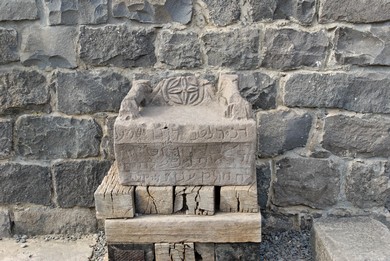
A replica of Moses’ seat, where Moses’ law was read, in the synagogue ruins at Chorazin.
The original is in the Israel Museum in Jerusalem.
Image from https://www.seetheholyland.net
Other ruins of ancient synagogues also have Moses’ seat. That’s the way it was done. The rabbi who read the law of Moses sat in Moses’ seat.
So what did Yeshua mean when He said, “The scribes and the Pharisees sat on Moses’ seat?”
In the synagogues, which the Pharisees ran, when they read the law of Moses, they sat on Moses’ seat, the place where the law was read.
Matt 23
3) All things therefore whatever they tell you to observe, observe and do, but don’t do their works; for they say, and don’t do.
When the Pharisees sat on Moses’ seat, they said something, but did not do what they said — “they say, and don’t do.” That is, they read the law, but did not keep the law. They read the law, and Christ said to observe and do that. But their works, don’t do.
Their rules about the Sabbath, don’t do.
Their rules about handwashing and washing of pots, don’t do.
And the Feast days that they set, which are different than the days that God sets, which came centuries after the Son of God walked the earth — their feast days are their works, too. “Don’t do their works.”
Mark 7
7) But in vain do they worship me, teaching as doctrines the commandments of men.’
8) “For you set aside the commandment of God, and hold tightly to the tradition of men—the washing of pitchers and cups, and you do many other such things.”
9) He said to them, “Full well do you reject the commandment of God, that you may keep your tradition.
13) …making void the word of God by your tradition, which you have handed down. You do many things like this.”
That’s exactly what the Pharisees did with the Feast days.
Calculating the Feast days, instead of going by God’s signs that He set in the heavens from Genesis, is only part of the many such things that the Pharisees/Judaism do. In changing the Feast days, they set aside the commandment of God from creation and substituted the traditions created by the rabbis.
Excuse me — I’m not supposed to call them rabbis.
Christ said that the Pharisees sat on Moses’ seat. They read the law from the law reading bench in the front of the synagogues, which was called Moses’ seat, where the law of Moses was read.
Christ also said that the Pharisees are on the hot seat — going to Gehenna. The Feasts will be observed in the Kingdom of God. The Pharisees will not be in the Kingdom of God. Who then, will set God’s Feasts in God’s Kingdom, if the Gehenna guys won’t be there?
Yahweh God Almighty.
Just as He sets them today.
Matthew 23 does not say that God gave authority to the Pharisees to change His Feasts. It does say that the Pharisees are sons of Gehenna. Sons of Gehenna are not given authority from God. They do not set God’s Feasts.
 Dan L. White Homeschool Helpers