The End Time Church: From the Cathedrals to the Catacombs
By Dan L. White
Copyright 2020 by Dan L. White, all rights reserved.
Scripture quotations are from the World English Bible (WEB) which is in the public domain.
Chapter 75
The Oracle of Delphi and the Jewish Calendar
Does breathing volcanic fumes help get close to God?
From a geography site, atlasobscura.com:
“The priestess, called the Pythia, sat above a chasm in the earth, which belched forth fumes. She breathed deeply – some believe that the fumes possessed hallucinogenic properties – and slipped into semi-consciousness. Her prophecies were opaque, often frantic. This was the Oracle of Delphi: the Greeks’ most famous and most feared window into the will of the gods. It lay in “a cavern hollowed down in the depths” of the hillside, as the historian Strabo reported, underneath the great Temple of Apollo.”
https://www.atlasobscura.com/places/the-oracle-of-delphi-greece 2/25/20.
The oracle of Delphi gave oracles at the Oracle of Delphi. They were supposed to show the future, that the god Apollo had shown her.
From a PBS article:
Dating back to 1400 BC, the Oracle of Delphi was the most important shrine in all Greece… Built around a sacred spring, Delphi was considered to be the omphalos – the center (literally navel) of the world.
People came from all over Greece and beyond to have their questions about the future answered by the Pythia, the priestess of Apollo. And her answers, usually cryptic, could determine the course of everything from when a farmer planted his seedlings, to when an empire declared war.
Arguments over the correct interpretation of an oracle were common, but the oracle was always happy to give another prophecy if more gold was provided.
https://www.pbs.org/empires/thegreeks/background/7_p1.html 2/25/20.
In the same way as modern day prophets, the oracle could adjust her prophecies — after the fact.
From historyanswers web site:
“The oracle received a multitude of visitors in the nine days she was available, from farmers desperate to know the outcome of the harvest to emperors asking if they should wage war on their enemies, and her answers were not always clear. Responses, or their translations by the temple priests, often seemed deliberately phrased so that, no matter the outcome, the oracle would always be right. It was essential for the consultant to carefully consider her words, or else risk a bad harvest, or even the defeat of an entire army. When Croesus, the king of Lydia, asked the oracle if he should attack Persia, he received the response: “If you cross the river, a great empire will be destroyed.” He viewed this as a good omen and went ahead with the invasion. Unfortunately, the great empire that was destroyed was his own. In this way, the oracle, just like the gods, was infallible, and her divine reputation grew. To question the oracle was to question the gods – and that was unthinkable.”
https://www.historyanswers.co.uk/ancient/cleopatras-affairs-were-a-political-gamble-that-failed
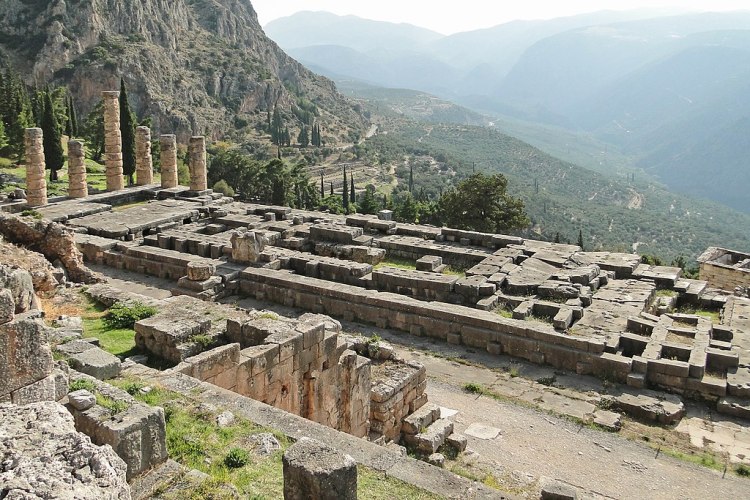
The Temple of Apollo at Delphi, Greece,
over the cavern of the Oracle of Delphi.
Photo from wikimedia, taken by Bernard Gagnon.
Again, at the (a) Oracle of Delphi, the (b) oracle gave (c) oracles.
American Heritage dictionary defines oracle as —
- A shrine consecrated to the worship and consultation of a prophetic deity, as that of Apollo at Delphi.
- A person, such as a priestess, through whom a deity is held to respond when consulted.
- The response given through such a medium, often in the form of an enigmatic statement or allegory.
American Heritage® Dictionary of the English Language, Fifth Edition. Copyright © 2016 by Houghton Mifflin Harcourt Publishing Company. Published by Houghton Mifflin Harcourt Publishing Company. All rights reserved.
So the English word “oracle” is obviously a heavy, heavy word, laden with the volcanic fumes of pagan history. It came from the Latin word ‘orare’, to speak, and is related to the English word orator, a public speaker. But oracle came to mean much more than just to speak.
The Greek word translated as oracle is “logion.” Bible students will recognize that logion is related to logos – word.
John 1:1
In the beginning was the Word [logos], and the Word [logos] was with God, and the Word [logos] was God.
Logion occurs 4 times in the Greek New Testament, including Romans 3:2.
Rom 3:1-2 World English Bible
1)Then what advantage does the Jew have? Or what is the profit of circumcision?
2)Much in every way! Because first of all, they were entrusted with the revelations of God.
Rom 3:1-2 King James Version
1) What advantage then hath the Jew? or what profit is there of circumcision?
2) Much every way: chiefly, because that unto them were committed the oracles of God.
How powerful that English word “oracle” seems in the KJV! For example, Mormons say that oracles includes messages received by their founder Joseph Smith.
“Section 90 of the Doctrine and Covenants was a revelation given specifically to Joseph Smith, that begins—
…through you shall the oracles be given to another, yea, even unto the church. And all they who receive the oracles of God, let them beware how they hold them lest they are accounted as a light thing, and are brought under condemnation thereby…
Through the Prophet the oracles or statements of the Lord were to be given to another, yea, even unto the church. In other words, we receive the word of God through the prophets…”
https://askgramps.org/can-you-explain-the-oracles-of-god
So Mormons believe that oracles of God are messages that they receive from God.
A web site from Brigham Young University Idaho (a Mormon school) says:
Brother Brigham took the stand, and he took the Bible, and laid it down; he took the Book of Mormon, and laid it down; and he took the Book of Doctrine and Covenants, and laid it down before him, and he said: “There is the written word of God to us, concerning the work of God from the beginning of the world, almost, to our day.” “And now,” said he, “when compared with the living oracles those books are nothing to me; those books do not convey the word of God direct to us now, as do the words of a Prophet or a man bearing the Holy Priesthood in our day and generation. I would rather have the living oracles than all the [p.23]writing in the books.” That was the course he pursued. When he was through, Brother Joseph said to the congregation: “Brother Brigham has told you the word of the Lord, and he has told you the truth.” (Conference Report, October 1897, p.22).
http://emp.byui.edu/satterfieldb/quotes/Modern%20Prophet%20More%20important%20the%20Scripture.html
So the Mormons viewed the living oracles, words of their current “prophets,” as worth more than the Bible. Those were extra-ordinary oracles!
The Revised English Version (REV) in its translation of the Greek word logion does not use “oracles.”
Rom 3:2
2) Much in every way. First of all, because they were entrusted with the words of God.
REV commentary on that verse:
“words.” The Greek word is logion (#3051 λόγιον; pronounced log’-ee-on), and it is the diminutive of logos, “word” or “message.” Literally, it is “little words.” See commentary on Acts 7:38.
In Acts 7:38 they again translate ‘logion’ as words.
Acts 7:38
38)[Stephen speaking] This is he who was with the assembly in the desert with the angel who spoke to him on Mount Sinai, and with our fathers, who received living words to give to us,
So in Stephen’s speech, logion refers to the Ten Commandments that God spoke on Mount Sinai.
Their commentary on that verse says:
”“words.” The Greek word is logion (#3051 λόγιον; pronounced log’-ee-on), and it is the diminutive of logos, “word” or “message.” Literally, it is “little words.” We can see why the Bible uses the word logion for communications from God, because the Greeks used logion for the divine utterances of the oracles, particularly the Oracle of Delphi. The reason for that was that the messages from the oracles were typically short. Thus in time, logion was used of the communications that come from the gods. We felt the translation “oracle” was too obscure for our English translation, although it occurs in many English Bibles, because the English word “oracle” has many meanings that do not apply. We went with “words” because it accurately represents that it is the words coming from God, and whereas the “word” of God means His entire communication, “words” of God can refer to smaller pieces of His revelation. The word occurs 4 times in the New Testament: Acts 7:38; Romans 3:2; Hebrews 5:12, and 1 Peter 4:11.”
So the Revised English translation uses “words” instead of “oracles” because the English word “oracle” has many meanings that do not apply. Oracles is taken to mean much more than just “words,” as the Mormons and Brigham Young do.
And the English word “oracles” is even applied to the Jewish calendar!
Some say that these “oracles of God” entrusted to the Jews in Romans 3:2 include the Pharisee-Jewish calendar.
A reminder here that what is commonly called the Jewish calendar is the Pharisee-Jewish calendar. After the fall of the Temple, the Pharisees created the Jewish calendar, so the Jewish calendar is the Pharisee calendar. And some say that those “oracles” mentioned by Paul are the God inspired Bible and the God inspired Pharisee-Jewish calendar.
How powerful that English word “oracles” is! The Pharisee calculated calendar is just as inspired as the Bible, because it’s part of the oracles of God.
However, when an English translation uses “words” instead of “oracles” for logion, that gives quite a different impression of Romans 3:2. In the Revised English Version just cited, the Jews were “entrusted with the words of God.” Obviously the phrase “words of God” does not seem to include the most complex calendar in human history.
But —
Early English translations did not render ‘logion’ as ‘oracles.’
Wycliffe Bible (1395 CE)
Rom 3:1) What then is more to a Jew, or what profit of circumcision?
2) Much by all wise [Much by all manner]; first, for the speakings of God were betaken to them.
Tyndale Bible (1534 CE)
Rom 3:2) Surely very moche. Fyrst vnto them was committed the worde of God.
Coverdale BIBLE (1535)
Rom 3:2) Surely very moch. First Vnto them was commytted what God spake.
Great Bible (1539 CE)
Rom 3:2) Surely verye moch. Fyrst because that vnto them were commytted the wordes of God.
The earliest English translations used speakings of God, word of God, what God spoke, or words of God, reflecting logion’s relation to logos. The Septuagint Greek translation of the Old Testament also used logion to mean passages of scripture, that is, the word of God.
However, the Geneva Bible did use “oracles.”
Geneva Bible (1560 CE)
Rom 3:2) Much euery maner of way: for chiefly, because vnto them were of credite committed the oracles of God.
The Geneva translators were English Protestants who had fled to Geneva, Switzerland, during the reign of Bloody Mary. She was the English queen who tried to turn England back to Catholicism and burned several hundred Protestants at the stake. The Geneva Bible also included “church” instead of “congregation” and “pastors” instead of “shepherds”, along with “oracles” instead of “words.” The Geneva English Protestants rejected the authority of the Roman Church and to some degree the Church of England, yet they tended to establish their own strong church authority, and their translation reflected that.
However, a few years after the Geneva Bible appeared, the Bishops Bible returned to the earlier English translation of “logion.”
Bishops Bible (1568)
Rom 3:2) Much euery way. First, for because yt vnto them were committed ye wordes of God.
A half century later the King James translators went back to the Geneva inclusion of “oracles.”
King James Version (1611)
Rom 3:2 Much every way: chiefly, because that unto them were committed the oracles of God.
The King James Bible had the backing of —
King James. He was the head of the Church of England and his churches better have his Bible! So over time the King James Bible became the English Bible version, even to this day, even with dozens of other translations available. Therefore when other English translations came along later, most dared not vary from the King James in certain well known verses, so most of them kept the word “oracles.” In modern times this has changed somewhat, and a number of translations avoid the word “oracles,” following more closely the practice of the early English Bible translators.
All this focus on the English word “oracles,” when many English translations don’t even use that word, anyway!
Why is the Pharisee-Jewish calendar said by some to be part of the “oracles” of God?
Simply because the Pharisee-Jewish calculated calendar is not in the Bible.
As we quoted before from the Sanhedrin website:
”Our current calendar will exceed halachically [Jewish law] acceptable limits and we will be celebrating Biblically commanded holidays at times other than when Scripture requires them to be celebrated. One could argue that, if a change is necessary in any event, it would be most correct according to Biblical and Jewish Law to once again use the system of witnesses. But it is certain that we will not longer be permitted to use the mathematical calendar of Hillel II in the near future.”
The Bible is inspired by God, but the Pharisee calculated calendar is not in the inspired Bible. Therefore the Pharisee Feast days must also be declared to be divinely inspired — as the “oracles of God.” As the Bible is inspired by God, so the teachings of the Pharisees on the Feasts are said to be inspired, in the same way that the Pharisees-Judaism say that the Talmud is holy writ.
The Pharisee calculated holy days are different than the days God sets by observation. But the Bible does not teach that method, so for those days to be holy, their calendar has to be declared holy. That’s how the Pharisee calendar becomes part of the “oracles of God,” going back to the King James wording.
So does Romans 3:2 mean that the non-Biblical Pharisee-Jewish calendar is inspired by God, in the same way that the Bible is inspired by God?
If it is, that brings up some serious questions.
- If the Pharisee calendar teachings are inspired, are their other teachings also inspired by God? Could they be divinely inspired at one time and just whitewashed hypocrites the rest of the time?
- If the Sanhedrin meeting in 358 CE sanctified the Pharisee calculated calendar, did the Sanhedrin meeting in 30 CE sanctify the decision to kill the Messiah? Satan entered into Judas, then Judas sold out Yeshua to the Pharisees and the other Jewish leaders, leading to Yeshua’s capture and death. Were those actions, including the Sanhedrin meetings, inspired by God or by Satan?
- If the Pharisee calculated calendar is an extra-Biblical divine work, how many other extra-Biblical divine works are there? If we admit to one, logically we have to investigate all other claims of divine inspiration. How about the Book of Mormon, which also lays claim to the “oracles of God?” And the Koran, and the writings of Ellen G. White, and Nostradamus, and an almost endless list of appellates to the claim of divine inspiration? If the Pharisees were inspired by God, surely some of these others must be.
- Some teach that the current Pharisee-Jewish calculated calendar goes all the way back to Moses. How can this be so, when the Pharisees-Judaism themselves say that is not so and plan to soon change back to the original Feast days? The Pharisee calculated calendar was created from the third century through the twelfth century, when it was codified by Maimonides, codified to prevent any more additions. That means that for century after century it was being changed and Moses was nowhere around. To say that the “divinely inspired” Pharisee-Jewish calculated calendar goes back to Moses is to ignore what the “divinely inspired” Pharisees say about their own calendar.
- How can you maintain that the Pharisee calendar is inspired when they themselves say it is wrong? Either the Pharisees were wrong in creating their calendar, or they are now wrong in saying their calendar is wrong. This means that the Pharisees cannot be divinely inspired by God, because one way or another, they’re wrong.
- Since the ‘Pharisee inspired calendar’ contradicts the Bible, as the Pharisees themselves admit, does that mean that the Bible itself is not inspired? If something is inspired by God and contradicts the Bible, that has to mean that the Bible is not inspired. On the other hand, if the Bible is inspired, and teaches setting Feast days by observation instead of calculation, then the Pharisee calculated calendar cannot be inspired. Two inspired works cannot contradict each other. Which should we choose, the word of God or the rules of the Pharisees?
- And as we have brought out before, why would God divinely inspire the biggest enemies of the Messiah, who to this day reject and revile Him? God does not give truth to people who reject Him. So wouldn’t their inspiration for their calculated Feast days be coming from another source?
Or maybe the phrase “oracles of God” is just a lousy translation, and “logion” means the words of God, the Hebrew scriptures, as it was in early English translations, many modern translations, and in the Septuagint Greek translation of the Old Testament.
In sum, does the word “oracles” in Romans 3:2, King James translation, mean that the Pharisee-Jewish calendar is inspired, as the Bible is inspired?
Guess what?
All this word study about oracles and logion is absolutely irrelevant to this question.
Why?
Because when Paul wrote Romans, the Pharisee-Jewish calculated calendar did not even exist! And as you undoubtedly have noticed in his writings, Paul, like Yeshua, was not a fan of the Pharisees, anyway.
As the Pharisees themselves attest, they did not change to their calculated Feast days until centuries after the Temple had fallen. Paul wrote when the Temple was still standing, and the Feasts were still set by observation. Therefore “oracles” could not possibly have meant the current Jewish calculated calendar. If “oracles” did mean the Jewish calendar, then it was the one that the Bible taught, the one that was used when Paul attended Feasts at the Temple, and the one that the Jews of today intend to return to.
Since the Pharisee-Jewish calculated calendar did not exist when Paul wrote, he absolutely did not refer to it when he wrote of the oracles words of God.
 Dan L. White Homeschool Helpers