Chapter 77 – Forward to the Past

The End Time Church: From the Cathedrals to the Catacombs

By Dan L. White

Copyright 2020 by Dan L. White, all rights reserved.

Scripture quotations are from the World English Bible (WEB) which is in the public domain.

Chapter 77

Forward to the Past

Jewish history is incredible!

Full of miracles.

It’s almost like they’re God’s people or something.

After the fall of Solomon’s Temple, the Jews were deported en masse to Babylon. Seventy years after the deportation began, Cyrus allowed the Jews to return to the Holy Land and Jerusalem. Most deported Jews chose not to return. Those Jews in Israel were never again under the throne of David, which sat empty, waiting to be given to Him whose right it is.

Five centuries later, the King of the Jews was born. The Jews rejected Him and turned Him over to Rome to be killed. Forty years after that, Rome destroyed Jerusalem and the second Temple. Many Jews were killed and many were taken into slavery.

About six decades passed before the next Jewish rebellion under Bar Kochba was crushed by Rome. Jews were then forbidden to even see Jerusalem.

After all that, there were far more Jews outside of the Holy Land than in it, concentrated mainly in the Middle East and Europe. Through the centuries, they suffered repeated persecutions. Hitler’s Holocaust was only the latest in a series of persecutions, but it was surely the worst. Three years after the end of the Holocaust and World War II, the Jews again had their own nation, in the Holy Land. Nineteen years after that they recaptured Jerusalem and the Temple Mount. So in twenty-two years the Jews went from being caged and exterminated like rats, to regaining their land and their Temple area, or rather Yahweh’s land and Temple area.

For whatever reasons, Israel left the Temple area under the daily administration of the Muslims. Currently, Jews are working toward building a third Temple on the Temple Mount. This seems politically unlikely, but given the miracles that have already occurred, the miracle of a third Temple may soon come to pass.

In addition to the Jews being back in the Holy Land and controlling the Temple Mount, a number of Jews are now accepting Yeshua as the Messiah, the King of the Jews, and their personal redeemer.

For nearly two millennia Jews overwhelmingly rejected Yeshua as the Messiah. The first flock was all Hebrews, but a century later Roman led Gentiles began to take over Christianity. From that time, few Jews accepted the risen Messiah as Jews were often persecuted by the Roman Christian Church and this only cemented their opposition to Christ.

Jews returning to the Messiah, the Messianic movement, is a spontaneous movement. It is not controlled by a Roman type pope, or any one particular denomination or human government. Although they risk being cast out and shunned by their families, a steady flow of Jews continues to return to the King of the Jews. As with the return of the Jews to Israel and the Temple Mount, this is also a modern miracle.

Moreover, many who are not Jews are grafting into this movement.

Church denominations that teach the Sabbath and Feasts may spend millions of dollars trying to recruit people into their churches. However, instead of adding many members to their own groups, these denominations may just hold even or even shrink in numbers. On the other hand, the Messianic movement in its varied sub-groups, without anyone spending millions on media and promotion, without any really ‘big name’ evangelists, grows steadily. The new converts are sometimes burdened by a fascination with Judaism, trying to follow the Messiah while following the Pharisees, but as yet they have not been hamstrung by the Corinthian fleshly fad of denominationalism.

Those in the Messianic movement then begin to learn about Yahweh’s Feasts. Mainstream Christians applaud as the Jews accept Christ, but because of that Christians then become aware of the Feasts. How can they then fault the Jews for keeping the same worship times as the Pentecost Jews, like, you know, Peter, James and John? So while mainstream Christians persist in the Roman holidays, their noses are rubbed in the Bible festivals.

The Jews came back to the Holy Land, some Jews are accepting Yeshua as Messiah —

And here is another modern miracle.

Just as Yahweh brought the Jews back to the Holy Land, so He is bringing spiritual Israel, both Jews and Gentiles, back to His Feasts.

For centuries, few outside of the Jews were concerned at all about the Bible Feasts. It was impossible for Christians on the western side of the globe to know of a new moon half a world away in Israel. They certainly could have observed a new moon wherever they were and set months and Feasts by that. But the reality is that the Feasts and Sabbath were so despised by Roman Christianity that up until the twentieth century, few Christians bothered with them. In fact, most Christians, including Sabbath keepers, viewed the Feasts as tantamount to sin, like trying to earn your salvation. So it didn’t matter to them when the Feasts were, other than a few observing Passover by the Pharisee-Jewish calendar.

Now events have brought the Feasts to the attention of the world. The tiny nation of Israel is continuously in the news and the battle over Jerusalem has the attention of the whole world. People around the globe now hear of Passover every year, they know about Yom Kippur and the biggest Christian/Messianic Succoth gathering in the world is in Jerusalem.

On the other hand, almost every Christian now knows that Christmas is not really the time of Christ’s birth, they know that the name Easter is from Ishtar and they know that Halloween is not really a hallowed evening. Some few Christians are then motivated to go beyond the Roman festivals back to the Bible Feasts. With the drive to build another temple, the focus on the Feasts will increase.

Why should Yahweh pull people away from following the Romans and their holidays just to send them to the Pharisees and their feast days?

Are the Pharisees better than the Romans?

No.

The Romans and the Pharisees/Jews both tried and crucified the Messiah. Roman Christianity adopted the doctrines and practices of the Roman Empire, the Pharisees simply became Judaism, and both widespread religions continue today. Yahweh is not leading people back to either Rome or Judaism.

Rome substituted the Roman high day Sunday for the Sabbath. Rome replaced Tabernacles and Passover Feasts with Christmas and Easter. Then only one generation after Constantine’s Council of Nicea, the Pharisees officially replaced the observed Temple Feasts with their calculated days.

Both Rome and the Pharisees thought they were doing right, but they exalted their own thoughts above God’s words.

Gen 3:2-4
2) The woman said to the serpent, “Of the fruit of the trees of the garden we may eat,
3) but of the fruit of the tree which is in the middle of the garden, God has said, ‘You shall not eat of it, neither shall you touch it, lest you die.’”
4) The serpent said to the woman, “You won’t surely die,

Satan said to Eve, “You won’t surely die” for disobeying God. Christ tied the Pharisees right back to that original lie of Satan.

John 8:44
44) You are of your father, the devil, and you want to do the desires of your father. He was a murderer from the beginning, and doesn’t stand in the truth, because there is no truth in him. When he speaks a lie, he speaks on his own; for he is a liar, and its father.

The idea that you can ignore, overrule or otherwise disregard God’s Word and get away with it is a lie. Both the Romans and the Pharisees bought that lie.

Overruling God’s words always seems so reasonable, right, Eve? Exalted human reason is the reason humans fall.

Amazingly, in one generation both Christians and Jews did away with Yahweh’s holy days. All that was no accident, but was part of Satan’s plan to deceive, appealing to self-exalting human reason.

And, it is no accident that today, just as Yahweh brought the Jews back to the Holy Land, so He is bringing people back to His Feasts.

Before the King of the Jews was born two millennia ago, Herod the Great beautified the Temple. Herod thought he was king of the Jews, so he tried to kill the baby Yeshua when he slaughtered all the baby boys around Bethlehem. However, this beastly man unwittingly prepared the Temple for the coming of the King by enlarging and enhancing it.

Likewise, before the King returns, the spiritual Temple — His flock — is returning to His Feasts, the times when His people are closest to Him — to beautify His spiritual Temple.

But mark this for certain.

God is not bringing people back to the Roman Christmas to prepare for His Son’s return. In the same way, He is not bringing people back to the Pharisee feasts to prepare for His Son’s return.

To prepare for His Son’s return, God is bringing people back to Him. The Feasts they learn will be Yahweh’s Feasts, as they were at the Temple. These will be the original Feast days, set by God Himself in His creation, as now admitted by the Pharisees themselves, and to some degree, also by Romish Christians.

All of this is absolutely incredible, yet this is what has happened and is happening.

At the Temple, festivals were set by observing when the new moon began a new month. Sighting of the new moon was announced by the priests to the people. With the fall of the Temple and the priesthood, self-appointed rabbis took over the function of announcing the new months. The rabbis gradually, however, switched from announcing the Feasts to setting the feasts. They switched to a calculated festival system, while still going through the pretense of observation. Finally, under Roman persecution, the Jews devolved solely to their calculated system. They actually changed the Feast days, while pretending to keep them.

In addition, over time they added their “postponements,” based on human reason. If they didn’t think a festival high day should be held next to a weekly Sabbath, they postponed it.

Why are they called “postponements?”

Because they took it upon themselves to “postpone” God’s holy days.

Just as Jeroboam “postponed” the Feast of Tabernacles by one month.

Can the Pharisees do that? Can they really change the holy day because they don’t think it’s right?

Your answer to that depends on your religion. Do you follow God, or do you follow humans who say they’re following God?

Since Yahweh gave no such commands anywhere in His Bible to postpone His holy days, the rabbis elevated themselves above El Shaddai, God Almighty. Their reason ruled over His.

All of this put the Pharisees in charge of the Feasts. “You have made the commandment of God void because of your tradition,” Matthew 15:6. And they did just that when they changed the holy days from God’s days to their days. Their traditions made Yahweh’s days void.

Again, before the return of His Son, God is not bringing the flock back to Rome or Judaism, whether Christmas or the Pharisee calendar.

We can now accurately know when the months really begin in the Holy Land and this shows just how remiss the Jewish calendar is. The Pharisee-Jewish calendar often calculates a “new moon,” and people can look up and see, “Ain’t no new moon up there!” This happens repeatedly and this motivates people – including the Pharisees — to return to the Temple system, when there really is a new moon up there. Yes, even the Pharisee rabbis themselves intend to return to that system, simply because it is Biblical and their calculated calendar is not Biblical. The Jewish calendar is just Pharisaical, full of complicated, convoluted, confusing rabbi regulations.

In Temple times, the Jews made a new month known by lighting fires from hilltop to hilltop. In this age of instant communications, the festival fires can now be lit worldwide, instantly announcing electronically a new moon from the Holy Land.

A number of Christians now observe the Feasts by that knowledge.

Most do not.

When the Pharisee rabbis themselves change back to the Temple festivals, what will these Christian Feast-keepers do?

Will they follow the Pharisees back to the Temple Feast days?

Or will they only follow the Pharisees when they forsook the Temple Feast days?

Or they can decide to go ahead and follow God directly, since they are God’s Feasts and not the Jews’ feasts and not the Pharisees’ feasts. They can keep Yahweh’s Feasts that He sets by His signs, as He said in Genesis 1:14.

However, it is very hard for people to change their religious traditions. Roman Christianity was faced with pagans who wanted to be Christian without giving up their paganism. Rome gave in and renamed the pagan practices to make them “Christian.” In like manner, Christians who have long observed the festivals set by the Pharisee-Jewish calendar are loathe to leave them. They now face the same test as the early Christians who hated leaving Rome’s days.

Do we follow God directly or do we follow a religious authority?

During the 2020 China Virus Pandemic which began in the spring, the Roman Pope gave permission to Roman Christians to skip giving up meat on Fridays for the pre-Easter Lent season. How compassionate!

However —

None of that comes from the Bible. Lent is not from the Bible, Easter is not from the Bible, and the Pope is not from the Bible. That’s all just human created religion.

In the same way, the Jewish Talmud is not from the Bible and the Pharisee-Jewish calendar, just like the Talmud, is not from the Bible. That’s all just human created religion.

Following a Pope or a rabbi looks religious, sounds religious, seems religious. Halloween, Christmas, and Easter seem very religious, and most of the world follows that. Speaking of the so-called “inspired Jewish calendar” seems very religious, and most festival observers go by that. But all that is just the religion of human reason, the traditions of men put above the Word of God.

Following a human religion always seems more religious than just following God.

But —

Following any religious authority between you and God is not following God. Following a Pope or a rabbi is not following God. The only way to truly follow God is to follow God.

And that is what we are called to do.

This is what Christians and Messianics and believers in Christ look forward to.

Acts 1:9-12
9) When he had said these things, as they were looking, he was taken up, and a cloud received him out of their sight.
10) While they were looking steadfastly into the sky as he went, behold, two men stood by them in white clothing,
11) who also said, “You men of Galilee, why do you stand looking into the sky? This Jesus, who was received up from you into the sky will come back in the same way as you saw him going into the sky.”
12) Then they returned to Jerusalem from the mountain called Olivet, which is near Jerusalem, a Sabbath day’s journey away.

Christ’s feet will return to the same Mount of Olives that they last touched. Many now understand that God’s Feasts outline His plan for His people. When the feet of Christ split the Mount of Olives, the flock of Christ will soon be keeping Succoth with Him.

Zech 14
4) His feet will stand in that day on the Mount of Olives, which is before Jerusalem on the east; and the Mount of Olives will be split in two, from east to west, making a very great valley. Half of the mountain will move toward the north, and half of it toward the south.

6) It will happen in that day, that there will not be light, cold, or frost.
7) It will be a unique day which is known to Yahweh; not day, and not night; but it will come to pass, that at evening time there will be light.
8) It will happen in that day, that living waters will go out from Jerusalem; half of them toward the eastern sea, and half of them toward the western sea; in summer and in winter will it be.
9) Yahweh will be King over all the earth. In that day Yahweh will be one, and his name one.

16) It will happen that everyone who is left of all the nations that came against Jerusalem will go up from year to year to worship the King, Yahweh of Armies, and to keep the feast of tents.
17) It will be, that whoever of all the families of the earth doesn’t go up to Jerusalem to worship the King, Yahweh of Armies, on them there will be no rain.
18) If the family of Egypt doesn’t go up, and doesn’t come, neither will it rain on them. This will be the plague with which Yahweh will strike the nations that don’t go up to keep the feast of tents.
19) This will be the punishment of Egypt, and the punishment of all the nations that don’t go up to keep the feast of tents.

When does all this happen? When will the nations begin to go up to Jerusalem to worship the King, Yahweh of Hosts, and to keep the Feast of Tabernacles?

Right after the King arrives!

Why wait? The King is here! Go up to worship the King!

Ps 47
1) Oh clap your hands, all you nations. Shout to God with the voice of triumph!
2) For Yahweh Most High is awesome. He is a great King over all the earth.
3) He subdues nations under us, and peoples under our feet.
4) He chooses our inheritance for us, the glory of Jacob whom he loved. Selah.
5) God has gone up with a shout, Yahweh with the sound of a trumpet.
6) Sing praise to God, sing praises. Sing praises to our King, sing praises.
7) For God is the King of all the earth. Sing praises with understanding.
8) God reigns over the nations. God sits on his holy throne.
9) The princes of the peoples are gathered together, the people of the God of Abraham. For the shields of the earth belong to God. He is greatly exalted!

No better time to sing praises to God than at His appointed times!

Just as the first flock waited for that Feast of Shavuoth or Pentecost in 30 CE, so the last flock waits for the first Feast of Succoth in the Kingdom of God, to worship with the returned King. And when the Messiah comes again and the world keeps the Feast of Tabernacles with Him, that Feast will not be calculated, regulated, or post-dated by the Pharisees. The Feast will be set by the King!

Isa 66:23
23) It shall happen, that from one new moon to another, and from one Sabbath to another, shall all flesh come to worship before me,” says Yahweh.

Again, the Feasts are Yahweh’s set times, when His people are closest to Him. His set times were kept during Temple times. Then there was a long period when most lost sight of His times, and kept the days set by Rome or Judaism. Now we are beginning to return to the way it was at the Temple, when Christians look directly to God to set the times for His people.

We are going forward to the past.

The way it will be is the way it was.

We are seeing marvelous miracles in these wretched modern times. One of these is that, just as in Temple times, we can know when Yahweh’s set times are. The whole world can know when they are, as the electronic bonfire signals fly out from the hills around Jerusalem to the farthest reaches of humanity.
Chapter 76 – The Leaven of Hypocrisy – Taking a Monkey Wrench to “God’s Calendar”

The End Time Church: From the Cathedrals to the Catacombs

By Dan L. White

Copyright 2020 by Dan L. White, all rights reserved.

Scripture quotations are from the World English Bible (WEB) which is in the public domain.

Chapter 76

The Leaven of Hypocrisy —
Taking a Monkey Wrench to “God’s Calendar”

Many who follow the Pharisee-Jewish calendar for setting God’s Feasts don’t realize they may be following the Pharisees in another way —

Hypocrisy.

What is hypocrisy?

Hypocrisy is a lie.

But hypocrisy is not just telling a lie. Hypocrisy is living a lie.

Hypocrisy was a hallmark of Jewish religion in the Bible. For instance, they fasted without humbling themselves.

Isa 58:3-11
3) ‘Why have we fasted,’ say they, ‘and you don’t see? Why have we afflicted our soul, and you take no knowledge?’ “Behold, in the day of your fast you find pleasure, and exact all your labors.
4) Behold, you fast for strife and contention, and to strike with the fist of wickedness: you don’t fast this day so as to make your voice to be heard on high.

They used the third commandment name Yahweh to sound religious — “As Yahweh lives!” — while ignoring what Yahweh wanted from them.

Jer 5:1-2
1) “Run back and forth through the streets of Jerusalem, and see now, and know, and seek in the broad places of it, if you can find a man, if there are any who does justly, who seeks truth; and I will pardon her.
2) Though they say, ‘As Yahweh lives;’ surely they swear falsely.”

They made a show of honoring the Temple of Yahweh while worshiping Baal.

Jer 7:4-10
4) Don’t trust in lying words, saying, The temple of Yahweh, the temple of Yahweh, the temple of Yahweh, are these.

8) Behold, you trust in lying words, that can’t profit.
9) Will you steal, murder, and commit adultery, and swear falsely, and burn incense to Baal, and walk after other gods that you have not known,
10) and come and stand before me in this house, which is called by my name, and say, We are delivered; that you may do all these abominations?

All that was hypocrisy.

Nobody personified hypocrisy more than the Pharisees. No wonder that Yeshua repeatedly called them hypocrites.

Matt 22:15-18
15) Then the Pharisees went and took counsel how they might entrap him in his talk.
16) They sent their disciples to him, along with the Herodians, saying, “Teacher, we know that you are honest, and teach the way of God in truth, no matter whom you teach, for you aren’t partial to anyone.
17) Tell us therefore, what do you think? Is it lawful to pay taxes to Caesar, or not?”
18) But
Yeshua perceived their wickedness, and said, “Why do you test me, you hypocrites?

The Pharisees pretended they wanted an answer to their question, while they were just trying to trap Yeshua. Their pretense — their hypocrisy — was wickedness.

Repeatedly Christ condemned the Pharisees not only for their other sins, but for their hypocrisy.

Matt 15:7-9
7) You hypocrites! Well did Isaiah prophesy of you, saying,
8) ‘These people draw near to me with their mouth, and honor me with their lips; but their heart is far from me.
9) And in vain do they worship me, teaching as doctrine rules made by men.’”

They pretended to worship God but actually followed doctrines of men, which ultimately meant they worshiped themselves.

In Matthew 23, Christ pronounced eight woes against the scribes and Pharisees, including this one.

Matt 23:27-28
27) “Woe to you, scribes and Pharisees, hypocrites! For you are like whitened tombs, which outwardly appear beautiful, but inwardly are full of dead men’s bones, and of all uncleanness.
28) Even so you also outwardly appear righteous to men, but inwardly you are full of hypocrisy and iniquity.

Along with the eight woes, seven times the Son of God called the Pharisees hypocrites. Since seven is the Bible number of perfection, that seems to make them perfect hypocrites, full of hypocrisy and iniquity.

So those rabbis who created the Pharisee-Jewish calculated calendar, with its Pharisaic rules and regulations, were the height of wicked hypocrisy.

Many who observe Feast days set by the Pharisee calculated calendar also fall into the trap of hypocrisy.

This is how.

  • They say that the Pharisee calendar is a divinely inspired oracle from God.
  • Then they throw away half of it.
  • That is hypocrisy, pretending to follow a calendar from God, then disregarding it and actually setting their own calendar.

How can you take something that is “divinely inspired by God,” then pick it apart, throw parts of it away and keep only those parts you like?

Many Christians do that with the Ten Commandments.

They say that the Ten Commandments are God’s law, then they totally drop this one, change that one, and mostly ignore the rest of them. In fact, most Christians who claim to honor the Ten Commandments can’t even remember what they are.

That’s hypocrisy, just as taking a monkey wrench to the “divinely inspired Jewish calendar” is hypocrisy.

If something is divinely inspired by God, you better not monkey with it.

Like the Bible.

The Bible is unequivocally divinely inspired by God.

“Every scripture is God-breathed,” 2 Timothy 3:16, World English Bible.

Since the Bible is God-breathed, God says don’t add to it or take away from it.

Deut 4:2
2) You shall not add to the word which I command you, neither shall you diminish from it, that you may keep the commandments of Yahweh your God which I command you.

Deut 12:32
32) Whatever thing I command you, that you shall observe to do: you shall not add thereto, nor diminish from it.

Rev 22:18-19
18) I testify to everyone who hears the words of the prophecy of this book, if anyone adds to them, may God add to him the plagues which are written in this book.
19) If anyone takes away from the words of the book of this prophecy, may God take away his part from the tree of life, and out of the holy city, which are written in this book.

If something is inspired by God, you don’t take a monkey wrench to it. God made it so you better leave it alone. You don’t touch the Ark of the Covenant, you don’t go into the Holy of Holies, and you don’t rewrite the Bible. It’s God-breathed.

So then, if the Pharisee-Jewish calendar is also God-breathed —

Of course, the Bible does not remotely say that the Pharisee-Jewish calendar is God-breathed —

But if the Pharisee-Jewish calendar is inspired by God as many say, then you better not take a monkey wrench to it. You can’t add to or take away from the Bible. So the same principle would have to apply to “God’s inspired Jewish calendar.” You can’t change it because you can’t add to or take away from what God purportedly made.

Many Christian Feast keepers, though, do monkey wrench the Jewish calendar. They say ‘Yep, it’s inspired by God.’ Then, as most Christians do with the Ten Commandments, they keep the parts they like and dump the rest.

How is the “divinely inspired Jewish calendar” changed by those who claim to follow it?

Let me count the ways.

1) The rabbi rules about the Sabbath and the festival high days are totally ignored.

If the rabbis have the authority to set the feast days, then surely they have the authority to set what can and can’t be done on those days.

2) Different Passover.

Yeshua observed the Passover with His disciples at a different time than the Jews. In Matthew, Mark and Luke He repeatedly said He would eat the Passover with His disciples, and that was the night before the Jews did and do.

3) Different wave sheaf offering day.

The Jews observe wave sheaf offering the day following the first high day of Unleavened Bread, but many Christians view it as the day following the weekly Sabbath during Unleavened Bread — on the day when Yeshua was accepted as the wave sheaf sacrifice by the Father in heaven. This day also begins the count toward Shavuoth or Pentecost.

4) Different Shavuoth or Pentecost.

Since Jews and Christians count to Pentecost from a different day, their Pentecost day is different. By counting from a fixed date, the Pharisee-Jewish calendar always counts to a fixed date, the sixth day of the third month, on whatever day of the week. Many Christians observe Pentecost on the fiftieth day following the weekly Sabbath during Unleavened Bread, on whatever day of the month that comes.

5) The Pharisee-Jewish calendar keeps the high days for two days outside of Israel, except for Atonement.

This points back to the time when the Feasts were set by observation of the moon, and distant locales were unsure of the new moon in the Holy Land, so they kept two days except for Atonement. Few Christian Feast-keepers follow this part of the Pharisee calendar.

So in all those points and more, many of those who accept the concept of the inspired Pharisee calendar turn around and reject much of it.

That’s hypocrisy and that’s a serious sin. Hypocrisy sears the conscience.

1Tim 4:1-2 KJV
1) Now the Spirit speaketh expressly, that in the latter times some shall depart from the faith, giving heed to seducing spirits, and doctrines of devils;
2) Speaking lies in hypocrisy; having their conscience seared with a hot iron;

Hypocrisy is bearing a false witness. Saying that the Pharisee-Jewish calendar is divine, then rejecting much of it is bearing a false witness. If it is divinely inspired – God-breathed like the Bible – then you have to take it all. If it’s not God-breathed, then you don’t have to take it at all. It’s just the work of men.

Christ warned to “beware of the leaven of the Pharisees, which is hypocrisy,” Luke 12:1, Modern King James Version.

Those who follow the divinely inspired Pharisee-Jewish calendar and then take a monkey wrench to it must beware of the leaven of the Pharisees, which is hypocrisy.

Beware!

In the list of parts of the Pharisee-Jewish calendar that Christians often reject, did you notice a pattern?

Many Christians keep Passover on the night before the Jews do. The Jews do not accept the Passover that the Messiah kept, because they do not accept Him as the Messiah.

Christians observe the wave sheaf offering on the day that Christ was accepted by the Father in heaven as that offering. Jews do not accept Yeshua as that offering, so they keep another day.

Jews do not observe the same Pentecost or Shavuoth as the Christians. Jews miss the Christian Pentecost, because they missed the Christ. As a whole, they are not part of the Messiah’s flock, which began on Pentecost.

You see, it seems that the Pharisee-Jewish calendar is so wrong, as agreed by most Christian Feast observers, because the Pharisees did make and do make the biggest mistake possible. They reject the Messiah, the King of the Jews, the Son of God.

Most Christian Feast-keepers see that the Pharisees are wrong in multiple parts of their calendar. If they are wrong in those things, then their calendar is not inspired by God Almighty. It is hypocrisy to say that it is and then act like it isn’t.

In these end times, God is pointing His people back to the first times, when the physical Temple still stood, when the first flock began, and when the spirit of Christ flowed through it. This means going back to the original Feast days, before the Pharisees changed them with their Jewish calendar. This means waiting and watching for God’s Feasts, the times when God is closest to His people. Most of all, this means waiting and watching for the return of the Messiah whom the Pharisees still reject.

Chapter 75 – The Oracle of Delphi and the Jewish Calendar

The End Time Church: From the Cathedrals to the Catacombs

By Dan L. White

Copyright 2020 by Dan L. White, all rights reserved.

Scripture quotations are from the World English Bible (WEB) which is in the public domain.

Chapter 75

The Oracle of Delphi and the Jewish Calendar

Does breathing volcanic fumes help get close to God?

From a geography site, atlasobscura.com:
“The priestess, called the Pythia, sat above a chasm in the earth, which belched forth fumes. She breathed deeply – some believe that the fumes possessed hallucinogenic properties – and slipped into semi-consciousness. Her prophecies were opaque, often frantic. This was the Oracle of Delphi: the Greeks’ most famous and most feared window into the will of the gods. It lay in “a cavern hollowed down in the depths” of the hillside, as the historian Strabo reported, underneath the great Temple of Apollo.”
https://www.atlasobscura.com/places/the-oracle-of-delphi-greece 2/25/20.

The oracle of Delphi gave oracles at the Oracle of Delphi. They were supposed to show the future, that the god Apollo had shown her.

From a PBS article:
Dating back to 1400 BC, the Oracle of Delphi was the most important shrine in all Greece… Built around a sacred spring, Delphi was considered to be the omphalos – the center (literally navel) of the world.

People came from all over Greece and beyond to have their questions about the future answered by the Pythia, the priestess of Apollo. And her answers, usually cryptic, could determine the course of everything from when a farmer planted his seedlings, to when an empire declared war.

Arguments over the correct interpretation of an oracle were common, but the oracle was always happy to give another prophecy if more gold was provided.
https://www.pbs.org/empires/thegreeks/background/7_p1.html 2/25/20.

In the same way as modern day prophets, the oracle could adjust her prophecies — after the fact.

From historyanswers web site:
“The oracle received a multitude of visitors in the nine days she was available, from farmers desperate to know the outcome of the harvest to emperors asking if they should wage war on their enemies, and her answers were not always clear. Responses, or their translations by the temple priests, often seemed deliberately phrased so that, no matter the outcome, the oracle would always be right. It was essential for the consultant to carefully consider her words, or else risk a bad harvest, or even the defeat of an entire army. When Croesus, the king of Lydia, asked the oracle if he should attack Persia, he received the response: “If you cross the river, a great empire will be destroyed.” He viewed this as a good omen and went ahead with the invasion. Unfortunately, the great empire that was destroyed was his own. In this way, the oracle, just like the gods, was infallible, and her divine reputation grew. To question the oracle was to question the gods – and that was unthinkable.”
https://www.historyanswers.co.uk/ancient/cleopatras-affairs-were-a-political-gamble-that-failed

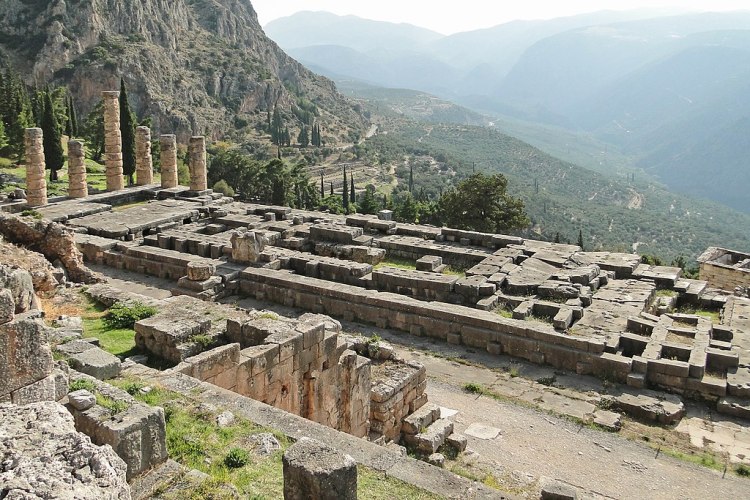
1024px-Temple_of_Apollo_in_Delphi_01

The Temple of Apollo at Delphi, Greece,
over the cavern of the Oracle of Delphi.
Photo from wikimedia, taken by Bernard Gagnon. 

Again, at the (a) Oracle of Delphi, the (b) oracle gave (c) oracles.

American Heritage dictionary defines oracle as —

  1. A shrine consecrated to the worship and consultation of a prophetic deity, as that of Apollo at Delphi.
  2. A person, such as a priestess, through whom a deity is held to respond when consulted.
  3. The response given through such a medium, often in the form of an enigmatic statement or allegory.
    American Heritage® Dictionary of the English Language, Fifth Edition. Copyright © 2016 by Houghton Mifflin Harcourt Publishing Company. Published by Houghton Mifflin Harcourt Publishing Company. All rights reserved.

So the English word “oracle” is obviously a heavy, heavy word, laden with the volcanic fumes of pagan history. It came from the Latin word ‘orare’, to speak, and is related to the English word orator, a public speaker. But oracle came to mean much more than just to speak.

The Greek word translated as oracle is “logion.” Bible students will recognize that logion is related to logos – word.

John 1:1
In the beginning was the Word
[logos], and the Word [logos] was with God, and the Word [logos] was God.

Logion occurs 4 times in the Greek New Testament, including Romans 3:2.

Rom 3:1-2 World English Bible
1)Then what advantage does the Jew have? Or what is the profit of circumcision?
2)Much in every way! Because first of all, they were entrusted with the revelations of God.

Rom 3:1-2 King James Version
1) What advantage then hath the Jew? or what profit is there of circumcision?
2) Much every way: chiefly, because that unto them were committed the oracles of God.

How powerful that English word “oracle” seems in the KJV! For example, Mormons say that oracles includes messages received by their founder Joseph Smith.

“Section 90 of the Doctrine and Covenants was a revelation given specifically to Joseph Smith, that begins—

…through you shall the oracles be given to another, yea, even unto the church. And all they who receive the oracles of God, let them beware how they hold them lest they are accounted as a light thing, and are brought under condemnation thereby…

Through the Prophet the oracles or statements of the Lord were to be given to another, yea, even unto the church. In other words, we receive the word of God through the prophets…”
https://askgramps.org/can-you-explain-the-oracles-of-god

So Mormons believe that oracles of God are messages that they receive from God.

A web site from Brigham Young University Idaho (a Mormon school) says:
Brother Brigham took the stand, and he took the Bible, and laid it down; he took the Book of Mormon, and laid it down; and he took the Book of Doctrine and Covenants, and laid it down before him, and he said: “There is the written word of God to us, concerning the work of God from the beginning of the world, almost, to our day.” “And now,” said he, “when compared with the living oracles those books are nothing to me; those books do not convey the word of God direct to us now, as do the words of a Prophet or a man bearing the Holy Priesthood in our day and generation. I would rather have the living oracles than all the [p.23]writing in the books.” That was the course he pursued. When he was through, Brother Joseph said to the congregation: “Brother Brigham has told you the word of the Lord, and he has told you the truth.”  (Conference Report, October 1897, p.22).
http://emp.byui.edu/satterfieldb/quotes/Modern%20Prophet%20More%20important%20the%20Scripture.html

So the Mormons viewed the living oracles, words of their current “prophets,” as worth more than the Bible. Those were extra-ordinary oracles!

The Revised English Version (REV) in its translation of the Greek word logion does not use “oracles.”

Rom 3:2
2) Much in every way. First of all, because they were entrusted with the words of God.

REV commentary on that verse:
“words.” The Greek word is logion (#3051 λγιον; pronounced log’-ee-on), and it is the diminutive of logos, “word” or “message.” Literally, it is “little words.” See commentary on Acts 7:38.

In Acts 7:38 they again translate ‘logion’ as words.

Acts 7:38
38)
[Stephen speaking] This is he who was with the assembly in the desert with the angel who spoke to him on Mount Sinai, and with our fathers, who received living words to give to us,

So in Stephen’s speech, logion refers to the Ten Commandments that God spoke on Mount Sinai.

Their commentary on that verse says:
“words.” The Greek word is logion (#3051 λγιον; pronounced log’-ee-on), and it is the diminutive of logos, “word” or “message.” Literally, it is “little words.” We can see why the Bible uses the word logion for communications from God, because the Greeks used logion for the divine utterances of the oracles, particularly the Oracle of Delphi. The reason for that was that the messages from the oracles were typically short. Thus in time, logion was used of the communications that come from the gods. We felt the translation “oracle” was too obscure for our English translation, although it occurs in many English Bibles, because the English word “oracle” has many meanings that do not apply. We went with “words” because it accurately represents that it is the words coming from God, and whereas the “word” of God means His entire communication, “words” of God can refer to smaller pieces of His revelation. The word occurs 4 times in the New Testament: Acts 7:38; Romans 3:2; Hebrews 5:12, and 1 Peter 4:11.”

So the Revised English translation uses “words” instead of “oracles” because the English word “oracle” has many meanings that do not apply. Oracles is taken to mean much more than just “words,” as the Mormons and Brigham Young do.

And the English word “oracles” is even applied to the Jewish calendar!

Some say that these “oracles of God” entrusted to the Jews in Romans 3:2 include the Pharisee-Jewish calendar.

A reminder here that what is commonly called the Jewish calendar is the Pharisee-Jewish calendar. After the fall of the Temple, the Pharisees created the Jewish calendar, so the Jewish calendar is the Pharisee calendar. And some say that those “oracles” mentioned by Paul are the God inspired Bible and the God inspired Pharisee-Jewish calendar.

How powerful that English word “oracles” is! The Pharisee calculated calendar is just as inspired as the Bible, because it’s part of the oracles of God.

However, when an English translation uses “words” instead of “oracles” for logion, that gives quite a different impression of Romans 3:2. In the Revised English Version just cited, the Jews were “entrusted with the words of God.” Obviously the phrase “words of God” does not seem to include the most complex calendar in human history.

But —

Early English translations did not render ‘logion’ as ‘oracles.’

Wycliffe Bible (1395 CE)
Rom 3:1) What then is more to a Jew, or what profit of circumcision?
2) Much by all wise [Much by all manner]; first, for the speakings of God were betaken to them.

Tyndale Bible (1534 CE)
Rom 3:2) Surely very moche. Fyrst vnto them was committed the worde of God.

Coverdale BIBLE (1535)
Rom 3:2) Surely very moch. First Vnto them was commytted what God spake.

Great Bible (1539 CE)
Rom 3:2) Surely verye moch. Fyrst because that vnto them were commytted the wordes of God.

The earliest English translations used speakings of God, word of God, what God spoke, or words of God, reflecting logion’s relation to logos. The Septuagint Greek translation of the Old Testament also used logion to mean passages of scripture, that is, the word of God.

However, the Geneva Bible did use “oracles.”

Geneva Bible (1560 CE)
Rom 3:2) Much euery maner of way: for chiefly, because vnto them were of credite committed the oracles of God.

The Geneva translators were English Protestants who had fled to Geneva, Switzerland, during the reign of Bloody Mary. She was the English queen who tried to turn England back to Catholicism and burned several hundred Protestants at the stake. The Geneva Bible also included “church” instead of “congregation” and “pastors” instead of “shepherds”, along with “oracles” instead of “words.” The Geneva English Protestants rejected the authority of the Roman Church and to some degree the Church of England, yet they tended to establish their own strong church authority, and their translation reflected that.

However, a few years after the Geneva Bible appeared, the Bishops Bible returned to the earlier English translation of “logion.”

Bishops Bible (1568)
Rom 3:2) Much euery way. First, for because yt vnto them were committed ye wordes of God.

A half century later the King James translators went back to the Geneva inclusion of “oracles.”

King James Version (1611)
Rom 3:2  Much every way: chiefly, because that unto them were committed the oracles of God

The King James Bible had the backing of —

King James. He was the head of the Church of England and his churches better have his Bible! So over time the King James Bible became the English Bible version, even to this day, even with dozens of other translations available. Therefore when other English translations came along later, most dared not vary from the King James in certain well known verses, so most of them kept the word “oracles.” In modern times this has changed somewhat, and a number of translations avoid the word “oracles,” following more closely the practice of the early English Bible translators.

All this focus on the English word “oracles,” when many English translations don’t even use that word, anyway!

Why is the Pharisee-Jewish calendar said by some to be part of the “oracles” of God?

Simply because the Pharisee-Jewish calculated calendar is not in the Bible.

As we quoted before from the Sanhedrin website:
Our current calendar will exceed halachically [Jewish law] acceptable limits and we will be celebrating Biblically commanded holidays at times other than when Scripture requires them to be celebrated. One could argue that, if a change is necessary in any event, it would be most correct according to Biblical and Jewish Law to once again use the system of witnesses. But it is certain that we will not longer be permitted to use the mathematical calendar of Hillel II in the near future.”

The Bible is inspired by God, but the Pharisee calculated calendar is not in the inspired Bible. Therefore the Pharisee Feast days must also be declared to be divinely inspired — as the “oracles of God.” As the Bible is inspired by God, so the teachings of the Pharisees on the Feasts are said to be inspired, in the same way that the Pharisees-Judaism say that the Talmud is holy writ.

The Pharisee calculated holy days are different than the days God sets by observation. But the Bible does not teach that method, so for those days to be holy, their calendar has to be declared holy. That’s how the Pharisee calendar becomes part of the “oracles of God,” going back to the King James wording.

So does Romans 3:2 mean that the non-Biblical Pharisee-Jewish calendar is inspired by God, in the same way that the Bible is inspired by God?

If it is, that brings up some serious questions.

  • If the Pharisee calendar teachings are inspired, are their other teachings also inspired by God? Could they be divinely inspired at one time and just whitewashed hypocrites the rest of the time?
  • If the Sanhedrin meeting in 358 CE sanctified the Pharisee calculated calendar, did the Sanhedrin meeting in 30 CE sanctify the decision to kill the Messiah? Satan entered into Judas, then Judas sold out Yeshua to the Pharisees and the other Jewish leaders, leading to Yeshua’s capture and death. Were those actions, including the Sanhedrin meetings, inspired by God or by Satan?
  • If the Pharisee calculated calendar is an extra-Biblical divine work, how many other extra-Biblical divine works are there? If we admit to one, logically we have to investigate all other claims of divine inspiration. How about the Book of Mormon, which also lays claim to the “oracles of God?” And the Koran, and the writings of Ellen G. White, and Nostradamus, and an almost endless list of appellates to the claim of divine inspiration? If the Pharisees were inspired by God, surely some of these others must be.
  • Some teach that the current Pharisee-Jewish calculated calendar goes all the way back to Moses. How can this be so, when the Pharisees-Judaism themselves say that is not so and plan to soon change back to the original Feast days? The Pharisee calculated calendar was created from the third century through the twelfth century, when it was codified by Maimonides, codified to prevent any more additions. That means that for century after century it was being changed and Moses was nowhere around. To say that the “divinely inspired” Pharisee-Jewish calculated calendar goes back to Moses is to ignore what the “divinely inspired” Pharisees say about their own calendar.
  • How can you maintain that the Pharisee calendar is inspired when they themselves say it is wrong? Either the Pharisees were wrong in creating their calendar, or they are now wrong in saying their calendar is wrong. This means that the Pharisees cannot be divinely inspired by God, because one way or another, they’re wrong.
  • Since the ‘Pharisee inspired calendar’ contradicts the Bible, as the Pharisees themselves admit, does that mean that the Bible itself is not inspired? If something is inspired by God and contradicts the Bible, that has to mean that the Bible is not inspired. On the other hand, if the Bible is inspired, and teaches setting Feast days by observation instead of calculation, then the Pharisee calculated calendar cannot be inspired. Two inspired works cannot contradict each other. Which should we choose, the word of God or the rules of the Pharisees?
  • And as we have brought out before, why would God divinely inspire the biggest enemies of the Messiah, who to this day reject and revile Him? God does not give truth to people who reject Him. So wouldn’t their inspiration for their calculated Feast days be coming from another source?

Or maybe the phrase “oracles of God” is just a lousy translation, and “logion” means the words of God, the Hebrew scriptures, as it was in early English translations, many modern translations, and in the Septuagint Greek translation of the Old Testament.

In sum, does the word “oracles” in Romans 3:2, King James translation, mean that the Pharisee-Jewish calendar is inspired, as the Bible is inspired?

Guess what?

All this word study about oracles and logion is absolutely irrelevant to this question.

Why?

Because when Paul wrote Romans, the Pharisee-Jewish calculated calendar did not even exist! And as you undoubtedly have noticed in his writings, Paul, like Yeshua, was not a fan of the Pharisees, anyway.

As the Pharisees themselves attest, they did not change to their calculated Feast days until centuries after the Temple had fallen. Paul wrote when the Temple was still standing, and the Feasts were still set by observation. Therefore “oracles” could not possibly have meant the current Jewish calculated calendar. If “oracles” did mean the Jewish calendar, then it was the one that the Bible taught, the one that was used when Paul attended Feasts at the Temple, and the one that the Jews of today intend to return to.

Since the Pharisee-Jewish calculated calendar did not exist when Paul wrote, he absolutely did not refer to it when he wrote of the oracles words of God.

Chapter 74 – The Pharisees, Moses’ Seat and the Hot Seat

The End Time Church: From the Cathedrals to the Catacombs

By Dan L. White

Copyright 2020 by Dan L. White, all rights reserved.

Scripture quotations are from the World English Bible (WEB) which is in the public domain.

Chapter 74

The Pharisees, Moses’ Seat and the Hot Seat

What does it mean to sit on Moses’ seat?

Matt 23 World English Bible
1) Then Yeshua spoke to the multitudes and to his disciples,
2) saying, “The scribes and the Pharisees sat on Moses’ seat.

Young’s Literal Translation and the Literal Translation of the Holy Bible also say “sat;” King James says “sit in Moses seat.”

Most Christian/Messianic Feast keepers believe that God gave the Pharisees authority to change the Feasts.

They believe that God approves the Pharisees replacing what He said in the Bible with what they said out of the Bible. And this is one of the linchpins of their logic —

The Pharisees sit on Moses’ seat!

Just as the Pharisees hold that the Talmud and Mishnah are divinely inspired, these Christians say that the Pharisee calendar is divinely inspired. You can’t question the Pharisee calendar because God inspired it through those guys.

After all, they sit on Moses’ seat!

To sit on Moses’ seat does sound impressive. But if that statement gives the Pharisees authority to change God’s laws, then why did Yeshua go on to say this?

Matt 23
3) All things therefore whatever they tell you to observe, observe and do, but don’t do their works; for they say, and don’t do.

So when the Pharisees sat on Moses’ seat, they said something, but did not do what they said.

What is it that the Pharisees don’t do?

John 7
19) Didn’t Moses give you the law, and yet none of you keeps the law? Why do you seek to kill me?”

The Pharisees don’t keep the law. The law was what they said but did not do.

Stephen affirmed that.

Acts 7
51) “You stiff-necked and uncircumcised in heart and ears, you always resist the Holy Spirit! As your fathers did, so you do.
52) Which of the prophets didn’t your fathers persecute? They killed those who foretold the coming of the Righteous One, of whom you have now become betrayers and murderers.
53) You received the law as it was ordained by angels, and didn’t keep it!”

The Pharisees and the Jews received the law but did not keep it. They said it but did not do it.

What they did do was to kill Yeshua and Stephen. Which brings up a critical question.

Why would God use people to set His Feasts who killed His prophets, killed His Christians, and killed His only begotten Son? The Pharisees and Jews delivered Yeshua to Rome to be executed. Both Jews and Gentiles are guilty of the greatest crime in the history of the world — committed at a Feast time.

Does it seem sensible that God the Father would use people who helped kill His only begotten Son — at a Feast time! — to set His Feasts? Does that seem sensible?

No. It doesn’t seem plausible that God would use Rome as headquarters for His people, and it does not seem sensible that God would use the Pharisees, of all people, to set His holy days.

But what about Moses’ seat?

After Yeshua said that the Pharisees sat on Moses’ seat, then He put them on the hot seat.

Matt 23
4) For they bind heavy burdens that are grievous to be borne, and lay them on men’s shoulders; but they themselves will not lift a finger to help them.
5) But all their works they do to be seen by men. They make their phylacteries broad, enlarge the fringes of their garments,
6) and love the place of honor at feasts, the best seats in the synagogues,
7) the salutations in the marketplaces, and to be called ‘Rabbi, Rabbi’ by men.
8) But don’t you be called ‘Rabbi,’ for one is your teacher, the Christ, and all of you are brothers.

Christ said not to call anyone rabbi. But the Pharisees are thought to have God’s authority only because they are rabbis.

Bit of a conflict there?

If God does not recognize the Pharisees as rabbis, then does He recognize what they do as rabbis?

Ironically, the passage that is most often used to say the Pharisees have divine authority is the New Testament passage that most condemns the Pharisees.

Matt 23 (cont.)
13) “Woe to you, scribes and Pharisees, hypocrites! For you devour widows’ houses, and as a pretense you make long prayers. Therefore you will receive greater condemnation.
14) “But woe to you, scribes and Pharisees, hypocrites! Because you shut up the Kingdom of Heaven against men; for you don’t enter in yourselves, neither do you allow those who are entering in to enter.
15) Woe to you, scribes and Pharisees, hypocrites! For you travel around by sea and land to make one proselyte; and when he becomes one, you make him twice as much of a son of Gehenna as yourselves.

Exactly what did Yeshua say there?

He said that the Pharisees are Gehenna guys.

Would God use guys who are going to Gehenna — the lake of fire reserved for the wicked — to set His holy days? Should those who are most wicked set the most holy?

Matt 23 (cont.)
16) “Woe to you, you blind guides, who say, ‘Whoever swears by the temple, it is nothing; but whoever swears by the gold of the temple, he is obligated.’
17) You blind fools! For which is greater, the gold, or the temple that sanctifies the gold?
18) ‘Whoever swears by the altar, it is nothing; but whoever swears by the gift that is on it, he is obligated?’
19) You blind fools! For which is greater, the gift, or the altar that sanctifies the gift?
20) He therefore who swears by the altar, swears by it, and by everything on it.
21) He who swears by the temple, swears by it, and by him who was living in it.
22) He who swears by heaven, swears by the throne of God, and by him who sits on it.
23) “Woe to you, scribes and Pharisees, hypocrites! For you tithe mint, dill, and cumin, and have left undone the weightier matters of the law: justice, mercy, and faith. But you ought to have done these, and not to have left the other undone.
24) You blind guides, who strain out a gnat, and swallow a camel!

It’s ironic that many Messianics look at Jewish rabbis as having great wisdom, the wisdom of “sages.” Did they not read Christ’s words? “You blind fools! You blind fools! You blind guides!”

Taking Christ at His word — that the Pharisees are blind — should those who are spiritually blind be given the authority to set the most spiritual times? Wouldn’t they also be spiritually blind in how they set their Feasts?

Matt 23 (cont.)
25) “Woe to you, scribes and Pharisees, hypocrites! For you clean the outside of the cup and of the platter, but within they are full of extortion and unrighteousness.
26) You blind Pharisee, first clean the inside of the cup and of the platter, that its outside may become clean also.
27) “Woe to you, scribes and Pharisees, hypocrites! For you are like whitened tombs, which outwardly appear beautiful, but inwardly are full of dead men’s bones, and of all uncleanness.
28) Even so you also outwardly appear righteous to men, but inwardly you are full of hypocrisy and iniquity.

The Pharisees appeared righteous. That is, people thought the Pharisee rabbis were inspired by God, just as people think their calendar is inspired by God. The Pharisees appear righteous.

Matt 23 (cont.)
29) “Woe to you, scribes and Pharisees, hypocrites! For you build the tombs of the prophets, and decorate the tombs of the righteous,
30) and say, ‘If we had lived in the days of our fathers, we wouldn’t have been partakers with them in the blood of the prophets.’
31) Therefore you testify to yourselves that you are children of those who killed the prophets.
32) Fill up, then, the measure of your fathers.
33) You serpents, you offspring of vipers, how will you escape the judgment of Gehenna?

Christ, the judge of all mankind, restates the judgment of the Pharisees — Gehenna. Their religion is the antithesis of what God wants.

Matt 23 (cont.)
34) Therefore, behold, I send to you prophets, wise men, and scribes. Some of them you will kill and crucify; and some of them you will scourge in your synagogues, and persecute from city to city;
35) that on you may come all the righteous blood shed on the earth, from the blood of righteous Abel to the blood of Zachariah son of Barachiah, whom you killed between the sanctuary and the altar.
36) Most certainly I tell you, all these things will come upon this generation.

There are 8 “woes” in Yeshua’s diatribe against the Pharisees/Judaism.

If we say, “Woe is me,” what does that mean?

It means I’m in big trouble.

The Greek word “ouai” that is translated as “woe” means about the same as the English word. It means somebody’s in big trouble.

Chorazin and Bethsaida were in big trouble.

Matt 11
20) Then he began to denounce the cities in which most of his mighty works had been done, because they didn’t repent.
21) “Woe to you, Chorazin! Woe to you, Bethsaida! For if the mighty works had been done in Tyre and Sidon which were done in you, they would have repented long ago in sackcloth and ashes.
22) But I tell you, it will be more tolerable for Tyre and Sidon on the day of judgment than for you.

Judas was also in big trouble.

Mark 14
21) For the Son of Man goes, even as it is written about him, but woe to that man by whom the Son of Man is betrayed! It would be better for that man if he had not been born.”

When Christ pronounced a woe on somebody, like Chorazin, Bethsaida or Judas, they were in big trouble.

And when Christ pronounced a woe eight times on the Pharisees/Judaism, do you know what that means?

They were in big, big, big, big, big, big, big, big trouble!

Now does that sound like God was going to use those people — 300 years later — to change His Feast days?

Probably not.

Okay, so what did Yeshua mean when He said that the Pharisees sat on Moses’ seat?

What was Moses’ seat?

We just read about the woe on Chorazin, and Chorazin had Moses’ seat.

Or one of them, anyway.

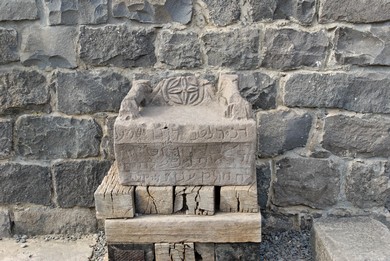
Chorazin refers to a town not far from the Sea of Galilee, and the ruins of a third or fourth century synagogue are still there. Moses’ seat was found in that old synagogue.

The Jerusalem Post, November 26, 2012.

“The archaeologist’s spade at Chorazin has unearthed numerous houses near the synagogue and a ritual bath adjoining a sizable oval cistern. In the 1920s, excavators found a decorated stone seat, referred to as, “the Seat of Moses,” which served as the place where an authoritative teacher would sit in the synagogue to read the Torah. The Israel Museum in Jerusalem houses the original seat today, but a replica sits beside the synagogue’s doorway in Chorazin.”
https://www.jpost.com/Travel/Around-Israel/Sites-and-Insights-Capernaum-with-a-view

Moses' Seat

A replica of Moses’ seat, where Moses’ law was read, in the synagogue ruins at Chorazin.

The original is in the Israel Museum in Jerusalem.
Image from https://www.seetheholyland.net

Other ruins of ancient synagogues also have Moses’ seat. That’s the way it was done. The rabbi who read the law of Moses sat in Moses’ seat.

So what did Yeshua mean when He said, “The scribes and the Pharisees sat on Moses’ seat?”

In the synagogues, which the Pharisees ran, when they read the law of Moses, they sat on Moses’ seat, the place where the law was read.

Matt 23
3) All things therefore whatever they tell you to observe, observe and do, but don’t do their works; for they say, and don’t do.

When the Pharisees sat on Moses’ seat, they said something, but did not do what they said — “they say, and don’t do.” That is, they read the law, but did not keep the law. They read the law, and Christ said to observe and do that. But their works, don’t do.

Their rules about the Sabbath, don’t do.

Their rules about handwashing and washing of pots, don’t do.

And the Feast days that they set, which are different than the days that God sets, which came centuries after the Son of God walked the earth — their feast days are their works, too. “Don’t do their works.”

Mark 7
7) But in vain do they worship me, teaching as doctrines the commandments of men.’
8) “For you set aside the commandment of God, and hold tightly to the tradition of men—the washing of pitchers and cups, and you do many other such things.”
9) He said to them, “Full well do you reject the commandment of God, that you may keep your tradition.

13) …making void the word of God by your tradition, which you have handed down. You do many things like this.”

That’s exactly what the Pharisees did with the Feast days.

Calculating the Feast days, instead of going by God’s signs that He set in the heavens from Genesis, is only part of the many such things that the Pharisees/Judaism do. In changing the Feast days, they set aside the commandment of God from creation and substituted the traditions created by the rabbis.

Excuse me — I’m not supposed to call them rabbis.

Christ said that the Pharisees sat on Moses’ seat. They read the law from the law reading bench in the front of the synagogues, which was called Moses’ seat, where the law of Moses was read.

Christ also said that the Pharisees are on the hot seat — going to Gehenna. The Feasts will be observed in the Kingdom of God. The Pharisees will not be in the Kingdom of God. Who then, will set God’s Feasts in God’s Kingdom, if the Gehenna guys won’t be there?

Yahweh God Almighty.

Just as He sets them today.

Matthew 23 does not say that God gave authority to the Pharisees to change His Feasts. It does say that the Pharisees are sons of Gehenna. Sons of Gehenna are not given authority from God. They do not set God’s Feasts.

Chapter 73 – Fencing in the Feasts

The End Time Church: From the Cathedrals to the Catacombs

By Dan L. White

Copyright 2020 by Dan L. White, all rights reserved.

Scripture quotations are from the World English Bible (WEB) which is in the public domain.

Chapter 73

Fencing in the Feasts

In 1944, the number one song in America was “Don’t Fence Me In.”

Everyone remembers that big hit, right? Before the Beatles and “Hard Days Night” and before Elvis and “Blue Suede Shoes,” there was Gene Autry and “Don’t Fence Me In.”

That western song had these lyrics.

Oh give me land, lots of land, under starry skies above
Don’t fence me in
Let me ride through the wide open country that I love
Don’t fence me in

By contrast, the Pharisees could have had a song like this.

We’ll Fence It In
Oh give me foods, lots of foods, to set our kosher rules,
We’ll fence
them in.
Give me clothes, hems and fringes, arms and meninges,
We’ll fence them in.
Give me Sabbath, a rest day for spiritual blessing,
We’ll add so many rules that we make it a cursing,
And if there’s anything else
, then we’re still working,
We’ll fence it in.

That Pharisee song was never number one, but has had much more influence than the Gene Autry song.

1906 Jewish Encyclopedia, “Pharisees”
The Pharisees “added new restrictions to the Biblical law in order to keep the people at a safe distance from forbidden ground; as they termed it, “they made a fence around the Law,”

The Pharisees were socialist/communist types. They did not rely on spiritual control but on government control, and they thought they were the religious government. So the Pharisees fenced everything. Sabbaths, foods, clothing – they set rules for everything.

Wikipedia, “Pharisees,” 12/28/19
Jewish law prohibits Jews from carrying objects from a private domain (“reshut ha-yachid”) to a public domain (“reshut ha-rabim”) on Sabbath. This law could have prevented Jews from carrying cooked dishes to the homes of friends for Sabbath meals. The Pharisees ruled that adjacent houses connected by lintels or fences could become connected by a legal procedure creating a partnership among homeowners; thereby, clarifying the status of those common areas as a private domain relative to the members of the partnership. In that manner people could carry objects from building to building.

How about that? The Pharisees made rules, then they made rules to get around their rules.

Whose rules?

Their rules.

Now here is a critical question.

If the Pharisees set rules for Sabbaths, foods, clothing, washing hands and platters, etc., etc., etc. –

Wouldn’t they also set rules for the Feasts?

Can a fish swim? Is the pope a Catholic? Yes! They were absolutely going to set rules for the Feasts, as they did for everything else. That’s what they do. They fence you in.

First of all, most of their Sabbath rules also apply to their Feast high days. So accepting their high days logically means accepting their Sabbath fences for their high days.

But what are the Pharisee Feast days?

The Pharisee Feast days are the days set by the Pharisees in their calendar. Again, when the Temple fell, the Pharisees with their synagogues became Judaism. So the “Jewish calendar” is the Pharisee calendar.

How did the Pharisee calendar come about?

1906 Jewish Encyclopedia, “Pharisees”
The history of the Jewish calendar may be divided into three periods—the Biblical, the Talmudic, and the post-Talmudic. The first rested purely on the observation of the sun and the moon, the second on observation and reckoning, the third entirely on reckoning.

The three periods of the Jewish calendar were:

  1. Biblical — following Bible instructions during Temple times. The months were set by the visible new moon, testified by witnesses, whoever and wherever they were in the Holy Land.

Once the Temple fell, the Feasts were still set by the Creator’s timing, not by rabbi calculations.

Jewish Encyclopedia (cont.)
After the destruction of the Temple (70 C.E.) Joanan ben Zakkai removed the Sanhedrin to Jabneh. To this body he transferred decisions concerning the calendar, which had previously belonged to the patriarch. After this the witnesses of the new moon came direct to the Sanhedrin.

As said before, the Sanhedrin did not set the Feasts. They only accepted what God had set in His creation.

  1. Talmudic period

Jewish Encyclopedia (cont.)
Under the patriarchate of Rabbi Judah I., surnamed “the Holy” (163-193), the Samaritans, in order to confuse the Jews, set up fire-signals at improper times [fires on hilltops were used to signal a new moon], and thus caused the Jews to fall into error with regard to the day of the new moon. Rabbi Judah accordingly abolished the fire-signals and employed messengers. The inhabitants of countries who could not be reached by messengers before the feast were accordingly in doubt, and used to celebrate two days of the holidays. By this time the fixing of the new moon according to the testimony of witnesses seems to have lost its importance, and astronomical calculations were in the main relied upon.

The Talmudic period was after the Temple had fallen but before the calculated Pharisee/Jewish calendar. The Talmud, a written record of the oral law of the rabbis, was compiled during this time. The Talmud shrank the Bible’s importance, because the oral law is viewed as being equally inspired. At this time the Jews also shrank the importance of Bible instructions about the Feasts, with a gradual replacing of Bible instructions for setting the Feasts in favor of their calculated method. As the Jewish Encyclopedia said, “fixing of the new moon according to the testimony of witnesses seems to have lost its importance.”

We have to appreciate the arrogance of those who add to the Bible. The Pharisee rabbis said that what the rabbis said was just as inspired as the Bible. To whatever degree, that’s like a rabbi saying, “Hey, I’m God and my words are inspired!”

As study of the Pharisees’ Talmud replaced much of their Bible study, so calculations of Feasts were put in place of Bible instruction — at about the same time!

Jewish Encyclopedia (cont.)
One of the important figures in the history of the calendar was Samuel (born about 165, died about 250), surnamed “Yarhinai” because of his familiarity with the moon. He was an astronomer, and it was said that he knew the courses of the heavens as well as the streets of his city (Ber. 58b). He was director of a school in Nehardea (Babylonia), and while there arranged a calendar of the feasts in order that his fellow-countrymen might be independent of Judea. He also calculated the calendar for sixty years. His calculations greatly influenced the subsequent calendar of Hillel.

Calculated the calendar for sixty years — How comfortably convenient! No more watching and waiting on God.

Jewish Encyclopedia (cont.)
Under the patriarchate of Rabbi Judah III. (300-330) the testimony of the witnesses with regard to the appearance of the new moon was received as a mere formality, the settlement of the day depending entirely on calculation. This innovation seems to have been viewed with disfavor by some members of the Sanhedrin, particularly Rabbi Jose, who wrote to both the Babylonian and the Alexandrian communities, advising them to follow the customs of their fathers and continue to celebrate two days, an advice which was followed, and is still followed, by the majority of Jews living outside of Palestine.

Remember that Yeshua said, “Beware of the leaven of the Pharisees, which is hypocrisy,” Luke 12:1, English Standard Version.

Hypocrisy. After Rome was ruled by Caesar dictators, they still kept the Senate. They looked like the old republic, but were a totalitarian government. And the Pharisees still accepted witnesses of the new moon, but then ignored what they said. In other words, they ignored what God had set, in favor of what the Pharisees themselves had set. Yet for a while, they went through with that charade.

But only for a while.

  1. Calculated period, to the present time.

Jews had said they had no king but Caesar, yet they kept rebelling against their king. Predictably, the Caesars didn’t like that. So the Jews fought Rome in the Great Revolt of 66-70 CE, the Bar Kochba rebellion in 132-135, and other smaller insurrections. This led Rome to detest Jews. Remember that Emperor Constantine opposed the Sabbath and Feasts because he wanted to “have nothing in common with the detestable Jewish crowd,” as Eusebius recorded. Consequently another Jewish revolt against Rome, this time in Galilee in 351, led to Rome preventing the announcing of the festival times by the rabbis.

That was the straw that broke the calendar’s back.

Jewish Encyclopedia (cont.)
Under the reign of Constantius (337-361) [son of Constantine] the persecutions of the Jews reached such a height that all religious exercises, including the computation of the calendar, were forbidden under pain of severe punishment.

So the Pharisees were forbidden from publicly announcing their Feast days. They had already given up going by what God set in favor of what they set by their calculations. Because of the Roman opposition, they then took the next step. Instead of announcing the Feast days they had calculated, they simply made public their calculations for setting their Feast days.

Jewish Encyclopedia (cont.)
This unselfish promulgation of the calendar, though it destroyed the hold of the patriarchs on the scattered Judeans, fixed the celebration of the Jewish feasts upon the same day everywhere. Later Jewish writers agree that the calendar was fixed by Hillel II. in the year 670 of the Seleucidan era; that is, 4119 A.M. or 359 C.E. Some, however, as Isaac Israeli, have fixed the date as late as 500. Saadia afterward formulated calendar rules, after having disputed the correctness of the calendar established by the Karaites.

This calendar method and the resulting Feast days were not exactly the same as the Jewish Pharisee calendar today.

Jewish Encyclopedia (cont.)
While it is not unreasonable to attribute to Hillel II the fixing of the regular order of intercalations, his full share in the present fixed calendar is doubtful.

Wikipedia, “Hebrew Calendar”
“The principles and rules were fully codified by Maimonides in the Mishneh Torah in the 12th century.”

The Pharisee/Jewish calendar was not some inspired revelation that God dropped down from Mt. Sinai. It was gradually developed over centuries, not by God but by the Pharisees. After all, the Pharisees were inevitably going to add to it, to fence it in. These fences included the multiple postponements of the days they themselves calculated, added to fence in the high days.

Of course, Yahweh God Himself forgot to put all those rules in the Bible, so the Pharisees had to help Him out with that.

The Jewish Encyclopedia says that the “unselfish promulgation of the calendar, though it destroyed the hold of the patriarchs on the scattered Judeans, fixed the celebration of the Jewish feasts upon the same day everywhere.” In reality, the Pharisee/Jewish calculated calendar did not destroy the hold of the patriarchs. In fact, the Pharisees put most Feast keepers under their control, even to the present day, by keeping the Feast days that the Pharisees set, instead of the Feast days that God sets.

Calculation is not just a different way of coming up with the same Feast days. Calculation is a different way of coming up with different Feast days.

And those different days are the days the Pharisees set.

You recall how Jeroboam changed the Feast of the seventh month to the eighth month?

In reality the Pharisees, with their complicated, convenient, calculated calendar, did the same thing. They Jerebombed the Feasts. They changed them.

When the Christian Church lost the weekly Sabbath, the process was gradual. First, Christians kept the Sabbath. Next, Christians kept the Sabbath and Sunday, the day that pagan society honored. Finally, Romish Christians kept Sunday and outlawed the Sabbath.

The changing of the Feasts went through a similar process, as you may have noticed. First, they were set by God’s creation, by observing the visible new moon. Next, they were set by calculation, but still receiving new moon witnesses. Finally, they were set only by calculation.

This process is like the shell game. A pea is placed under one of three walnut shells, all three shells are quickly shuffled around, until you just lose sight of where that little pea was. That’s what happened with the Sabbath in the Christian churches and the Feasts among the Jews.

However —

Flash forward sixteen centuries from Hillel II in 358 to 1948. The Jews again became a nation, in the Holy Land. Nineteen years later they regained the Temple Mount. And then the Pharisee Jewish calendar had a problem.

They could see it was wrong.

Any individual in Israel could see the monthly new moon, and realize that the Pharisee Jewish calendar calculated new moon was not the chodesh at all. Even the Pharisees could see that!

The Karaites, who disagreed with the Pharisee calculated Feast days, could see it, too, and they went back to the Bible calendar used at the Temple.

McGill, Karaite Interpretation
Karaites use the lunar month and the solar year, but determine when to add a leap month by observing the ripening of barley (called abib) in Israel, rather than the calculated and fixed calendar of Rabbinic Judaism. This puts them in sync with the Written Torah, while other Jews are often a month later. (For several centuries, many Karaites, especially outside Israel, have just followed the calculated dates of the Oral Law (the Mishnah and the Talmud) with other Jews for the sake of simplicity. However, in recent years most Karaites have chosen to again follow the Written Torah practice.)
https://www.cs.mcgill.ca/~rwest/wikispeedia/wpcd/wp/h/Hebrew_calendar.htm

The Jews — the Pharisees — are working hard toward building a third Temple. They have established a new Sanhedrin. This is what the new Sanhedrin, who are all Pharisee Jews, says about the Pharisee/Jewish calendar.

From the Sanhedrin website:
“The Jewish Calendar has a discrepancy of about one day every century. This means that by the year 6000, Pesach [Passover] will come out two new moons (Sivan) after the first day of spring.” [Sivan is the 3rd month of the biblical year.] http://www.thesanhedrin.org/en/index.php/Committee_concerning_the_fixing_of_the_Calendar

That is, in a couple of centuries the Pharisee Jewish calendar will be so askew that Passover will be about Pentecost time.

“Our current calendar will exceed halachically acceptable limits and we will be celebrating Biblically commanded holidays at times other than when Scripture requires them to be celebrated. One could argue that, if a change is necessary in any event, it would be most correct according to Biblical and Jewish Law to once again use the system of witnesses. But it is certain that we will not longer be permitted to use the mathematical calendar of Hillel II in the near future.” (Ibid)

What does this mean?

The Pharisees have created the most complex calendar known to man — and it’s still wrong.

And they, with their plans for a third Temple, want to change the Feast days back to the original days. As the Sanhedrin says, “But it is certain that we will not longer be permitted to use the mathematical calendar of Hillel II in the near future.”

Their new Sanhedrin has the presumed authority to change back the Sanhedrin’s Feast day changes of 358, as they presumed it had the authority to change God’s Feasts back in 358.

New World Encyclopedia, “Sanhedrin”
Since the Jewish Calendar was based on witnesses’ testimony, which was too dangerous to collect during these Roman times, Hillel II recommended a mathematical Calendar that was adopted at a clandestine, and maybe last, meeting in 358 C.E. This marked the last universal decision made by that body...

In October 2004 (Hebrew Calendar=Tishrei 5765), a group of rabbis claiming to represent varied communities in Israel undertook a ceremony in Tiberias, where the original Sanhedrin was disbanded, which they claim re-establishes the body according to the proposal of Maimonides and the Jewish legal rulings of Rabbi Yosef Karo. The controversial attempt has been subject to debate within different Jewish communities.

So the Feasts were originally set by the new moon.

The Pharisees changed that to Feasts set only by their calculations. Now they themselves admit that their calculations miss the new moon.

This makes for a clear choice. Go by what God said or go by what the Pharisees said. Which authority should we bow to?

Even the Pharisees say their Feast days are wrong. So why do people follow what is admittedly wrong?

Because the Pharisees, and those who follow the Pharisees, say they are not wrong even if they are wrong. Even if their Feast days differ from those God set with the new moons, the Pharisees are said to have the authority to change those days.

We previously mentioned a church leader who kept Pentecost on Monday, then changed it to Sunday. But he maintained that he was not wrong when he and his church kept it on Monday, because he had the authority of Peter, and whatever he said was right, even if it was wrong. In effect, he said he had the authority to change the Feast days. The Pharisees certainly do not claim the authority of Peter, but they do claim authority as God’s rabbis, and some say that authority makes their Feast days right, even if they’re wrong.

Did the Pharisees have authority from God to change God’s Feast days? Do they have the authority to change them back? Do we have to wait on the Pharisees’ Sanhedrin to return to God’s Feast days?


Chapter 72: Waiting on God

The End Time Church: From the Cathedrals to the Catacombs

By Dan L. White

Copyright 2020 by Dan L. White, all rights reserved.

Scripture quotations are from the World English Bible (WEB) which is in the public domain.

Chapter 72

Waiting on God

Why do Christian preachers like to set the date of Christ’s return?

One of the most famous is William Miller. For twelve years he preached that Christ would return on a day in 1843. When that day passed, he then corrected the error of not allowing for a year zero in the Roman calendar, and changed his date to 1844. When that day passed, Miller then said he was just wrong. Others said he wasn’t wrong, and they became the Seventh Day Adventist Church.

Repeatedly during the last two millennia, people have tried to set the time of Christ’s return, even though He himself said —

Matt 24
36) But no one knows of that day and hour, not even the angels of heaven, but my Father only.

People really, really want to know the time of Christ’s return, but God doesn’t tell us that date. Even Yeshua Himself did not know it. Like it or not, we have to wait on the Father to show us that much anticipated special time.

Christians often don’t like waiting on God. Israel probably didn’t like it, either.

After Israel had finished building the Tabernacle, and Moses had placed all the furniture in it —

Exod 40
34) Then the cloud covered the Tent of Meeting, and the glory of Yahweh filled the tabernacle.
35) Moses wasn’t able to enter into the Tent of Meeting, because the cloud stayed on it, and Yahweh’s glory filled the tabernacle.
36) When the cloud was taken up from over the tabernacle, the children of Israel went onward, throughout all their journeys;
37) but if the cloud wasn’t taken up, then they didn’t travel until the day that it was taken up.
38) For the cloud of Yahweh was on the tabernacle by day, and there was fire in the cloud by night, in the sight of all the house of Israel, throughout all their journeys.

So from the time that the Tabernacle was first set up, Israel no longer needed Google maps. They couldn’t plan their trip itinerary ahead of time, either. They didn’t know exactly where they were going, and they didn’t know when they were going.

Num 9
15) On the day that the tabernacle was raised up, the cloud covered the tabernacle, even the Tent of the Testimony: and at evening it was over the tabernacle as it were the appearance of fire, until morning.
16) So it was continually. The cloud covered it, and the appearance of fire by night.
17) Whenever the cloud was taken up from over the Tent, then after that the children of Israel traveled; and in the place where the cloud remained, there the children of Israel encamped.
18) At the commandment of Yahweh, the children of Israel traveled, and at the commandment of Yahweh they encamped. As long as the cloud remained on the tabernacle they remained encamped.
19) When the cloud stayed on the tabernacle many days, then the children of Israel kept Yahweh’s command, and didn’t travel.
20) Sometimes the cloud was a few days on the tabernacle; then according to the commandment of Yahweh they remained encamped, and according to the commandment of Yahweh they traveled.
21) Sometimes the cloud was from evening until morning; and when the cloud was taken up in the morning, they traveled: or by day and by night, when the cloud was taken up, they traveled.
22) Whether it was two days, or a month, or a year that the cloud stayed on the tabernacle, remaining on it, the children of Israel remained encamped, and didn’t travel; but when it was taken up, they traveled.
23) At the commandment of Yahweh they encamped, and at the commandment of Yahweh they traveled. They kept Yahweh’s command, at the commandment of Yahweh by Moses.

So how would that fit with your schedule?

Many people love strict schedules. I have seen where people might say, ‘we will do such and such and then be back home by five o’clock.’ Their whole day was then controlled by the unyielding requirement to be back home by five. That self-imposed schedule became a burden on the day’s activities, hurrying them along with a load of worry, just to meet their schedule. But the five o’clock deadline wasn’t imposed from on high, and had no real significance — it was must made up on the spur of the moment. The world would not end if home was not reached by five o’clock, because nothing was going on at home after five o’clock. People would sacrifice their day to meet that fateful hour, and when they arrived home at the self-appointed time, then they would be satisfied they had kept their schedule, and would promptly sit down at home and do nothing.

Such people would not have done well in the wilderness. Israel didn’t know where they were going, didn’t know when they were going, and didn’t know how long they would be going. At least they didn’t have to worry about being back home at five o’clock.

And oh! the packing.

And unpacking.

Num 10
33) They set forward from the Mount of Yahweh three days’ journey. The ark of the covenant of Yahweh went before them three days’ journey, to seek out a resting place for them.
34) The cloud of Yahweh was over them by day, when they set forward from the camp.
35) It happened, when the ark went forward, that Moses said, “Rise up, Yahweh, and let your enemies be scattered! Let those who hate you flee before you!”
36) When it rested, he said, “Return, Yahweh, to the ten thousands of the thousands of Israel.”

How strange that plan seems to the human mind. Why didn’t God give Israel a detailed itinerary of their trip to the Holy Land?

Because people were not in charge of God’s plan. Therefore Israel had to watch and wait on God. It wasn’t just the route itself that was important. What was most important was Who set the route.

In the same way as Israel having to watch and wait for God to tell them when to go, we have to watch and wait for the return of Christ. We can’t just pen it into our schedules.

Christ gave signs of His return, to show when the time is near. However, Christians have thought they saw those signs in every generation of Christians, including the first flock.

Jas 5
7) Be patient therefore, brothers, until the coming of the Lord. Behold, the farmer waits for the precious fruit of the earth, being patient over it, until it receives the early and late rain.
8) You also be patient. Establish your hearts, for the coming of the Lord is at hand.
9) Don’t grumble, brothers, against one another, so that you won’t be judged. Behold, the judge stands at the door.

Phil 4
4) Rejoice in the Lord always! Again I will say, “Rejoice!”
5) Let your gentleness be known to all men. The Lord is at hand.

1Pet 4
7) But the end of all things is near. Therefore be of sound mind, self-controlled, and sober in prayer.

Rev 22
20) He who testifies these things says, “Yes, I come quickly.” Amen! Yes, come, Lord Yeshua.

So all those examples show that the first flock was expecting the return of the Messiah very quickly.

Christ gave certain signs of the end of the age, but He also said that everyday life would be going on pretty much as normal —

  • as life was before the Flood, until people rolled their eyes when the thunder first rolled;
  • and as life was before Sodom burned, until the Sodomians said, “What’s that smell?”

Luke 17
26) As it happened in the days of Noah, even so will it be also in the days of the Son of Man.
27) They ate, they drank, they married, they were given in marriage, until the day that Noah entered into the ship, and the flood came, and destroyed them all.
28) Likewise, even as it happened in the days of Lot: they ate, they drank, they bought, they sold, they planted, they built;
29) but in the day that Lot went out from Sodom, it rained fire and sulfur from the sky, and destroyed them all.
30) It will be the same way in the day that the Son of Man is revealed.

All those generations of Christians who thought they saw the signs of the end of this age in their time were wrong, but in another sense they were right.

  • Their lives were short, like grass, so they were living in their last days.
  • Watching helped them keep their lamps burning.

Luke 12
35) “Let your waist be dressed and your lamps burning.
36) Be like men watching for their lord, when he returns from the marriage feast; that, when he comes and knocks, they may immediately open to him.
37) Blessed are those servants, whom the lord will find watching when he comes. Most certainly I tell you, that he will dress himself, and make them recline, and will come and serve them.
38) They will be blessed if he comes in the second or third watch, and finds them so.
39) But know this, that if the master of the house had known in what hour the thief was coming, he would have watched, and not allowed his house to be broken into.
40) Therefore be ready also, for the Son of Man is coming in an hour that you don’t expect him.”
41) Peter said to him, “Lord, are you telling this parable to us, or to everybody?”
42) The Lord said, “Who then is the faithful and wise steward, whom his lord will set over his household, to give them their portion of food at the right times?
43) Blessed is that servant whom his lord will find doing so when he comes.
44) Truly I tell you, that he will set him over all that he has.
45) But if that servant says in his heart, ‘My lord delays his coming,’ and begins to beat the menservants and the maidservants, and to eat and drink, and to be drunken,
46) then the lord of that servant will come in a day when he isn’t expecting him, and in an
our that he doesn’t know, and will cut him in two, and place his portion with the unfaithful.
47) That servant, who knew his lord’s will, and didn’t prepare, nor do what he wanted, will be beaten with many stripes,
48) but he who didn’t know, and did things worthy of stripes, will be beaten with few stripes. To whomever much is given, of him will much be required; and to whom much was entrusted, of him more will be asked.

So, Christ said let your waist be dressed and your lamps burning. Watch and wait for Him.

Why do people really, really want to know the time of Christ’s return?

They want to slough off for most of their lives and then, right before the big event, cram for the test. They don’t want to watch every day, but only when it counts most.

It does seem as if it would be quite handy to be able to pencil in Christ’s return on your calendar, even a 2000 year calendar. Why doesn’t the Father tell us more plainly the time of His Son’s return?

Because we have to watch and wait on God.

This is an important principle, hard to fathom in its fullest meaning.

Ps 5
2) Listen to the voice of my cry, my King and my God; for to you do I pray.
3) Yahweh, in the morning you shall hear my voice. In the morning I will lay my requests before you, and will watch expectantly.

To watch expectantly, even in our everyday lives.

Israel in the wilderness had to watch and wait on God, to find out when and where they were going. Christians for two millennia have had to watch and wait on God, for the return of their King.

And in the same way, God set the Feasts so that we have to watch and wait on Him, just to see when they are. We cannot calculate them ahead of time. We have to watch the creation and know by those signs when the Feasts are. It’s very handy to calculate them for a hundred years in advance, or for next year, or next autumn. Ultimately, though, people with their calculations are not in charge of God’s Feasts, any more than William Miller with his complicated prophetic calculations was in charge of Christ’s return. God is in charge of Christ’s return and God is in charge of setting His Feasts.

People cannot use mathematical calculations to predict the time of Christ’s return. God planned it that way. You can’t just calculate the second coming and then forget it. And people cannot use mathematical calculations to set the Feast days. God planned it that way. You can’t just calculate the date and then forget it. Like it or not — and people really don’t like it that way — if we will keep the same Feast days that were kept at the Temple, we must watch and wait on God.

The timing of the Feasts, which look forward to the return of the King, are themselves a lesson of His return. In both cases, we have to watch and wait on God.

This may not seem too handy, but it sure is a beautiful plan.

Chapter 71: How God Sets the Feasts

The End Time Church: From the Cathedrals to the Catacombs

By Dan L. White

Copyright 2020 by Dan L. White, all rights reserved.

Scripture quotations are from the World English Bible (WEB) which is in the public domain.

Chapter 71

How God Sets the Feasts

For most of history, humans had no personal timepiece they could carry with them.

The personal watch came along about 1500. It was called a clock-watch and was like a clock you carried with you. It was bulky and expensive — those were pre-Timex days — and was worn around the neck or carried inside a coat. The clock-watch also lost several hours a day and was more for showing off than getting off on time.

“These early clock-watches were not worn to tell the time. The accuracy of their verge and foliot movements was so poor, with errors of perhaps several hours per day, that they were practically useless. They were made as jewelry and novelties for the nobility, valued for their fine ornamentation, unusual shape, or intriguing mechanism, and accurate timekeeping was of very minor importance,” Wikipedia, “History of watches.”

Those clock-watches were kinda like the Apple Watch of the time, but since they didn’t really work, they were more like a rotten Apple Watch.

800px-PHN_-_Watch_1505

An early watch from around 1505 by Peter Henlein
CC BY-SA 4.0, https://commons.wikimedia.org/w/index.php?curid=75187046

Since humans mostly had no timepiece they could carry with them, what did they do?

They went by the two great lights in the heavens. The sun and moon were always there, everywhere, for everyone on earth. The sun told the time of day, in a general way. For example, when the sun was highest in the sky, that was noon — sun time, not time zone time.

And the moon told the time of the month.

The lunar cycle — the period of time between one full Moon and the next — has been a common timekeeping device for human beings across the world. Each lunar cycle is 29.5 days long, a constant and handy time unit… https://www.skyandtelescope.com/astronomy-resources/native-american-full-moon-names/1/2/2020

When TV westerns were popular, Indians were often depicted saying, “Many moons ago…” Like many peoples around the world, Indians used the moon to mark time. You couldn’t miss when the moon went dark, you noticed when the silver sliver of the new moon slid down the western sky, and you gazed in awe at the awesome full moon. Just as the sun marked the days, so the moon marked the moonths, or months.

That’s what the sun and moon are for, to mark the passage of time; and to set Yahweh’s appointed times, the annual Feasts.

Gen 1 Lexham English Bible
14) And God said, “Let there be lights in the vaulted dome of heaven to separate day from night, and let them be as signs and for appointed times, and for days and years,

Using the moon and sun to mark God’s appointed times is very handy and very simple. Simple, that is, if you just go by what you can see and don’t try to calculate the appointed times for all eternity.

What happens if you do try to calculate God’s appointed times for all eternity?

You have the Jewish calendar.

Since the Pharisees became Judaism after the fall of the Temple, the Jewish calendar is the Pharisee calendar. There are other Jewish calendars, such as the Karaite and Essene, but the most used Jewish calendar is that of the Pharisees. So the well known Jewish calendar is the Pharisee calendar. They made it.

As you might expect, the Pharisee calendar is very, very complicated.

May I quote from an article about the complicated Pharisee calendar?

San Diego Jewish World, 9/17/14, “You Think Your Personal Calendar is Complex?”
Jewish days are divided into 24 hours, each hour into 1080 parts (alaqim), and each part into 76 moments (regaim). The time of the new month, or molad, is counted from 6 P.M., sunset, the start of the Jewish day.

Using the appropriate equations, for example, the molad of the new moon for Rosh Hashanah 5775 is 4d 14h 339p, which we read as: day 4, 14th hour, 339 parts. This corresponds to Wednesday (day 4), 14 hours, 339 parts after 6 P.M. Fourteen hours after 6 P.M. is 8:00 A.M., the next day, and 339 parts computes to 18 minutes, 50 seconds. So the molad of Rosh Hashanah 5775 takes place on a Thursday at 8:18:50 A.M. (The actual date of Rosh Hashanah is determined by finding the number of days in a given calendar year and then counting forward from the previous Rosh Hashanah.)

In the secular calendar, the Gregorian calendar, common years have 365 days and leap years have 366 days. Leap years occur every four years, except on century years not divisible by 400. Regular or common Jewish years can have 353 (defective year), 354 (normal year), or 355 (abundant year) days. A Jewish leap year, a year in which an extra month of thirty days is added to the calendar, takes place at fixed intervals seven times (the 3rd, 6th, 8th, 11th, 14th, 17th, and 19th years) within a nineteen-year cycle, known as the Metonic cycle, giving rise to leap years with 383 (defective year), 384 (normal year), or 385 (abundant year) days.

Why so complicated?

First of all, because that’s the way the universe is.

Trying to calculate what God set as appointed times is necessarily very complex, because it involves both the moon and the sun and God did not intend for people to calculate it. He intended for people to observe it. The Roman calendar only goes by the sun, and the Muslim calendar goes only by the moon, but the Feasts are set by the moon and the solar season, so that is naturally complicated to calculate.

It’s actually impossible to calculate.

However — given how the Pharisees are — they took already complex calculations and then complicated things still further. As usual, they added their own rabbi-rules. When rabbis rule, they add their rules.

“You Think Your Personal Calendar is Complex?” Continued —
Unfortunately, the Jewish calendar is not really a lunisolar calendar either; it is rabbinic-Judaism’s mandated lunisolar calendar. Here’s why. Reason 1: if the molad of 1 Tishri (Rosh Hashanah) falls on a Wednesday or Friday, then Yom Kippur, ten days later, would fall either the day before or the day after Shabbat, a terrible, if not impossible inconvenience for observant Jews who cannot, among other things, prepare meals, as no work can be performed on either Shabbat or Yom Kippur. If the molad of 1 Tishri were to fall on a Sunday, then the holiday of Hoshana Rabbah (Seventh Day of Sukkot) would fall on the Sabbath, precluding the required Beating-of-the-Willows ceremony. Consequently, if the molad of 1 Tishri falls on a Sunday, Wednesday, or Friday, then Rosh Hashanah is postponed one day.

There are three other reasons for Rosh Hashanah being postponed for up to two days in any given year:

Reason 2: since the Jewish day begins at 6 P.M., the day is three-quarters over at noon the next day, and the rabbis consider it an “old moon.” If the molad of 1 Tishri occurs after 12 P.M. on any given day, then Rosh Hashanah is postponed one day. If, as a result of this postponement, Rosh Hashanah now falls on a Sunday, Wednesday, or Friday, the holiday is postponed one additional day.

Reason 3: if the molad of 1 Tishri falls in a common year on a Tuesday at or later than 9 hours (Wednesday, 3 A.M.) and 204 parts, then Rosh Hashanah is postponed two days, since it cannot fall on a Wednesday for reasons listed above. In addition, the rabbis understood that under this condition, the molad of 1 Tishri of the following year will fall after 12 P.M. on a Sabbath, thereby moving it to Sunday, which is not allowed and making the present common Hebrew year 356 days long, which is also not permitted.

Reason 4: if the molad of 1 Tishri falls in a common year following a leap year on a Monday at 15 hours (Tuesday, 9 A.M.), 589 parts or later, Rosh Hashanah is postponed one day for reasons similar to Reason 3; the preceding year will have only 382 days, which is unacceptable.

So we see that trying to calculate the Feast is already complex, but then the rabbis added all their rules, making a complex calculation even more so.

Okay, that article continues on with those fascinating complexities and the author even has a thrilling book about the world’s most complicated calendar, but we’ll ask for your forgiveness and stop quoting there. The point is already made. The Pharisee calculated calendar for setting Yahweh’s appointed times is very complex.

How complex?

That article concludes:
Now you know why people like Chassidic Rabbi Yanki Tauber say, “the Jew has what is probably the most complex calendar known to man,” and the late Wolfgang Alexander Schocken, mathematician, Jewish calendar expert, and concertmaster of the Israel Radio Orchestra, referred to the Jewish calendar as “the most sophisticated calendar system.”

The most complex calendar known to man — Is that the way God chose to set His Feasts?

Uncomplicated answer —

No.

Genesis 1:14 cited above says that God put the lights in the heavens as signs for the appointed times.

How did that work?

How were the Feasts set during Temple times, before the rabbis ruled?

In Egypt, Yahweh said to Moses:

Ex 12
2) This month shall be to you the beginning of months. It shall be the first month of the year to you.

The Hebrew word translated “month” is “chodesh.”

H2320 (Mickelson’s Enhanced Strong’s Dictionaries of the Greek and Hebrew Testaments),
H2320 ×—(cho’-desh).
1. the new moon.
2. (by implication) a month.”

So chodesh means new moon, and then by extension a month.

For people all around the world, including the Hebrews, the month began when the moon reappeared. That was the natural way to note the passage of what we call months. So chodesh is a new moon.

The Pharisee rabbis later changed the definition of chodesh to mean the dark moon, when the moon can’t be seen at all. They did that for purposes of their calendar calculations. The maximum dark period of the moon can be calculated. The visible new moon cannot be exactly calculated. So for the Pharisee Jewish calendar, the Pharisees changed the application of chodesh to mean dark moon instead of new moon, so they could calculate it.

Pharisee rules notwithstanding, Chodesh means “new moon.”

The original meaning of the term new moon, which is still sometimes used in non-astronomical contexts, is the first visible crescent of the Moon after conjunction with the Sun.
“new moon”. Oxford English Dictionary (3rd ed.). Oxford University Press. September 2005.

When the rabbis changed the meaning of chodesh from new moon to dark moon, that was a very big change. That’s similar to saying that day is night or that Sabbath is Sunday. Chodesh means new moon, when the moon is newly visible. It does not mean dark moon, when the moon is not visible.

When Exodus 12:2 says that the month when Israel left Egypt “shall be the first month [chodesh] of the year to you,” that literally said the first new moon of the year. That first month was called “Abib,” or green ears relating to the barley stage. The Jews later adopted the Babylonian name Nisan for this month.

Exod 13
3) Moses said to the people, “Remember this day, in which you came out from Egypt, out of the house of bondage; for by strength of hand Yahweh brought you out from this place. No leavened bread shall be eaten.
4) This day you go out in the month Abib.

The name of the first month was what it was, the time of green barley.

So Exodus establishes that a new moon begins the month, and Abib is the first month of the year, at the time of green ears of barley. When the plague of hail struck Egypt, shortly before Israel left, the barley was in the ear.

Exod 9
31) The flax and the barley were struck, for the barley was in the ear, and the flax was in bloom.
32) But the wheat and the spelt were not struck, for they had not grown up.

That was the time shortly before Israel left Egypt and the barley was in the ear. Abib.

Leviticus 23 is the Feast chapter in the Bible, with the most instructions about the Feasts.

Lev 23
5) In the first month, on the fourteenth day of the month in the evening, is Yahweh’s Passover.
6) On the fifteenth day of the same month is the feast of unleavened bread to Yahweh. Seven days you shall eat unleavened bread.

24) “Speak to the children of Israel, saying, ‘In the seventh month, on the first day of the month, shall be a solemn rest to you, a memorial of blowing of trumpets, a holy convocation.

27) “However on the tenth day of this seventh month is the day of atonement:

34) “Speak to the children of Israel, and say, ‘On the fifteenth day of this seventh month is the feast of tents for seven days to Yahweh.

In those feast instructions, the word translated month is again chodesh, literally “new moon.” Rendering chodesh as month tends to overlook its basic meaning of “new moon.” Chodesh is taken to mean month only because that is the period between new moons. Reading chodesh literally in those Feast instructions gives a different emphasis —

In the first new moon, on the fourteenth day of the new moon at evening, is Yahweh’s Passover.

On the fifteenth day of the same new moon is the feast of unleavened bread to Yahweh.

In the seventh month, on the first day of the new moon, shall be a solemn rest to you, a memorial of blowing of trumpets.

On the tenth day of this seventh new moon is the day of atonement.

On the fifteenth day of this seventh new moon is the feast of tents.

Reading chodesh literally emphasizes over and over that the month begins with the new moon. And it is very important that the months begin with chodesh, not darknesh.

As an academic site hosted by McGill University says:
The first commandment the Jewish People received as a nation was the commandment to determine the New Moon. The beginning of Exodus Chapter 12 says “This month (Nissan) is for you the first of months.”.
https://www.cs.mcgill.ca/~rwest/wikispeedia/wpcd/wp/h/Hebrew_calendar.htm

And again that verse says, “This new moon is for you the first of new moons.”

The Bible clearly teaches that months begin with the new moons.

The just cited article goes on:
Two major forms of the calendar have been used: an observational form used prior to the destruction of the Second Temple in 70 CE, and based on witnesses observing the phase of the moon, and a rule-based form first fully described by Maimonides in 1178 CE, which was adopted over a transition period between 70 and 1178.

Two forms of the calendar were used: an original one used at the Temple and a later one created by the rabbis, over a thousand year period. The Temple calendar was based on witnesses observing the chodesh, the literal, visible new moon. The Jewish/Pharisee calendar — “a rule based form” — is based on their rules.

The Temple Institute exists today to enable the building of a third Temple. They are trying to recreate everything that was involved with the Temple, so they discuss the chodesh and the Temple.

The commandment to declare the new moon and establish its appearance for all the children of Israel was the first commandment received by the Israelites, even before they had emerged from their bondage in Egypt,(sic) Establishing the new moon was of such great import for the entire nation of Israel, that it became a matter for the Great Sanhedrin – the highest court in the land. Two witnesses who had seen the appearance of the new moon were required to testify before the Great Sanhedrin, which convened in the Chamber of Hewn Stone, which was located on the northern wall of the Inner Courtyard of the Holy Temple. There they would be questioned and cross examined to verify their fitness as witnesses, and the truth of their words. Only when this had been done to the satisfaction of the sages of the Great Sanhedrin, would the new moon – Rosh Chodesh – be declared. Messengers would be sent forthwith to inform communities of Israel as well as the far flung villages of the diaspora.
The Temple Institute, “Introduction to the Holy Temple Calendar”

At the Temple, the Sanhedrin did not set the new moons and Feasts. They only confirmed what God had set and people had seen. And note too that when they executed their Messiah, the Sanhedrin was forced out of the Chamber of Hewn Stone.

The McGill University article confirms the chodesh:
In Second Temple times, the beginning of each lunar month was decided by two eyewitnesses testifying to having seen the new crescent moon. Patriarch Gamaliel II (c. 100) compared these accounts to drawings of the lunar phases. According to tradition, these observations were compared against calculations made by the main Jewish court, the Sanhedrin.

So, how about that?

The Feasts in Temple times were set not by myriad rules of men but by the creation clock put in place by the Creator. This creation clock is far too complex to ever be accurately calculated, and the Pharisees now admit that their calendar has failed in its attempt to do that. Moreover, if the sky was cloudy or hazy so that the new moon could not possibly be seen, the expected new moon day was automatically the next day, when it would definitely be visible.

How do you calculate that? How do you calculate “cloudy” a thousand years in advance?

You don’t.

God does.

You see, it is absolutely impossible to calculate a chodesh calendar. You have to wait on God and see what He does with His creation.

So that’s it. The two forms of calendar — We have the most complex calendar known to mankind, the Pharisee/Jewish calendar, compared with —

“Hey, there’s the new moon. It’s a new month.”

God makes things simple. Man makes things complex. Especially, Pharisee men.

Going by the creation clock with its visible new moon means you’re never sure which day will start a month. Even if you calculate that a new moon should definitely be visible, you never know — for sure — that the sky will be clear. And until you know the chodesh, you can’t know when God has set His holy days.

But not being able to calculate the Feasts a year, or a decade, or a millennium in advance —

How do you plan around that?

In our modern, helter-skelter, torrentially torrid pace of life, how do you plan for a holy day without knowing exactly what day it’ll be? Yeah, sure, they did that during Temple times but, hey — times have changed! We’re busy!

Can such a watch-and-wait visible system really be from God?

In the handy Pharisee calendar, you can calculate a holy day a hundred years in advance. You can plan for a holy day when you won’t even be alive. How convenient!

Isn’t the Pharisee system better, where you don’t have to wait on God?

Chapter 70 – Does God Give Authority over His Feasts to the Pharisees?

The End Time Church: From the Cathedrals to the Catacombs

By Dan L. White

Copyright 2019 by Dan L. White, all rights reserved.

Scripture quotations are from the World English Bible (WEB) which is in the public domain.

Chapter 70

Does God Give Authority over His Feasts to the Pharisees?

(Are You Kidding Me?)

Benedict Arnold was an American officer in the Revolution against Britain and a close associate of George Washington. During the war, though, Arnold married into a family of British supporters and socialized with those who were loyal to the British king. His wife even maintained a friendship with the head of British intelligence in the colonies, Major John Andre.

Such close connections with the enemy might have caused Washington some suspicions of Arnold’s dedication to the American cause. In spite of that, Washington put Arnold in charge of the important American fortifications at West Point, New York.

Guess what happened?

Arnold tried to turn West Point over to the British.

The fortuitous capture of Major Andre revealed the plot, West Point was saved, and Benedict Arnold became the most famous traitor in American history.

Should Washington have put Arnold in charge of West Point’s defense, in spite of his camaraderie with the enemy?

No. That was a big mistake and a military disaster was avoided only by a lucky break.

Many Feast observers believe that God puts the Pharisees in charge of His festivals. Is that like putting Benedict Arnold in charge of West Point?

Who are the Pharisees?

God’s enemies.

Mainstream Judaism believes that God gave authority over His Sabbath and Feasts to the Pharisee rabbis. They revere the rabbis and go by the rabbi rules for those days. And the Pharisee rules about the Feasts, including their calculations of dates, are about as complex and confusing as their rules about the Sabbath.

Most Christian and Messianic Feast observers do not accept Pharisee Sabbath rules. They do not light Sabbath candles, they do read electronic Bibles on the Sabbath and they do write Sabbath sermon notes with a pen. However, despite ignoring rabbi Sabbath rules, they generally believe that God gave the Pharisees authority over the Feasts. They believe that the Pharisee calculations set the holy days, and that certain rabbinical traditions should be carried out during the Feasts.

It’s obviously inconsistent to accept Pharisee authority over the Feasts and not over the Sabbath. Since the Sabbath is the first Feast named in Leviticus 23, if God gave authority to the Pharisees to set Feast rules, they would also have authority to set Sabbath rules.

And if the Pharisees have authority to set the Feast dates and ceremonies, then why wouldn’t the rest of their rules about the Feasts apply? Such as not reading a laptop Bible or taking notes with a pen or turning on a light to read on a holy day.

Yeshua’s earthly teaching period was centered around the Feasts. Did Christ obey the Pharisee Feast rules?

No.

At the time when Yeshua walked the earth, Pharisees did not rule the Feasts. The Temple had not fallen, the priests still served at the Temple, and the Pharisees did not unilaterally rule Judaism. The Feasts that Yeshua and the first flock kept were not set by the Pharisees. Their Feast rules came much, much later.

Most people are not aware that Judaism is the Pharisees. Saying that God gave the Jews spiritual authority sounds a bit better than saying that God gave the Pharisees authority. As cited earlier, though, Judaism is the Pharisees.

Jewish Encyclopedia, 1910 edition, article Pharisees
…with the destruction of the Temple the Sadducees disappeared altogether, leaving the regulation of all Jewish affairs in the hands of the Pharisees.

Henceforth Jewish life was regulated by the teachings of the Pharisees; the whole history of Judaism was reconstructed from the Pharisaic point of view…”

So saying that God gave the Jews authority over the Feasts is saying that God gave the Pharisees authority over the Feasts. They are Judaism.

Do they have that authority? Does God set the time and conduct of His Feasts by Pharisee rabbi rules?

The Pharisees?

What an incredible proposition! That God sets His holy days by those who murdered His only begotten Son!

That’s as preposterous as saying that God uses Judas to lead His church. During His earthly teaching time, nobody opposed Christ more than the Pharisees. Conversely, Christ condemned the Pharisees more than any other people on earth.

Matt 21:42-45
42) Yeshua said to them, “Did you never read in the Scriptures, ‘The stone which the builders rejected, the same was made the head of the corner. This was from the Lord. It is marvelous in our eyes?’
43) “Therefore I tell you, the Kingdom of God will be taken away from you, and will be given to a nation bringing forth its fruit.
44) He who falls on this stone will be broken to pieces, but on whomever it will fall, it will scatter him as dust.”
45) When the chief priests and the Pharisees heard his parables, they perceived that he spoke about them.

 Yeah, He did speak about them. “The Kingdom of God will be taken away from you.”

Matt 5:20
For I tell you that unless your righteousness exceeds that of the scribes and Pharisees, there is no way you will enter into the Kingdom of Heaven.

So the unrighteousness of the Pharisees will not be in the Kingdom of Heaven.

That presents a festival problem.

God’s Feasts will be kept in the Kingdom of God. But if the unrighteous Pharisees won’t be there, then who will set the annual holy days? When the Feast of Tabernacles is kept by the world right after Christ’s return, will Yeshua keep that Feast by the Pharisee rules — who won’t even be there?

Surely not.

If the Pharisees won’t control the Feasts in the Kingdom of God, should they control them today?

In the Kingdom of God, won’t the holy days be set by the Holy One, who set those days to begin with?

Gen 1:14 Lexham English Bible
14) And God said, “Let there be lights in the vaulted dome of heaven to separate day from night, and let them be as signs and for appointed times, and for days and years…

The Hebrew word for “appointed times,” often rendered in this verse as “seasons,” is “moed.”

H4150 (Mickelson’s Enhanced Strong’s Dictionaries of the Greek and Hebrew Testaments) moed.
1. (properly) an appointment, i.e. a fixed time or season.
2. (specifically) a festival.

God set the signs for the festivals, because He is directly in charge of them. The Pharisees, though, say we have to look to them, not God, for discerning the Feast times.

The Pharisees presume to have authority to set God’s holy times, yet Christ said they could not discern the signs of the times.

Matt 16:1-12
1) The Pharisees and Sadducees came, and testing him, asked him to show them a sign from heaven.
2) But he answered them, “When it is evening, you say, ‘It will be fair weather, for the sky is red.’
3) In the morning, ‘It will be foul weather today, for the sky is red and threatening.’ Hypocrites! You know how to discern the appearance of the sky, but you can’t discern the signs of the times!
4) An evil and adulterous generation seeks after a sign, and there will be no sign given to it, except the sign of the prophet Jonah.” He left them, and departed.
5) The disciples came to the other side and had forgotten to take bread.
6) Yeshua said to them, “Take heed and beware of the yeast of the Pharisees and Sadducees.”
7) They reasoned among themselves, saying, “We brought no bread.”
8) Yeshua, perceiving it, said, “Why do you reason among yourselves, you of little faith, ‘because you have brought no bread?’
9) Don’t you yet perceive, neither remember the five loaves for the five thousand, and how many baskets you took up?
10) Nor the seven loaves for the four thousand, and how many baskets you took up?
11) How is it that you don’t perceive that I didn’t speak to you concerning bread? But beware of the yeast of the Pharisees and Sadducees.”
12) Then they understood that he didn’t tell them to beware of the yeast of bread, but of the teaching of the Pharisees and Sadducees.

If the Pharisees did not have the wisdom to figure out that the Son of God was among them, would they have the wisdom to discern when God’s Feasts should be held?

Christ also warned us to beware of the teaching of the Pharisees. That would surely include their teachings on the Feasts.

Yeshua plainly said that the Pharisees are blind.

Matt 15:12-14
12) Then the disciples came, and said to him, “Do you know that the Pharisees were offended, when they heard this saying?”
13) But he answered, “Every plant which my heavenly Father didn’t plant will be uprooted.
14) Leave them alone. They are blind guides of the blind. If the blind guide the blind, both will fall into a pit.”

Surely, God does not use those who are spiritually blind to rule His holiest times. Throughout the Bible, the times when God’s people were closest to Him were at His Feasts. Coming out of Egypt, entering the Promised Land, dedicating the first Temple, Ezra’s Tabernacles after returning from Babylon captivity, Hezekiah’s Passover/Unleavened Bread, Josiah’s Passover/Unleavened Bread, and Yeshua’s Passover sacrifice — those were the highest spiritual times in the Bible, all at festivals.

The Sabbath is extremely important, as it is a memorial and connecting time to the Creator. The Feasts are likewise extremely important, as they teach what God is doing with humankind and with each human. Rome could not really change the Sabbath day and the Pharisees could not change the Feast days. But they both thought they could, because of God’s authority.

If the blind guide the blind, both will fall into a pit.” Would God use those who are spiritually blind to set His Feasts? Should the times when God’s people are closest to Him be set by those who are farthest from Him?

Common sense says no.

Here is the ultimate problem with having the Pharisees rule the Feasts.

Luke 5:18-21
18) Behold, men brought a paralyzed man on a cot, and they sought to bring him in to lay before Yeshua.
19) Not finding a way to bring him in because of the multitude, they went up to the housetop, and let him down through the tiles with his cot into the midst before Yeshua.
20) Seeing their faith, he said to him, “Man, your sins are forgiven you.”
21) The scribes and the Pharisees began to reason, saying, “Who is this that speaks blasphemies? Who can forgive sins, but God alone?”

The big insurmountable problem of Pharisees/Judaism is that they do not accept that Yeshua is the Son of God, and is God, and is one with God the Father. How can they set the holy days of God– the Father and the Son — when they don’t even accept the Son as God?

As discussed earlier, the Pharisee rabbi rules for the Sabbath are enormously complex. Even the Judaism site chabad.org describes them as “overwhelming” with “an impossible number of restrictions.”

Guess what?

The Pharisee rules for the Feasts, including their calculations, are the same way.

I once heard a wise man say, “God makes things simple. Man makes things complex.” I have never forgotten that.

Sabbath rules, food rules, Feast rules — nobody complicates things like the Pharisees. Yet that wise man went by the complicated rules of the Pharisee calendar, which he could not figure himself, because he believed that God gave the Pharisees authority over the Feasts.

Over and over Yeshua contended with the Pharisees over who is Lord of the Sabbath, Him or them. He totally disregarded their Sabbath laws and absolutely did not accept that the Pharisees had authority over the Sabbath.

Pharisee authority over the Feasts rests on the same principle as their presumed authority over the Sabbath. That principle is that God gave them authority to change His laws and days. If Christ did not accept Pharisee authority over the Sabbath, it would be totally contradictory for Him to accept Pharisee authority over the Feasts, because the Sabbath is the first Feast.

Yet most Christian and Messianic Feast observers follow the Pharisee Feast rules, in setting the time of the Feasts and in rituals done at the Feasts. They believe the Pharisees — the Jews — have authority to add to God’s laws. They think that God lets the Pharisees undo what He did.

Rome says that God gave the Roman Church authority to nullify the Sabbath. They have a Bible passage to “prove” that. Does the Bible say that God also gave the Pharisees authority to change the Feast days?

Chapter 69 – Can the Pharisees Fiddle with the Feasts?

The End Time Church: From the Cathedrals to the Catacombs

By Dan L. White

Copyright 2019 by Dan L. White, all rights reserved.

Scripture quotations are from the World English Bible (WEB) which is in the public domain.

Chapter 69

Can the Pharisees Fiddle with the Feasts?

Almost the whole world keeps Rome’s religious days, because of Rome’s authority.

Rome’s days are not taught in the Bible. Rome’s days were not kept by the first flock. Rome’s days, Halloween, Valentine’s, Christmas and Easter, are the same days — renamed — that were kept in pagan Rome. But almost the whole world keeps Rome’s religious days because of Rome’s authority.

And where did Rome get that authority?

They gave it to themselves.

The first flock certainly did not keep Rome’s pagan days. If they wouldn’t eat meat sacrificed to an idol, they certainly wouldn’t keep an idol worship day.

That’s a huge point.

The first flock did not do what Rome did. They did not keep Roman pagan feasts. They still observed what Rome called “Jewish” days.

However, the first flock did not do what the Jews — the Pharisees — did, either.

As covered in a previous chapter, Paul kept the Feasts with Gentiles in their lands, not in Jerusalem. Feasts of the Jews were kept only in Jerusalem, at the Temple. Feasts of the Christians were kept wherever Christians were. So except for the Temple location, Christians would not have kept the “Jewish” Feasts with the anti-Christ Jews. That’s why John wrote of the “feasts of the Jews”, which were kept differently than Feasts of the Christians. Same days, different focus. Christians focused on Yeshua the Messiah; Jews focused on traditions of the rabbis.

Logically then, Christians did not follow Jewish traditions related to the Feasts or Sabbath or foods or dress, or anything else for that matter. Christians followed the Hebrew scriptures. Jews followed the writings of the rabbis, which were honored even above the Bible, since their traditions nullified God’s Commandments.

People often assume that for a Christian to keep the Bible Feasts means learning the junk of Judaism.

Not so.

Judaism is not the answer to humanity’s spiritual problem. Judaism is a fruit of humanity’s spiritual problem. The traditions of the Jews are just human religious rules, based on the authority of the Pharisee rabbis.

Remember that the Pharisees, along with the Sadducees and scribes, rejected their King for Caesar.

We have no king but Caesar!John 19:15.

Now was that wisdom?

Hardly. That was the antithesis of sagacity, the epitomical opposite of erudition, and the most woeful lack of wisdom in the history of mankind. The Pharisees rejected their Creator, who came to lead them into God’s Kingdom. In the whole history of humanity, who has made a spiritually stupider decision than those Jews?

Nobody.

So why would anyone want to follow their religious rules? Should an Inuit teach people how to surf? Should a paraplegic teach dancing? Should a deaf-mute give singing lessons? Should Pharisees teach spiritual matters?

No to all the above.

Pharisees became Judaism.

The Sadducees were the priestly party in charge of the Temple. The Pharisees ran the synagogues. This is what Christ said the Pharisees did in their synagogues.

  • They sounded a “trumpet” when they did a merciful deed, for their own glory.
  • They took the best seats at synagogue and Feasts, for their own glory.
  • They loved to stand praying in their synagogues, for their own glory.
  • They loved to be called, “rabbi, rabbi,” for their own glory.
  • They beat the Christians who met with them on Sabbath.
  • They cast Christ’s disciples out of the synagogues.

That was the Pharisees.

When the Temple burned, the Sadducees — the priests — lost their positions. There was no Temple to serve in. That left the Pharisees and their synagogues and they became Judaism.

Jewish Encyclopedia, 1910 edition, article “Pharisees,”
…with the destruction of the Temple the Sadducees disappeared altogether, leaving the regulation of all Jewish affairs in the hands of the Pharisees.

Henceforth Jewish life was regulated by the teachings of the Pharisees; the whole history of Judaism was reconstructed from the Pharisaic point of view…”

New World Encyclopedia, “Pharisees”, said that the fall of the Temple:
would place the Pharisees in a position of unrivaled leadership, since the priesthood and its affiliated Sadducean party was left without a base…”

Jerusalem Post, May 26, 2015, “Who Were the Pharisees?”
In Jewish tradition, the Pharisees are forerunners of the rabbis in theology and practice. This group of scribes and teachers established the foundation of Judaism for two millennia and are heroes in Jewish history.

Wikipedia, “Pharisees”, 11/30/2019
After the destruction of the Second Temple in 70 CE, Pharisaic beliefs became the foundational, liturgical and ritualistic basis for Rabbinic Judaism.

The Pharisees became Judaism, and this is how they were.

Isa 29
10) For Yahweh has poured out on you a spirit of deep sleep, and has closed your eyes, the prophets; and he has covered your heads, the seers.
11) All vision has become to you like the words of a book that is sealed, which men deliver to one who is educated, saying, “Read this, please;” and he says, “I can’t, for it is sealed:”
12) and the book is delivered to one who is not educated, saying,“Read this, please;” and he says,“I can’t read.”
13) The Lord said, “Because this people draws near with their mouth and with their lips to honor me, but they have removed their heart far from me, and their fear of me is a commandment of men which has been taught;
14) therefore, behold, I will proceed to do a marvelous work among this people, even a marvelous work and a wonder; and the wisdom of their wise men will perish, and the understanding of their prudent men will be hidden.”

That was and is the Pharisees and their Jewish traditions — … their fear of me is a commandment of men …the wisdom of their wise men will perish.

So where is Godly wisdom?

Not with the Pharisees!

Mark 7
1) Then the Pharisees, and some of the scribes gathered together to him, having come from Jerusalem.
2) Now when they saw some of his disciples eating bread with defiled, that is, unwashed, hands, they found fault.
3) (For the Pharisees, and all the Jews, don’t eat unless they wash their hands and forearms, holding to the tradition of the elders.
4) They don’t eat when they come from the marketplace, unless they bathe themselves, and there are many other things, which they have received to hold to: washings of cups, pitchers, bronze vessels, and couches.)
5) The Pharisees and the scribes asked him, “Why don’t your disciples walk according to the tradition of the elders, but eat their bread with unwashed hands?”
6) He answered them, “Well did Isaiah prophesy of you hypocrites, as it is written, ‘This people honors me with their lips, but their heart is far from me.
7) But in vain do they worship me, teaching as doctrines the commandments of men.’
8) “For you set aside the commandment of God, and hold tightly to the tradition of men—the washing of pitchers and cups, and you do many other such things.”
9) He said to them, “Full well do you reject the commandment of God, that you may keep your tradition.
10) For Moses said, ‘Honor your father and your mother;’ and, ‘He who speaks evil of father or mother, let him be put to death.’
11) But you say, ‘If a man tells his father or his mother, “Whatever profit you might have received from me is Corban, that is to say, given to God;”’
12) then you no longer allow him to do anything for his father or his mother,
13) making void the word of God by your tradition, which you have handed down. You do many things like this.” 

Yeshua specifically taught against Jewish traditions — which teach as doctrines the commandments of men. Nothing in the Bible teaches Christians to keep extra-Biblical Pharisee traditions.

Titus 1
10) For there are also many unruly men, vain talkers and deceivers, especially those of the circumcision,
11) whose mouths must be stopped; men who overthrow whole houses, teaching things which they ought not, for dishonest gain’s sake.
12) One of them, a prophet of their own, said, “Cretans are always liars, evil beasts, and idle gluttons.”
13) This testimony is true. For this cause, reprove them sharply, that they may be sound in the faith,
14) not paying attention to Jewish fables and commandments of men who turn away from the truth. 

The days which Rome keeps are not in the Bible. Likewise the traditions of the Jews are not in the Bible. Both groups taught that truth was not what God said, but what men said God said.

Christ said, “You are not to be called rabbi.” If Yeshua doesn’t even recognize rabbis, does He recognize rabbis’ rules?

Absurd.

Rabbis’ rules are merely “commandments of men” “making void the word of God,” as Christ said; and “Jewish fables and commandments of men who turn away from the truth,” as Paul said.

Such as the Pharisee rules about the weekly Sabbath.

https://www.myjewishlearning.com/article/shabbats-work-prohibition/

In the Mishnah, the Rabbis enumerated 39 major categories (with hundreds of subcategories) of labor that were forbidden (avot melachah) based on the types of work that were related to the construction of the Tabernacle in the wilderness, which ceased on the Sabbath (Shab. 7:2). 

Activities that cannot be performed on the Sabbath are basic tasks connected with preparing the showbread (sowing, plowing, reaping, binding, threshing, winnowing, selecting, grinding, sifting, kneading, baking), work related to making the coverings in the Tabernacle and the vestments used by the Kohanim (shearing sheep), bleaching, carding (changing tangled or compressed material into separate fibers), dyeing, spinning, stretching (material), making two loops (meshes), threading needles, weaving, separating, tying (a knot), untying (a knot), sewing, tearing, activities concerned with writing and the preparation of parchment from animal skin (trapping or hunting), slaughtering, flaying (skinning), treating skins (curing hides), scraping pelts, marking out (to make ready for cutting), cutting (to shape), writing, erasing, construction (building, demolishing), kindling a flame (lighting, extinguishing), carrying (from private to public domain, and vice versa), and putting the finishing touches to a piece of work already begun before the Sabbath. 

The Rabbis decreed that one not only should avoid forbidden acts but also must not do anything that (1) resembles a prohibited act or could be confused with it, (2) is a habit linked with a prohibited act, or (3) usually leads to performing a prohibited act. 

The rabbinic enactment of measures to prevent these possibilities was termed “putting a fence around the Torah” (Avot 1:1). For example, ripping up a piece of paper was forbidden since it resembles “cutting to shape” or could be confused with it. 

Similarly, agreeing to buy something was prohibited, because most agreements are confirmed in “writing”; climbing a tree is forbidden, because it may lead to breaking twigs or tearing leaves, which could be construed as “reaping” (i.e., separating part of a growing plant from its source). Other activities that by extension are prohibited on the Sabbath include the following:

Adding fresh water to a vase of cut flowers (sowing–any activity that causes or furthers plant growth).

Making a bouquet of flowers (making a sheaf).

Separating good fruit from spoiled fruit (winnowing, selecting, sifting).

Brushing dried mud from boots or clothes (grinding).

Cutting hair or nails (shearing sheep-removing outer covering of a human or animal).

Applying makeup (dyeing).

Braiding hair (weaving).

Drawing blood for a blood test (slaughtering).

Rubbing soap to make lather, applying face cream, polishing shoes, using scouring powder for utensils or other surfaces (scraping-smoothing the surface of any material by grinding, rubbing, or polishing).

Sharpening a pencil (cutting to shape-altering the size or shape of an item to make it better for human use).

Painting, drawing, typing (writing, making durable marks on a durable material).

Tearing through lettering on a package (erasing).

Opening an umbrella or unfolding a screen (building).

Smoking a cigarette, using the telephone (kindling a fire).

Switching off an electric light (extinguishing a fire).

Setting or winding a clock or watch (finishing off).

Wearing eyeglasses not permanently required (carrying from private to public domain and vice versa). 

Muktzeh: “Things You Can’t Even Touch”

Any items that may not be used on the Sabbath may not even be handled on that day, lest one unintentionally perform one of the forbidden types of work. These objects are termed muktzeh, meaning to “set aside” or “store away.” Among the many things considered muktzeh are money and checks; scissors, hammers and saws; pencils and pens; battery-operated toys and flashlights; radios and CDs; telephones and computers; and certain religious objects such as shofar, tefillin, and lulav. Even the Sabbath candlesticks are muktzeh and thus should not be touched on the Sabbath after the candles have been lit. 

Even if not strictly classified as forbidden work, certain “mundane matters” should be avoided on the Sabbath. These include weekday chores (such as packing suitcases and rearranging furniture, which are not in keeping with enjoyment of the restful spirit of the Sabbath), opening mail, and discussing business issues or matters of everyday concern. One is forbidden to even think about or make plans for the week ahead, such as preparing equipment, mapping out a route, readying a briefcase for the next day, or setting the table for a party on Saturday night. 

One of the most memorable Pharisee rules is about how to walk on the Sabbath. Not how far to walk on the Sabbath, but how to walk on the Sabbath.

Based on Isaiah’s exhortation that one “honor it (the Sabbath) by not doing your usual ways” (Isa. 58:13), the Rabbis recommended that a person should even walk differently on the Sabbath, avoiding the long strides and rushing about that characterize the pace of most people on weekdays.

This means that on day 1 through 6, people will walk normally, but on the Sabbath they will mince. Is it true that God meant for people to mince on the Sabbath? Did Christ mince on the Sabbath? He didn’t mince words, but did He mince when He walked?

Probably not.

All those Sabbath rules are the words of men about the word of God. None of those Sabbath rules are in the Bible, but those words of men are treated as laws of God.

How many Sabbath rules are there?

There are 39 basic rules, then each of those rules has multiple rules covering each rule.

Complicated?

https://www.chabad.org/library/article_cdo/aid/95907/jewish/The-Shabbat-Laws.htm

The Shabbat laws are quite complex, requiring careful study and a qualified teacher. At first, it’s often overwhelming and seems like an impossible number of restrictions. But spending shabbat with others who are shabbat observant will show you that eventually, you, too, will become comfortable with the Shabbat laws, as long as you realize that becoming shomer shabbat (shabbat observant) is a gradual process rather than an overnight transformation. You will also recognize that the wealth of details provides for a lifetime of scholarship—even those who have been keeping Shabbat for years find that there is always more to learn on this subject.

The Pharisees make the Sabbath a lifelong burden, requiring a lifetime of study, shifting the focus from God to the Pharisees and their rules. You have to have them teach you their rules.

Furthermore, those Sabbath rules of the Pharisees also apply to the Feast days, except the rules for preparing food.

Wikipedia, “Activities prohibited on Sabbath”:

Many of these activities are also prohibited on the Jewish holidays listed in the Torah, although there are significant exceptions permitting carrying and preparing food under specific circumstances.

If it’s wrong to read an electronic Bible on the Sabbath, is it wrong to read the Bible on your computer or phone on a Feast day? If it’s wrong to walk normally on the Sabbath, must you also mince on a Feast day? If it’s sin to use a pen on the Sabbath, is it sin to take sermon notes on a Feast day?

Yes, yes, and yes, according to the Pharisees.

But do rabbi rules really apply to the Sabbath and Feasts? Did God give the Pharisees the authority to set such Feast laws? Do the Pharisees rule the Feasts?


Chapter 68 – The Reach of Roman Authority

The End Time Church: From the Cathedrals to the Catacombs

By Dan L. White

Copyright ©2019 by Dan L. White, all rights reserved.

Scripture quotations are from the World English Bible (WEB) which is in the public domain.

Chapter 68

The Reach of Roman Authority

How does a religious authority get it?

Their authority, that is.

Where does their authority come from?

A previous chapter titled “Who Has Authority Straight from God?” discussed the only religious authority that comes straight from God.

“Christ was sent from God, by God, and is God. There is no other religious authority like that.

Is a religious authority right when it’s wrong, because it’s the religious authority? Or is a religious authority right only because it teaches what is right? Should a religious authority add to and change what God said? Or should a religious authority just teach and practice what God said?

Over and over, religious authorities go from teaching what is right to teaching who is right. And, of course, that’s them.

Christ has authority directly from God the Father. No one else does. No others should act as if they do. Religious leaders can obey God’s laws. Religious leaders can teach God’s laws. But no religious authority can change God’s laws.”

Why is a religious authority accepted as an authority?

Maybe they teach right things, to some degree. When someone teaches things that you can see are right, then you begin to accept other things they say. Some of those things may not be so right. They say, ‘We taught this truth,” so that makes us givers of truth. And then they often go on to say they’re the only givers of truth.

Religious authorities may simply proclaim themselves to be religious authorities. That seems to be the major claim to fame of Diotrophes in 3 John. If someone keeps yelling, “I am the end time Elijah,” and a lot do yell that, then some people are bound to believe him.

Religious authorities may claim a supernatural event sets them apart. Constantine’s various visions were used to say that either Christ or Apollo were working through him. At the time of the end, religious authority will be gained by having real supernatural events, using “the power of Satan” with “miraculous signs” and “lying wonders,” 2 Thessalonians 2:9.

Once accepted as a religious authority, as with rabbis or popes, that authority then moves from teaching what is right to teaching who is right. And that’s them. You have to be under them to get to God, because they’re the religious authority. Constantine and Roman Christianity said you had to accept their creed to be a Christian and you had to agree to break God’s Commandments. If you didn’t accept that, or them, they would anathematize you. Later, If you didn’t accept them, they would traumatize you.

Rome claims that the Roman Church had authority to make the Nicean decisions, which changed God’s laws about the Sabbath and Feasts, among other things. Their changes, under the Roman emperor Constantine, copied what Roman emperor Hadrian had done two centuries earlier. They outlawed those things which were “Jewish.” However, to disallow those things that are “Jewish” ultimately leads to abandoning the “Jewish” Hebrew scriptures themselves — the “Old” Testament;, and forsaking the Jewish Ten Commandments; and rejecting the Jewish Messiah for a sanitized, non-Jewish version.

An end time figure will also presume to change laws and times. Those “times” are seasons or appointed occasions.

Dan 7:25
25) He shall speak words against the Most High, and shall wear out the saints of the Most High; and he shall think to change the times and the law; and they shall be given into his hand until a time and times and half a time.

Likewise, Rome changed the times and the law. Those changes were based on the authority of Rome, they were not based on the word of God or Christ’s teachings, but based only on the authority of Rome. So just where did Rome get their authority to make those changes?

The Roman Church says that authority came from Peter, the first pope in Rome.

There are a few problems with that.

First, there were no popes for centuries after Christ. The position of pope, or worldwide ecclesiastical emperor, developed after the Roman Church merged with the Roman Empire. So Peter could not have been the first pope when there was no such position.

As discussed earlier, Paul corrected Peter, and Peter feared James, so Peter was no pope. Nor was anyone else considered pope for several centuries, even in the Roman Church.

Second, the New Testament gives no indication that Peter was ever in Rome. Rome was a Gentile city and Gentiles were Paul’s responsibility. Paul, not Peter, wrote a letter to the Romans that’s included in the New Testament. Jews and Jewish Christians were in Rome but were expelled by Rome, as Aquila and Priscilla were, Acts 18:2. Peter was the apostle to the Jews and since the Jews were kicked out of Rome, he had no business there.

It is said when Peter wrote “She who is in Babylon…greets you,” 1 Peter 5:13, that he figuratively referred to Rome. But Peter wrote a personal letter to brethren, not like John’s mystical book of Revelation which also mentions Babylon. So when Peter said Babylon, he was talking about Babylon – not Rome. If saying Babylon didn’t mean Babylon, then how could he say Babylon? Babylon means Babylon.

Peter wrote his letter to the chosen ones living as foreigners in the Dispersion — the Jews — in Pontus, Galatia, Cappadocia, Asia, and Bithynia, 1 Peter 1:1. When Peter named all those places, he meant all those places, just as he meant Babylon when he named it. And notice that Peter didn’t mention Rome at all.

Third, Peter was supposedly given authority by Christ to change God’s laws in Matthew 16. That authority was then transferred from Peter to all other succeeding popes.

No person or institution has authority to change God’s law, as stated in Deuteronomy.

Deut 4:2
2) You shall not add to the word which I command you, neither shall you diminish from it, that you may keep the commandments of Yahweh your God which I command you.

Deut 12:32
32) Whatever thing I command you, that you shall observe to do: you shall not add thereto, nor diminish from it.

Prov 30:5-6
5) “Every word of God is flawless. He is a shield to those who take refuge in him.
6) Don’t you add to his words, lest he reprove you, and you be found a liar.

Whoever can add to or take away from what God says is then equal to God. That would be like editing a book; God writes, then you edit and correct His mistakes.

Can anyone correct God?

Moses couldn’t.

Exod 32:31-33
31) Moses returned to Yahweh, and said, “Oh, this people have sinned a great sin, and have made themselves gods of gold.
32) Yet now, if you will, forgive their sin—and if not, please blot me out of your book which you have written.”

Moses kinda gave God some instruction there: blot me out of your book.

What Yahweh did was just blot out Moses’ suggestion.

33) Yahweh said to Moses, “Whoever has sinned against me, him will I blot out of my book,” thank you very much, Moshe.

God didn’t really say that last part, but He could have, because it seems to fit.

You can’t correct God. You can obey Him or disobey Him but you can’t correct what He does.

But the Roman Church maintains from Matthew 16 that —

1) Christ gave such authority to Peter.
2) Christ subsequently gave that authority to Rome.

Matt 16 World English Bible
18) I also tell you that you are Peter, and on this rock I will build my assembly, and the gates of Hades will not prevail against it.
19) I will give to you the keys of the Kingdom of Heaven, and whatever you bind on earth will have been bound in heaven; and whatever you release on earth will have been released in heaven.”

In verse 18, in the Greek there are two rocks, a little rock – petros — and a big rock – petra. Peter is the petros and Christ is the petra.

The Bible makes clear that Christ alone is the foundation stone – the big rock.

Ps 118:22
22) The stone which the builders rejected has become the head of the corner.

Peter himself quoted that verse.

1Pet 2
6) Because it is contained in Scripture, “Behold, I lay in Zion a chief cornerstone, chosen, and precious: He who believes in him will not be disappointed.”
7) For you who believe therefore is the honor, but for those who are disobedient, “The stone which the builders rejected, has become the chief cornerstone,”
8) and, “a stone of stumbling, and a rock of offense.” For they stumble at the word, being disobedient, to which also they were appointed.

The Greek word for ‘rock’ there in verse 8 is again petra.

So in Matthew 16:18 Yeshua said to Peter, ‘You’re the little rock, but on this big rock I will build my crowd.’ If He had meant Peter as the foundation rock, He would not have used two distinct words.

Verse 19 of Matthew 16 is translated two different ways. First, as quoted above in the World English Bible.

19) I will give to you the keys of the Kingdom of Heaven, and whatever you bind on earth will have been bound in heaven; and whatever you release on earth will have been released in heaven.”

The ISV renders it basically the same way.

Matt 16:19 International Standard Version
19) I will give you the keys to the kingdom from heaven. Whatever you prohibit on earth will have been prohibited in heaven, and whatever you permit on earth will have been permitted in heaven.”

Those translations have Peter only affirming what has already been done. Bullinger’s Companion Bible explains, “Binding and loosing is a Hebrew idiom for exercising authority. To bind = to declare what shall be binding (e.g. laws and precepts) and what shall be not binding.”

However, Jerome’s Latin Vulgate translation from the late 300’s renders the verse differently, and many English translations follow that approach, seeming to grant greater authority to Peter.

English translation of Jerome’s Latin Vulgate,

And I will give to thee the keys of the kingdom of heaven. And whatsoever thou shalt bind upon earth, it shall be bound also in heaven: and whatsoever thou shalt loose on earth, it shall be loosed also in heaven.
http://vulgate.org/nt/gospel/matthew_16.htm

That makes it sound as if Peter has authority to do things not yet done in heaven. However, Christ gave that same instruction not just to Peter, but also to the other disciples.

Matt 18 World English Bible, to the disciples:

18) Most certainly I tell you, whatever things you bind on earth will have been bound in heaven, and whatever things you release on earth will have been released in heaven.
19) Again, assuredly I tell you, that if two of you will agree on earth concerning anything that they will ask, it will be done for them by my Father who is in heaven.
20) For where two or three are gathered together in my name, there I am in their midst.”

So Yeshua did not give some papal authority solely to Peter. If He did give such authority, then He gave it to all the disciples. But that’s not papal then, is it? You can’t have twelve popes at once.

Ironically, shortly after instructing Peter in Matthew 16, Christ sharply corrected him.

Matt 16
21) From that time on, Yeshua began to show his disciples that he would have to go to Jerusalem and suffer a great deal because of the elders, the high priests, and the scribes. Then he would be killed, but on the third day he would be raised.
22) Peter took him aside and began to rebuke him, saying, “God be merciful to you, Lord! This must never happen to you!”
23) But Yeshua turned and told Peter, “Get behind me, Satan! You are an offense to me, because you are not thinking God’s thoughts but human thoughts!”

Now that did not sound like a would-be pope.

And in Peter’s own writings, he does not sound like a pope.

1Pet 5
1) I exhort the elders among you, as a fellow elder, and a witness of the sufferings of Christ, and who will also share in the glory that will be revealed.
2) Shepherd the flock of God which is among you, exercising the oversight, not under compulsion, but voluntarily, not for dishonest gain, but willingly;
3) neither as lording it over those entrusted to you, but making yourselves examples to the flock.

Peter was a fellow elder, not lording it over anyone. He was not popey. Nobody kissed his ring.

Peter did the speaking in Acts 2 on Pentecost, and Peter was used in Acts 10 to introduce Cornelius, the first Gentile, into the Faith. But Christ did not give Peter a unique papal authority, as Rome maintains. Peter was not the first pope.

Further, Rome presumes that Peter’s (nonexistent) papal authority then transfers to them.

Why Rome?

Rome’s authority makes sense only if God uses the Roman Empire as the model for His government. Rome had an emperor, with all authority. At his passing, another emperor took his place, who received all the authority of his predecessors. So saying Peter was the first pope, and then other popes followed him one by one, makes sense only if Christ’s flock looks like the Roman Empire.

The Roman Church does look like the Roman Empire, with an emperor – the pope — who is pontifex maximus, and whose authority passes down from pope to pope. But Christ began his flock not with a pope but with twelve disciples who became the twelve apostles. When Judas fell away, Matthias was chosen by God to take his place, to keep the number at twelve. In addition, Paul was chosen personally by Christ and James was an apostle at Jerusalem, and others are said to have been apostles. Nobody is ever called chief apostle or anything like a pope, and there are no instructions for succession.

So when Rome claims Peter’s (nonexistent) papal authority, the Bible does not give them authority to claim that authority.

Again, why would God use the capital of Satan’s world, the seat of Satan’s kingdom, as headquarters for His assembly, the founding location of Christ’s flock? Wouldn’t Rome be the last such location?

Yes.

But human authority is often granted by other humans to those who most loudly claim it.

This cannot be overstated.

People who arrogantly assume they are great and repeatedly proclaim themselves to be great sometimes get other people to believe they are great. However, those who most loudly proclaim their own authority are their own authority. And that’s the only authority they have.

The Roman Church proclaims its own authority. No place does the Bible say that God wants His people ruled from Rome. And nobody paid much attention to Rome’s claims until Constantine merged the Roman Church with the Roman Empire. Then the seat of the Empire and the seat of the Church were in the same place, working together —

Now that’s authority!

But that authority is still just human authority. And that human authority is what changed the Sabbath and Feasts.

Remember that the first flock — the first Christians, including all the apostles, kept the Sabbath and Feasts. Yet notice the enormous effect of Rome’s human authority.

https://www.learnreligions.com/christianity-statistics-700533

In 2015, Christians still comprised the largest religious group in the world (with 2.3 billion adherents), representing nearly a third (31%) of the total global population.

Roman Catholic – The Roman Catholic Church denomination is the largest Christian group in the world today with more than a billion followers constituting about half of the world’s Christian population. Brazil has the largest number of Catholics (134 million), more than in Italy, France, and Spain combined.

Protestant – There are approximately 800 million Protestants in the world, comprising 37% of the global Christian population. The United States has more Protestants than any other country (160 million), which is about 20% of the worldwide total number of Christians.

Orthodox – Approximately 260 million people worldwide are Orthodox Christians, comprising 12% of the global Christian population. Nearly 40% of Orthodox Christians worldwide live in Russia.

About 28 million Christians worldwide (1%) do not belong to one of these three largest Christian traditions.

Of those billions of Christians alive now, almost all defer to Constantine as their spiritual authority, even if they don’t realize it. The number of Christians who visit with God on both the Sabbath and Feasts, as the apostles and Paul and the first flock did, is incredibly tiny. The number of those who follow the authority of Rome and keep the very same days as pagan Rome is –

Billions.

Many of those Christians do not realize their practices are based on the authority of Rome and not the authority of Christ. Yet they don’t carefully search the Bible to see how to live, but live only as they are told to by religious authorities.

So how about those few — that tiny number — who do try to keep the Bible holy days, the Sabbath and Feasts?

Do they follow a human authority, too?