The End Time Church: From the Cathedrals to the Catacombs
By Dan L. White
Copyright ©2017 by Dan L. White, all rights reserved.
Scripture quotations are from the World English Bible (WEB) which is in the public domain.
Chapter 26
How This King Rules
Ahasuerus kind of got carried away with that king thing.
Kings like to be kingly. Lords like to be lordly. But throwing a six month long party?
That’s what Ahasuerus, or Xerxes, did, just to show how great he was.
Est 1:1-11 Good News Bible
From his royal throne in Persia’s capital city of Susa, King Xerxes ruled 127 provinces, all the way from India to Ethiopia. In the third year of his reign he gave a banquet for all his officials and administrators. The armies of Persia and Media were present, as well as the governors and noblemen of the provinces. For six whole months he made a show of the riches of the imperial court with all its splendor and majesty.
He got carried away with himself, but what a kingdom he had!
127 provinces, from India to Ethiopia, a distance of 2700 miles if straight across the ocean, or over 3000 miles across the crescent of land involved. It would take a traveler at 30 miles a day over 100 days just to go from end to end of the empire. Day after day for over three months, the traveler would still be in Ahasureus’ kingdom.
From BibleStudy.org
The Medo-Persian empire is considered the most powerful of the ancient empires. At the height of its power, during the reign of Darius I the Great, the empire controlled more than 2.9 million square miles (7.5 million square kilometers) of land and spanned three continents (Asia, Africa and Europe)…
It is estimated that in 480 B.C. the Persian empire had 50 million people living until its control. This huge amount was roughly 44% of the world’s population at the time, making it the largest empire ever in terms by population percentage.
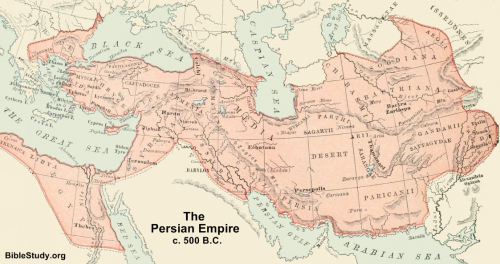
Courtesy of BibleStudy.org
As fitting for such a king, Ahasuerus/Xerxes staged a showoff celebration for 180 days, about half a year. That’s a long party, but he still wasn’t through.
Est 1:1-11 Good News Bible cont.
After that, the king gave a banquet for all the people in the capital city of Susa, rich and poor alike. It lasted a whole week and was held in the gardens of the royal palace. The courtyard there was decorated with blue and white cotton curtains, tied by cords of fine purple linen to silver rings on marble columns. Couches made of gold and silver had been placed in the courtyard, which was paved with white marble, red feldspar, shining mother-of-pearl, and blue turquoise. Drinks were served in gold cups, no two of them alike, and the king was generous with the royal wine. There were no limits on the drinks; the king had given orders to the palace servants that everyone could have as much as they wanted.
I heard of a religious leader who bragged about having solid gold tableware. I don’t suppose Ahasureus had gold forks, or maybe any forks at all, but he did have gold cups, all unique works of art, and the people who drank from them sat on golden couches. No preacher can ever match that!
Meanwhile, Queen Vashti was also showing off.
Est 1:1-11 Good News Bible cont.
Meanwhile, inside the royal palace Queen Vashti was giving a banquet for the women. On the seventh day of his banquet the king was drinking and feeling happy, so he called in the seven eunuchs who were his personal servants, Mehuman, Biztha, Harbona, Bigtha, Abagtha, Zethar, and Carkas. He ordered them to bring in Queen Vashti, wearing her royal crown. The queen was a beautiful woman, and the king wanted to show off her beauty to the officials and all his guests.
Two showoffs ran headlong into each other. The king wanted to show off his queen, like a golden cup with curves. That was humiliating for her, because she was right in the middle of her own showoff session. So, probably just to show off how big she was before all the highfalutin women, she refused Ahasuerus’ showoff command.
Then Vashti didn’t have to worry about any more showoff sessions herself, because she didn’t have any more. Vashti vanished from history.
Ahasuerus threw that six month party just to glorify himself. He got a bit carried away, but that’s what kings usually do. They try to glorify themselves.
Unlike him, Yeshua, born to be King of the Jews, did not seek his own glory.
Joh 8
48) Then the Jews answered him, Don’t we say well that you are a Samaritan, and have a demon?
49) Yeshua answered, I don’t have a demon, but I honor my Father, and you dishonor me.
50) But I don’t seek my own glory. There is one who seeks and judges.
Ahab built a house of ivory and Solomon took nearly twice as long building his own palace as he did the temple. All kings have sought their own glory, usually a lot, some perhaps just a little, but this King of the Jews did not seek his own glory at all.
And he could have had a heap of glory — all the kingdoms of this world!
Mat 4
8) Again, the devil took him to an exceedingly high mountain, and showed him all the kingdoms of the world, and their glory.
9) He said to him, I will give you all of these things, if you will fall down and worship me.
10) Then Yeshua said to him, Get behind me, Satan! For it is written, You shall worship the Lord your God, and you shall serve him only.
11) Then the devil left him, and behold, angels came and served him.
Think about that. Ahasureus ruled from India to Ethiopia but Christ could have ruled from Antarctica to the Arctic. He turned that down flat. Get behind me, Satan!
This king came as a servant.
Php 2
5) Have this in your mind, which was also in Christ Yeshua,
6) who, existing in the form of God, didn’t consider equality with God a thing to be grasped,
7) but emptied himself, taking the form of a servant, being made in the likeness of men.
Unlike the rabbis who took the chief seats, Christ taught his followers to take the low seats, as he had done.
Luk 14
8) When you are invited by anyone to a marriage feast, don’t sit in the best seat, since perhaps someone more honorable than you might be invited by him,
9) and he who invited both of you would come and tell you, Make room for this person. Then you would begin, with shame, to take the lowest place.
10) But when you are invited, go and sit in the lowest place, so that when he who invited you comes, he may tell you, Friend, move up higher. Then you will be honored in the presence of all who sit at the table with you.
11) For everyone who exalts himself will be humbled, and whoever humbles himself will be exalted.
Yeshua did not try to lord it over the kings who were lords of the land. In fact, he paid the taxes they levied on him.
Mat 17
24) When they had come to Capernaum, those who collected the didrachma coins came to Peter, and said, Doesn’t your teacher pay the didrachma?
25) He said, Yes. When he came into the house, Yeshua anticipated him, saying, What do you think, Simon? From whom do the kings of the earth receive toll or tribute? From their children, or from strangers?
26) Peter said to him, From strangers. Yeshua said to him, Therefore the children are exempt.
27) But, lest we cause them to stumble, go to the sea, cast a hook, and take up the first fish that comes up. When you have opened its mouth, you will find a stater coin. Take that, and give it to them for me and you.
What is a stater? The Word Bible program note on Matthew 17:27 says:
A stater is a silver coin equivalent to four Attic or two Alexandrian drachmas, or a Jewish shekel: just exactly enough to cover the half-shekel temple tax for two people.
The Pharisees thought they could catch Yeshua in a tax trap.
Mat 22
15) Then the Pharisees went and took counsel how they might entrap him in his talk.
16) They sent their disciples to him, along with the Herodians, saying, “Teacher, we know that you are honest, and teach the way of God in truth, no matter whom you teach, for you aren’t partial to anyone.
17) Tell us therefore, what do you think? Is it lawful to pay taxes to Caesar, or not?”
18) But Yeshua perceived their wickedness, and said, “Why do you test me, you hypocrites?
19) Show me the tax money.” They brought to him a denarius.
20) He asked them, “Whose is this image and inscription?”
21) They said to him, “Caesar’s.” Then he said to them, “Give therefore to Caesar the things that are Caesar’s, and to God the things that are God’s.”
22) When they heard it, they marveled, and left him, and went away.
Christ paid the stater and the denarius. He did not physically try to overthrow Rome or Herod. Instead, he taught about a new kingdom, beyond the old kingdoms of Israel and Judah and beyond the empire of Rome, and that was the Kingdom of Heaven, the Kingdom of God.
In a worldly kingdom, people strive mightily with each other to be the greatest. Who then is greatest in the Kingdom of Heaven? The disciples asked, perhaps because they wanted to be.
Mat 18
1) In that hour the disciples came to Yeshua, saying, Who then is greatest in the Kingdom of Heaven?
2) Yeshua called a little child to himself, and set him in the middle of them,
3) and said, Most certainly I tell you, unless you turn, and become as little children, you will in no way enter into the Kingdom of Heaven.
4) Whoever therefore humbles himself as this little child, the same is the greatest in the Kingdom of Heaven.
Mar 10
13) They were bringing to him little children, that he should touch them, but the disciples rebuked those who were bringing them.
14) But when Yeshua saw it, he was moved with indignation, and said to them, Allow the little children to come to me! Don’t forbid them, for God’s Kingdom belongs to such as these.
15) Most certainly I tell you, whoever will not receive God’s Kingdom like a little child, he will in no way enter into it.
16) He took them in his arms, and blessed them, laying his hands on them.
Repeatedly the disciples heard the Messiah teach about having the humility of little children and not taking the chief seats. So guess what they wanted to do?
Mar 9
33) He came to Capernaum, and when he was in the house he asked them, “What were you arguing among yourselves on the way?”
34) But they were silent, for they had disputed one with another on the way about who was the greatest.
35) He sat down, and called the twelve; and he said to them, “If any man wants to be first, he shall be last of all, and servant of all.”
36) He took a little child, and set him in the middle of them. Taking him in his arms, he said to them,
37) “Whoever receives one such little child in my name, receives me, and whoever receives me, doesn’t receive me, but him who sent me.”
The selfish ambitions of the disciples seemed to grow as they neared the end of Christ’s 3 1/2 years of teaching, and as they came to the time of the penultimate Passover.
Mat 20
17) As Yeshua was going up to Jerusalem, he took the twelve disciples aside, and on the way he said to them,
18) Behold, we are going up to Jerusalem, and the Son of Man will be delivered to the chief priests and scribes, and they will condemn him to death,
19) and will hand him over to the Gentiles to mock, to scourge, and to crucify; and the third day he will be raised up.
Yeshua told the twelve, as he had several times, that he was going to be killed. Did they then think that they had to enhance their individual positions before he passed on, while they still had a chance?
Mat 20
20) Then the mother of the sons of Zebedee came to him with her sons, kneeling and asking a certain thing of him.
21) He said to her, What do you want? She said to him, Command that these, my two sons, may sit, one on your right hand, and one on your left hand, in your Kingdom.
22) But Yeshua answered, You don’t know what you are asking. Are you able to drink the cup that I am about to drink, and be baptized with the baptism that I am baptized with? They said to him, We are able.
23) He said to them, You will indeed drink my cup, and be baptized with the baptism that I am baptized with, but to sit on my right hand and on my left hand is not mine to give; but it is for whom it has been prepared by my Father.
Dear old Mom was looking out for her boys, with a strategic political endorsement. And her boys joined with her in that, because when Christ asked if they were able to endure what he had to go through, they said, “We are able.” Those fellows were right with Mom in this scheme!
Amazingly, this is the same John who leaned on Christ at the last Passover meal.
Joh 21
(20) Then Peter, turning around, saw a disciple following. This was the disciple whom Yeshua loved, the one who had also leaned on Yeshua’s breast at the supper and asked, “Lord, who is going to betray You?”
This disciple was as close to Christ as any of them, yet he and his brother James and their momma were concerned about getting a high position for themselves, right next to the King of Kings.
When the other ten disciples heard about that little incident, they did not shake their heads in sympathy because James and John Zebedee had not humbled themselves like little children. Nope. Instead they got really, really mad at the two brothers because —
The ten wanted those high positions for themselves!
Mat 20
24) When the ten heard it, they were indignant with the two brothers.
25) But Yeshua summoned them, and said, You know that the rulers of the nations lord it over them, and their great ones exercise authority over them.
26) It shall not be so among you, but whoever desires to become great among you shall be your servant.
27) Whoever desires to be first among you shall be your bondservant,
28) even as the Son of Man came not to be served, but to serve, and to give his life as a ransom for many.
Kings like to be served. But this King of the Jews and King of Kings did not come to be served. He came only to serve, even at the cost of his life.
Christ and his twelve ambitious disciples went on into Jerusalem, for his final Passover meal.
Luk 22
7) The day of unleavened bread came, on which the Passover must be sacrificed.
8) Yeshua sent Peter and John, saying, “Go and prepare the Passover for us, that we may eat.”
9) They said to him, “Where do you want us to prepare?”
10) He said to them, “Behold, when you have entered into the city, a man carrying a pitcher of water will meet you. Follow him into the house which he enters.
11) Tell the master of the house, ‘The Teacher says to you, “Where is the guest room, where I may eat the Passover with my disciples?”’
12) He will show you a large, furnished upper room. Make preparations there.”
13) They went, found things as Yeshua had told them, and they prepared the Passover.
That was Christ’s last Passover in his earthly life; the Bible never calls it ‘The Last Supper,’ a title that came along later from people who forsook the Passover. And at that Passover, the Creator of everything got down on his knees, lowered his head and washed the feet of those he came to serve.
P.S. — Without socks or shoes, those were really dirty feet.
Joh 13
2) During supper, the devil having already put into the heart of Judas Iscariot, Simon’s son, to betray him,
3) Yeshua, knowing that the Father had given all things into his hands, and that he came from God, and was going to God,
4) arose from supper, and laid aside his outer garments. He took a towel, and wrapped a towel around his waist.
5) Then he poured water into the basin, and began to wash the disciples’ feet, and to wipe them with the towel that was wrapped around him.
6) Then he came to Simon Peter. He said to him, “Lord, do you wash my feet?”
7) Yeshua answered him, “You don’t know what I am doing now, but you will understand later.”
8) Peter said to him, “You will never wash my feet!” Yeshua answered him, “If I don’t wash you, you have no part with me.”
9) Simon Peter said to him, “Lord, not my feet only, but also my hands and my head!”
10) Yeshua said to him, “Someone who has bathed only needs to have his feet washed, but is completely clean. You are clean, but not all of you.”
11) For he knew him who would betray him, therefore he said, “You are not all clean.”
12) So when he had washed their feet, put his outer garment back on, and sat down again, he said to them, “Do you know what I have done to you?
13) You call me, ‘Teacher’ and ‘Lord.’ You say so correctly, for so I am.
14) If I then, the Lord and the Teacher, have washed your feet, you also ought to wash one another’s feet.
15) For I have given you an example, that you also should do as I have done to you.
16) Most certainly I tell you, a servant is not greater than his lord, neither one who is sent greater than he who sent him.
Christ knew that Peter would deny him three times, but he still washed all ten toes.
And the King of the Jews also washed the feet of Judas.
Such a scene has never been seen in all of human history. That is how this King rules.
Soon after the Creator of the universe stooped down and washed the dusty feet of his disciples, like a menial servant, he told them this.
Luk 22
21) But behold, the hand of him who betrays me is with me on the table.
22) The Son of Man indeed goes, as it has been determined, but woe to that man through whom he is betrayed!
23) They began to question among themselves, which of them it was who would do this thing.
When he announced that one of those twelve would betray him, they naturally buzzed back and forth, Is it you, Is it me, Is it him?
Then they morphed from defending themselves — ‘It’s not me, I know that!’ — to proclaiming how great they were. ‘Why, I’m the best dude here!’ ‘No, you’re not. I am!’
They instantly went from wondering which one was the bad guy to arguing which one was the best guy! RIGHT AFTER THE FOOTWASHING!
Luk 22
24) There arose also a contention among them, which of them was considered to be greatest.
Did Yeshua then sigh before he went on to tell them — again?
Luk 22
25) He said to them, The kings of the nations lord it over them, and those who have authority over them are called benefactors.
26) But not so with you. But one who is the greater among you, let him become as the younger, and one who is governing, as one who serves.
27) For who is greater, one who sits at the table, or one who serves? Isn’t it he who sits at the table? But I am among you as one who serves.
When Satan offered Christ the kingdoms of this world if Christ would bow down to him, Satan sought to be served and exalted. On the other hand, Christ washed the dirty feet of those he taught, and he sacrificed himself for those he had created. He sought to serve and be humble.
That is the difference between the two great spiritual kingdoms. One seeks to be served. The other seeks to serve. One seeks to be exalted. The other seeks to be humbled. One is Satan. The other is Christ.
This is always the basic difference between the two kingdoms, to serve or to be served. This applies to all people and all leaders, political and religious, in whatever position. Are they seeking to be served and exalted? Or are they humbly seeking to serve? To get or to give?
Many religious leaders who say they are serving Christ act more like they are following Satan’s example. Wealthy, puffed up religious potentates are always following the wrong example. There are no exceptions to this, no extenuating circumstances, never a need for a preacher to be puffed up. If he is, and many are, then he is wrong.
As Christ told the sons of Zebedee, You know that the rulers of the nations lord it over them, and their great ones exercise authority over them. It shall not be so among you, but whoever desires to become great among you shall be your servant.
Servants do not desire exalting titles, distinctive attire, or elite estates. A servant’s satisfaction is in the serving. That is the way this King rules.


 Dan L. White Homeschool Helpers