The End Time Church: From the Cathedrals to the Catacombs
By Dan L. White
Copyright 2020 by Dan L. White, all rights reserved.
Scripture quotations are from the World English Bible (WEB) which is in the public domain.
Chapter 85
Making Preparations for the House of Yahweh
If you’re going to build a house for God, that’s not the same as building a Levittown house.
Levittown, NY, was the first mass produced suburb in America in 1947.
“Levittown has 17,447 houses, one of which was built every 16 minutes during the peak of its construction boom.”
https://www.insider.com/vintage-photos-levittown-suburbs-50s#the-community-grew-fast-in-fact-a-house-was-built-every-16-minutes-in-levittown-7
Levittown houses were small and cheap. If you could pay $29 a month, you could buy one. Veterans returning from wartime military service didn’t even have to have a down payment.
The Temple could not be like a Levittown house.
Even though he would not see the Temple, David made very careful preparations for building it.
1Chr 22
1) Then David said, “This is the house of Yahweh God, and this is the altar of burnt offering for Israel.”
2) David gave orders to gather together the foreigners who were in the land of Israel; and he set masons to cut worked stones to build the house of God.
3) David prepared iron in abundance for the nails for the doors of the gates, and for the couplings; and brass in abundance without weight;
4) and cedar trees without number: for the Sidonians and they of Tyre brought cedar trees in abundance to David.
5) David said, “Solomon my son is young and tender, and the house that is to be built for Yahweh must be exceedingly magnificent, of fame and of glory throughout all countries. I will therefore make preparation for it.” So David prepared abundantly before his death.
David gathered materials for the Temple.
1Chr 22
14) Now, behold, in my affliction [his old age, approaching seventy] I have prepared for the house of Yahweh one hundred thousand talents of gold, one million talents of silver, and brass and iron without weight; for it is in abundance. I have also prepared timber and stone; and you may add to them, [he said to Solomon].
15) There are also workmen with you in abundance, cutters and workers of stone and timber, and all kinds of men who are skillful in every kind of work:
16) of the gold, the silver, and the brass, and the iron, there is no number. Arise and be doing, and may Yahweh be with you.”
17) David also commanded all the princes of Israel to help Solomon his son, saying,
18) “Isn’t Yahweh your God with you? Hasn’t he given you rest on every side? For he has delivered the inhabitants of the land into my hand; and the land is subdued before Yahweh, and before his people.
An incredible amount of wealth was voluntarily put into the building of the first Temple – because people wanted to honor Yahweh. A hundred thousand talents of gold at 2020 prices equals a hundred-twenty-million dollars. And that was just the value of the gold that went into the building, not including silver or any other materials, or the costs of the laborers.
The construction was also blessed by peace. A time of peace allowed the construction to go on, unfettered and unhindered. This is a very important consideration for the building of any new temple.
David also prepared by organizing the Levites who would serve in the Temple.
1Chr 23
1) Now David was old and full of days; and he made Solomon his son king over Israel.
2) He gathered together all the princes of Israel, with the priests and the Levites.
3) The Levites were numbered from thirty years old and upward: and their number by their polls, man by man, was thirty-eight thousand.
4) David said, “Of these, twenty-four thousand were to oversee the work of the house of Yahweh; six thousand were officers and judges;
5) four thousand were doorkeepers; and four thousand praised Yahweh with the instruments which I made, for giving praise.”
6) David divided them into divisions according to the sons of Levi: Gershon, Kohath, and Merari.
38,000 workers were to run the Temple. As you might expect with David, 4,000 of them were musicians, who would perform many of David’s psalms in the Temple.
As befits a Temple for the true Creator God, the utensils were pure gold.
1Kgs 7
48) Solomon made all the vessels that were in the house of Yahweh: the golden altar, and the table whereupon the show bread was, of gold;
49) and the lampstands, five on the right side, and five on the left, before the oracle, of pure gold; and the flowers, and the lamps, and the tongs, of gold;
50) and the cups, and the snuffers, and the basins, and the spoons, and the fire pans, of pure gold; and the hinges, both for the doors of the inner house, the most holy place, and for the doors of the house, of the temple, of gold.
Surely, this first Temple was the finest building ever constructed in human history.
Jewish historian Josephus said that when you saw it, you just couldn’t believe it. Solomon “made that temple which was beyond this a wonderful one indeed, and such as exceeds all description in words; nay, if I may so say, is hardly believed upon sight.”
https://biblehub.com/library/josephus/the_antiquities_of_the_jews/chapter_3_of_the_building.htm
The second Temple built by Zerubbabel did not reach the magnificence of Solomon’s Temple. At that time Judah was no longer a kingdom, but merely a province of a Gentile king. They never recovered their original grandeur and the second Temple was not as grand as the first. It was still far grander, though, than a Levittown house.
Ezra 1
3) [Cyrus wrote] Whoever there is among you of all his people, may his God be with him, and let him go up to Jerusalem, which is in Judah, and build the house of Yahweh, the God of Israel (he is God), which is in Jerusalem.
4) Whoever is left, in any place where he lives, let the men of his place help him with silver, with gold, with goods, and with animals, besides the freewill offering for the house of God which is in Jerusalem.’”
5) Then the heads of fathers’ households of Judah and Benjamin, and the priests, and the Levites, even all whose spirit God had stirred to go up rose up to build the house of Yahweh which is in Jerusalem.
6) All those who were around them strengthened their hands with vessels of silver, with gold, with goods, and with animals, and with precious things, besides all that was willingly offered.
Herod, whom Rome placed as king of the Jews, enlarged and beautified this second Temple, before the first coming of the Messiah.
The Jews are now preparing for the building of another temple to Yahweh, and those two Temples are the standard for what they are doing.
So how are they doing?
Israel recaptured the Temple Mount in the war with Jordan in 1967. One of the first Israeli soldiers to reach the Temple Mount later began The Temple Institute.
templeinstitute.org/about-us
Rabbi Yisrael Ariel, founder and head of the Temple Institute, served in the paratrooper brigade which liberated the Temple Mount in the Six Day War of 1967, and was one of the first soldiers to reach the Mount.
The purpose of The Temple Institute founded by Ariel?
To rebuild the temple!
templeinstitute.org/about-us
The Temple Institute (in Hebrew, Machon HaMikdash), founded in 1987, is a non-profit educational and religious organization located in the Jewish quarter of Jerusalem’s Old City…Our short-term goal is to rekindle the flame of the Holy Temple in the hearts of mankind through education. Our long-term goal is to do all in our limited power to bring about the building of the Holy Temple in our time.
Way back in 1963, a young Bill Cosby released a comedy album where he played Noah, when God told Noah to build an ark.
God: NOAH!!
Noah: Who is that?
God: It’s the Lord, Noah.
Noah: Rightttt…
Where are ya? What do ya want? I’ve been good.
God: I want you to build an ark.
Noah: Rightttt…
Finally Noah asks God —
…How come you want me to do all these weird things?
God: I’m going to destroy the world.
Noah: Rightttt…Am I on Candid Camera?
So the purpose of the Temple Institute is — after two thousand years! — to rebuild the Temple.
Rightttt…
Okay. So, the Jews are going to build another temple. Well, whaddya do then?
Before constructing the temple, first you have to build the utensils and implements needed for temple service.
Ezra 1
7) Also Cyrus the king brought forth the vessels of the house of Yahweh, which Nebuchadnezzar had brought out of Jerusalem, and had put in the house of his gods;
8) even those, Cyrus king of Persia brought out by the hand of Mithredath the treasurer, and numbered them to Sheshbazzar [Zerubbabel], the prince of Judah.
9) This is the number of them: thirty platters of gold, one thousand platters of silver, twenty-nine knives,
10) thirty bowls of gold, silver bowls of a second sort four hundred and ten, and other vessels one thousand.
11) All the vessels of gold and of silver were five thousand and four hundred. Sheshbazzar brought all these up, when the captives were brought up from Babylon to Jerusalem.
For a new temple, the Jews have to build that stuff.
And this is what the Temple Institute has done so far.
templeinstitute.org/about-us
The major focus of the Institute is its efforts towards (sic) the beginning of the actual rebuilding of the Holy Temple. Towards this end, the Institute has begun to restore and construct the sacred vessels for the service of the Holy Temple…They are made according to the exact specifications of the Bible, and have been constructed from the original source materials, such as gold, copper, silver and wood. These are authentic, accurate vessels, not merely replicas or models. All of these items are fit and ready for use in the service of the Holy Temple. Among the many items featured in the exhibition are musical instruments played by the Levitical choir, the golden crown of the High Priest, and gold and silver vessels used in the incense and sacrificial services. After many years of effort and toil, the Institute has completed the three most important and central vessels of the Divine service: the seven-branched candelabra, or Menorah, made of pure gold; the golden Incense Altar, and the golden Table of the Showbread. Other completed projects include the sacred uniform of the Kohen Gadol, the High Priest. This project was the culmination of years of study and research. The High Priest’s Choshen (Breastplate), Ephod and the tzitz have been completed.
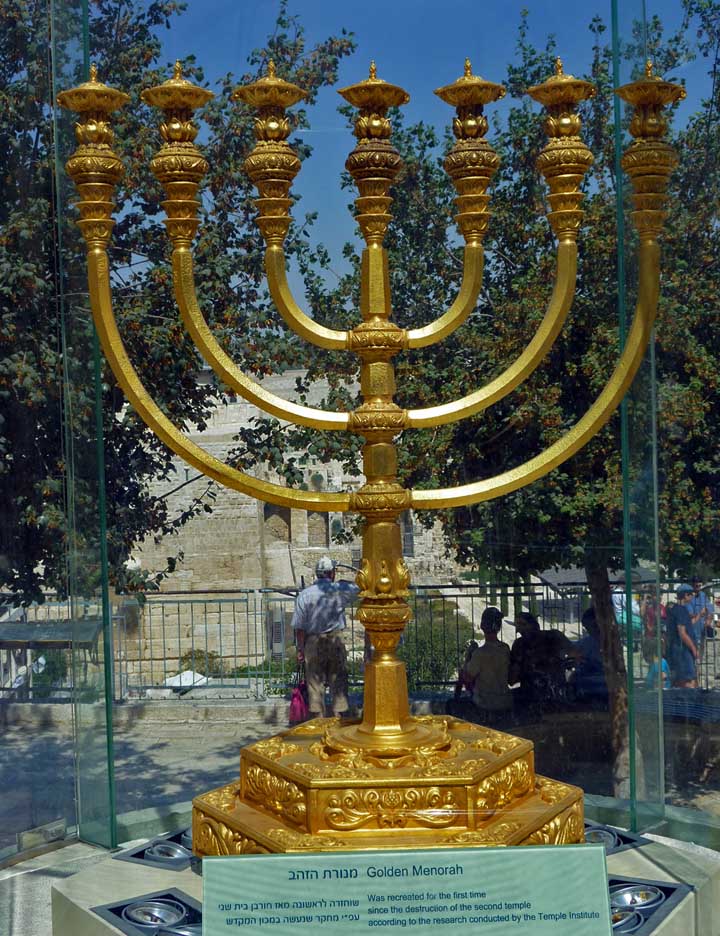
The Temple Institute says: the Menorah’s location alongside the Yehudah HaLevi steps leading down to the Western Wall Plaza and the Temple Mount has become a place where thousands of people stop daily, meet friends, learn about the menorah, marvel at its beauty and envision its ultimate standing place in the Kodesh Sanctuary of the rebuilt Holy Temple.
Image from The Temple Institute
The Temple Institute receives contributions from all over the world. Golden utensils don’t come cheaply, you know. The pure gold menorah – a thousand pounds of pure gold! – was paid for by one individual.
templeinstitute.org/history-holy-temple-menorah
The menorah weighs one-half ton. It contains forty five kilograms of twenty four karat gold. Its estimated value is approximately three million dollars. The construction of the menorah was made possible through the generosity of Vadim Rabinovitch, a leader of the Jewish community of Ukraine.
Careful research and care went into the building of the temple utensils.
templeinstitute.org/about-us
In this manner, over sixty sacred Temple vessels have already been restored, including some of the most difficult and complicated projects, such as the Menorah and the precious stones of the High Priest’s breastplate. The stones of the breastplate – recently created – were investigated with the help of professional gemologists, geologists and other experts. The wide range of material necessitated the examination of over 30 differing viewpoints for establishing the criteria for identifying the stones.
After preparing temple utensils, the next step is to build the temple.
templeinstitute.org/about-us
Another example of research currently underway involves the topography and makeup of the Temple Mount and the structure of the Holy Temple, as well as a working architectural plan for the rebuilding of the Holy Temple on Mount Moriah, according to modern building standards and with the best materials and technology available.
When the Jews returned to Jerusalem during Cyrus’ time, they built an altar and offered sacrifice, before the Temple was rebuilt.
Ezra 3
1) When the seventh month had come, and the children of Israel were in the cities, the people gathered themselves together as one man to Jerusalem.
2) Then stood up Jeshua the son of Jozadak, and his brothers the priests, and Zerubbabel the son of Shealtiel, and his brothers, and built the altar of the God of Israel, to offer burnt offerings thereon, as it is written in the law of Moses the man of God.
3) They set the altar on its base; for fear was on them because of the peoples of the countries: and they offered burnt offerings thereon to Yahweh, even burnt offerings morning and evening.
4) They kept the feast of tents, as it is written, and offered the daily burnt offerings by number, according to the ordinance, as the duty of every day required;
5) and afterward the continual burnt offering, and the offerings of the new moons, and of all the set feasts of Yahweh that were consecrated, and of everyone who willingly offered a freewill offering to Yahweh.
6) From the first day of the seventh month began they to offer burnt offerings to Yahweh: but the foundation of the temple of Yahweh was not yet laid.
The Jews of today have already had a trial sacrifice offering.
https://www.jpost.com/israel-news/temple-ready-altar-dedicated-on-last-day-of-hanukkah-by-activist-groups-573980, 12/10/18
“on Monday morning, the last day of Hanukkah, a new altar, fit for the Temple, was dedicated outside the walls of the Old City of Jerusalem.
On the last day of Hanukkah – which literally means “dedication” – a new altar built in accordance with all the Jewish laws pertaining to the Temple vessels and infrastructure was unveiled and nominally dedicated for use in the yet-to-be built Third Temple by several Temple activist organizations.
The altar is built out of bricks over a wooden frame, and specifically not of stone, since Jewish law requires that the Temple and its various structures not be made out of stone that has been hewn by iron implements…
Organizers intended that a sheep was to be slaughtered during the dedication ceremony, and the various rituals, including burning some of its limbs and innards on the altar, was [sic]to be performed. However, Weiss said, objections were raised by the Jerusalem Municipal Authority’s legal department.
https://www.breakingisraelnews.com/118441/miracle-dedication-altar-third-temple/
The municipal authorities did not permit a sheep to be slaughtered on site so one was slaughtered at another location [an abattoir]. The sections of meat were arranged on the ramp leading up to the altar in the ritually prescribed manner and one piece was thrown onto the fire on the altar to be burned completely.
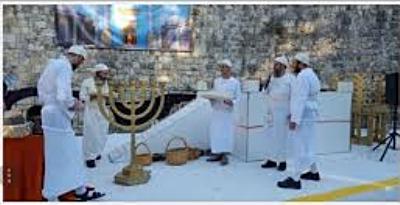
Dedicating the newly built altar
As you would expect, the Jews/Pharisees have tried to be very meticulous in following every Biblical detail in all their preparations for their new temple, including selecting the new kohanim or priests to serve. However, you can see in the above picture that some of the kohanim at the altar dedication were wearing tennis shoes, or basketball shoes, or sneakers, whichever modern name you prefer. (I don’t know what they were called back in Bible times.) Some kohanim wore sandals with socks as you can see, others were simply barefoot, but most were in the Nike/Adidas/New Balance mode. Call me picky if you will, but somehow it just does not seem kosher to offer a Biblical sacrifice wearing tennis shoes.
The Sanhedrin met in the second Temple in the hall of hewn stones, until they were forcibly forced out in 30 CE. A new temple must have a sitting Sanhedrin, and the Jews have already established a new Sanhedrin. This body is not currently accepted by all Jews.
From the Sanhedrin web site: http://www.thesanhedrin.org/en/index.php/The_Re-established_Jewish_Sanhedrin
The Sanhedrin is the name given in the mishna to the council of seventy-one Jewish sages who constituted the supreme court and legislative body in Judea during the Roman period. It continued to function for more than four hundred years after the destruction of the Temple and there have been several orthodox attempts to re-establish it since that time. The current attempt to re-establish the Sanhedrin is generally referred to as the “nascent Sanhedrin”, or the “developing Sanhedrin”.
The last decision of the ancient Sanhedrin was in 358, when they decided to change the Bible festivals. They changed from the original festivals set by God in His creation to festivals set by Pharisee calculations, afterwards called the Jewish Calendar. That was not just a different method of keeping the same days. It is a different method of keeping different days.
The penultimate binding decision of the Sanhedrin was in 358, when the Hebrew Calendar was adopted. https://www.geni.com/projects/The-Great-Sanhedrin/13069
In preparing for their new temple, what are the Jews doing about the festivals?
They are preparing to revert back to the original festivals, set by observing the new moon, as the Bible teaches. This is shown by the Temple Institute Facebook page, right after the festival seventh month in 2020.

So the Jews have made all those preparations for their coming temple.
Quite extensive.
As stated before, the Jews are preparing like crazy to build a new temple. Now to build their temple they are looking for a time of peace as Solomon had.
The focal point of the Temple was the Holy of Holies, which contained the Ark of the Covenant.
What are the Jews doing about that?
The Ark has been missing for two and a half millennia. How are they preparing to put the Ark of the Covenant in their new temple?

